Watercress and Potato Soup
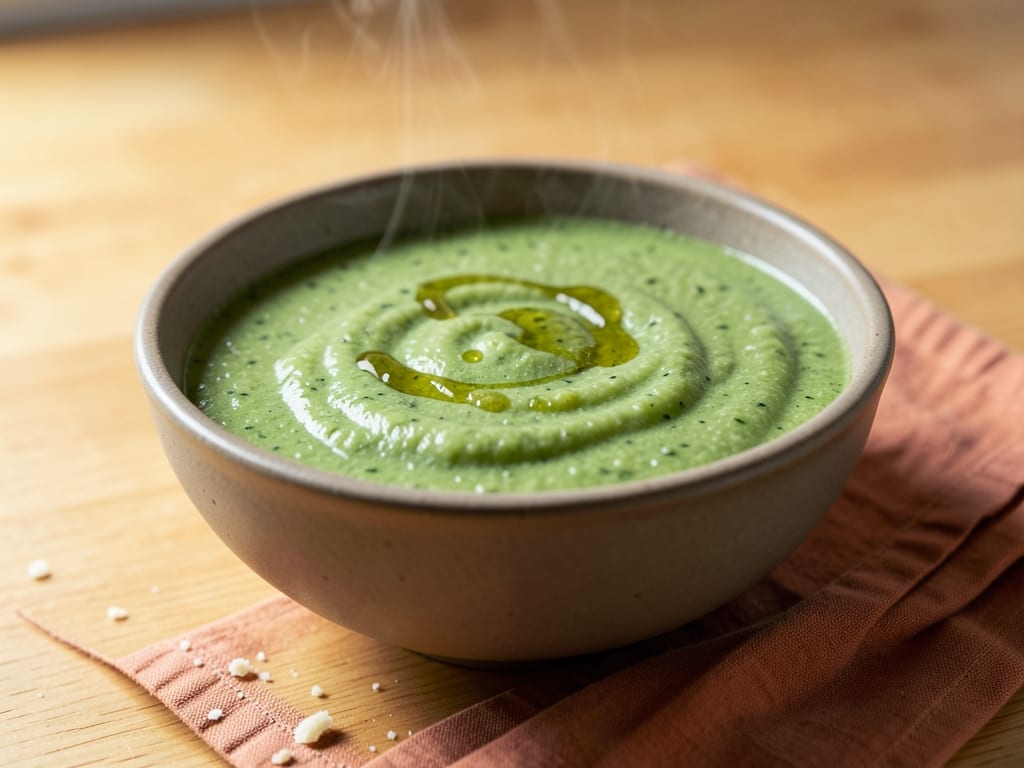
A classic British soup that's silky, vibrant, and ready in about half an hour. Tender potatoes and onions are simmered in vegetable broth, then blended until smooth with fresh watercress for a distinctive peppery flavor. Finished with a swirl of cream, it's the perfect starter or light lunch. The key is adding watercress near the end of cooking—this preserves its bright color and peppery punch, creating a soup that tastes and looks as fresh as it is.
- Prep
- 8 min
- Cook
- 29 min
- Total
- 37 min
- Makes
- 4 servings (5–6 cups total)
Steps
Before you start
- Measure out and prep all ingredients before cooking (mise en place)
- Have your blender ready—either an immersion blender in the pot or a traditional blender nearby
- Peel and chop potatoes just before cooking to prevent browning
- If using a regular blender, have a towel handy for safe blending of hot soup
Prep the vegetables
- Peel the potatoes and cut them into ½-inch cubes (about 500 g / 1 lb).
- Peel and dice the onion into ½-inch pieces.
- Roughly chop the watercress, discarding the thickest or most fibrous stems.
- Set all vegetables aside.
+ Show details− Hide details
Tip: Prep potatoes just before cooking to prevent browning. Keeping the pieces uniform helps them cook at the same rate.
Sauté the onion
- In a large saucepan or Dutch oven (3–4 quart) over medium heat, melt the butter.
- Add the diced onion and sauté for 4–5 minutes, stirring occasionally, until soft and translucent.
- The onion should smell sweet and fragrant.
+ Show details− Hide details
Ready when: Onion is soft, translucent, and fragrant
Tip: Keep heat at medium to avoid browning the onion; you want it to release moisture and soften, not caramelize.
Add potatoes and broth
- Add the diced potatoes and vegetable broth to the pan.
- Increase the heat to medium-high and bring to a gentle boil, stirring occasionally.
+ Show details− Hide details
Ready when: Liquid is simmering with visible bubbles rising to the surface
Tip: The broth will become the silky base of your finished soup, so use a good-quality vegetable broth if possible.
Simmer the potatoes
- Reduce heat to medium and simmer uncovered for 15–18 minutes, until the potatoes are very soft and easily pierced with a fork.
- They will begin to break apart slightly and the broth may look a bit cloudy from starch.
+ Show details− Hide details
Ready when: Potatoes collapse easily when pierced with a fork; no firm pieces remain
Tip: This is a good time to ready your blender and have a kitchen towel on hand if you'll be using a traditional blender.
Add the watercress
- Stir the roughly chopped watercress into the pot.
- The pot will seem quite full at first, but the watercress will wilt down significantly within seconds.
+ Show details− Hide details
Tip: Add watercress near the end of cooking to preserve its bright green color and peppery, fresh flavor.
Simmer watercress until wilted
- Continue simmering on medium heat for 2–3 minutes, stirring gently, until the watercress is fully wilted and tender.
- The broth will turn a pale, vibrant green.
+ Show details− Hide details
Ready when: Watercress is completely wilted; broth is bright pale green and watercress leaves are tender
Tip: The broth turning bright green is a sign the watercress is tender and its flavor has infused the liquid.
Blend the soup smooth
- Remove the pan from heat.
- If using an immersion blender: Blend the soup directly in the pot, moving the blender from the bottom to the top, until completely smooth (2–3 minutes).
- If using a regular blender: Allow the soup to cool for 2–3 minutes, then carefully transfer in batches (filling the blender no more than half full) and blend until smooth.
- Return the blended soup to the pot.
+ Show details− Hide details
Ready when: Soup is completely smooth with no visible chunks or potato pieces
Tip: If using a traditional blender, never fill it more than halfway with hot liquid. Remove the center cap from the lid and cover with a kitchen towel for safety as steam escapes.
Stir in cream and season
- If the soup has cooled significantly, return the pan to low heat just to warm it.
- Stir in the heavy cream and let it heat through for about 1 minute until the soup is warm again.
- Taste and season generously with salt and freshly ground black pepper, adding gradually so you can adjust to your preference.
+ Show details− Hide details
Ready when: Cream is fully incorporated and soup is warm throughout
Tip: Add salt and pepper at the end so you can taste as you season. Watercress and broth can be quite salty, so taste first before adding too much.
Serve
- Ladle the soup into serving bowls.
- Garnish each with a small handful of fresh watercress leaves (if reserved), a crack of freshly ground black pepper, and a small dollop of crème fraîche or a drizzle of good olive oil if desired.
- Serve hot.
+ Show details− Hide details
Tip: A few fresh raw watercress leaves add a vibrant peppery bite and beautiful color to contrast the creamy soup.
Good to know
Tips
- Reserve a small handful of fresh watercress leaves before chopping to use as a garnish—they add a fresh bite and vibrant color to each serving.
- For a lighter soup, substitute milk or half-and-half for the heavy cream, or omit it entirely and finish each bowl with a small drizzle of good olive oil.
- This soup reaches peak flavor within 2–3 hours of making. It tastes best fresh, while the watercress color is bright and the peppery flavor is vivid.
- If your blended soup seems too thick, thin it with additional broth (¼ cup / 60 ml at a time). If too thin, simmer gently for a few minutes to reduce and concentrate flavor.
Make ahead
You can prepare the soup through step 6 (watercress is wilted) up to 1 day ahead. Cool, cover, and refrigerate. When ready to serve, reheat gently over medium heat, then blend (step 7), stir in cream (step 8), and serve. The soup can also be frozen (without cream added) for up to 3 months. Thaw overnight in the refrigerator, reheat gently on the stovetop, then add fresh cream just before serving.
Storage & reheating
Room temperature: Cool in the pot for no more than 1 hour, then refrigerate. Refrigerator: Store in an airtight container for up to 3 days. Reheat gently on the stovetop over medium heat, stirring occasionally, until warm. Freezer: Freeze the soup without cream (or with 1 tablespoon of cornstarch stirred in as a stabilizer) in freezer-safe containers for up to 3 months. Thaw overnight in the refrigerator, reheat on the stovetop over medium heat, then stir in fresh cream just before serving.
Substitutions
- unsalted butter → 2 tablespoons / 30 ml extra-virgin olive oil. The soup will be slightly earthier and more Mediterranean in character. Use a neutral oil if you prefer a lighter taste.
- heavy cream → ½ cup / 120 ml Greek yogurt, sour cream, or crème fraîche. Any of these creates a silky texture with a subtle tang. Stir in after removing from heat to prevent curdling.
- fresh watercress → 3 cups / 100 g fresh baby spinach or arugula. Spinach will yield a milder, slightly sweeter soup. Arugula will be more peppery but less vivid in color. Simmer both the same way.
- vegetable broth → 4 cups / 960 ml chicken or light chicken broth. Chicken broth adds a savory depth. Avoid dark broths, which will muddy the soup's bright green color.