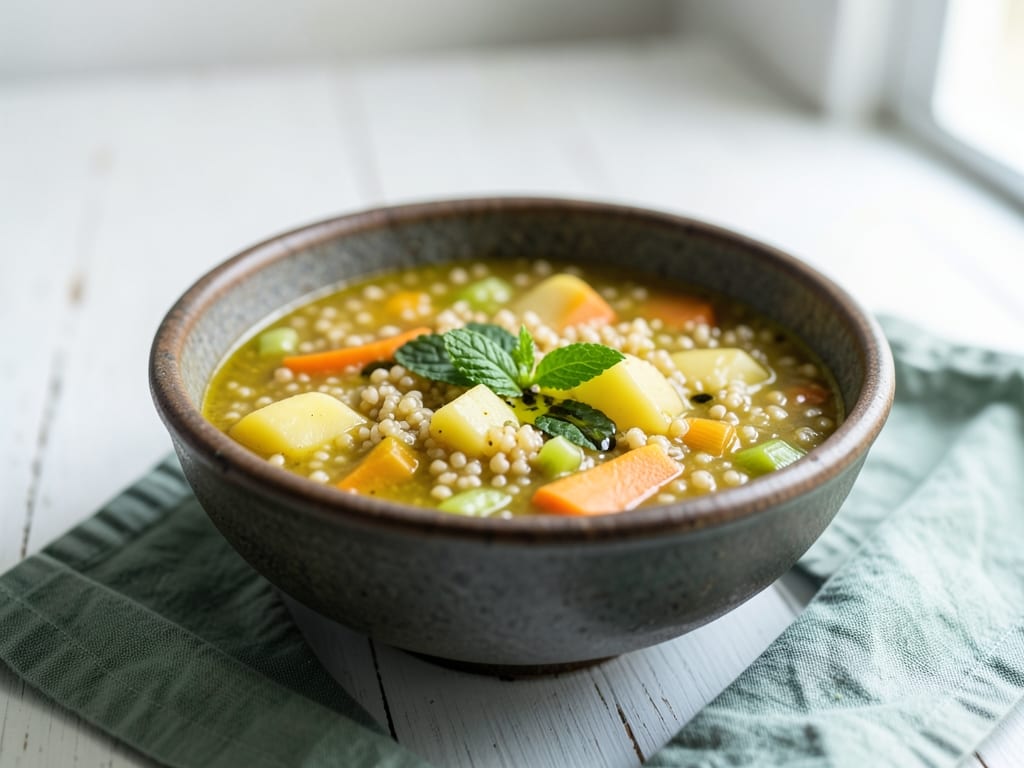
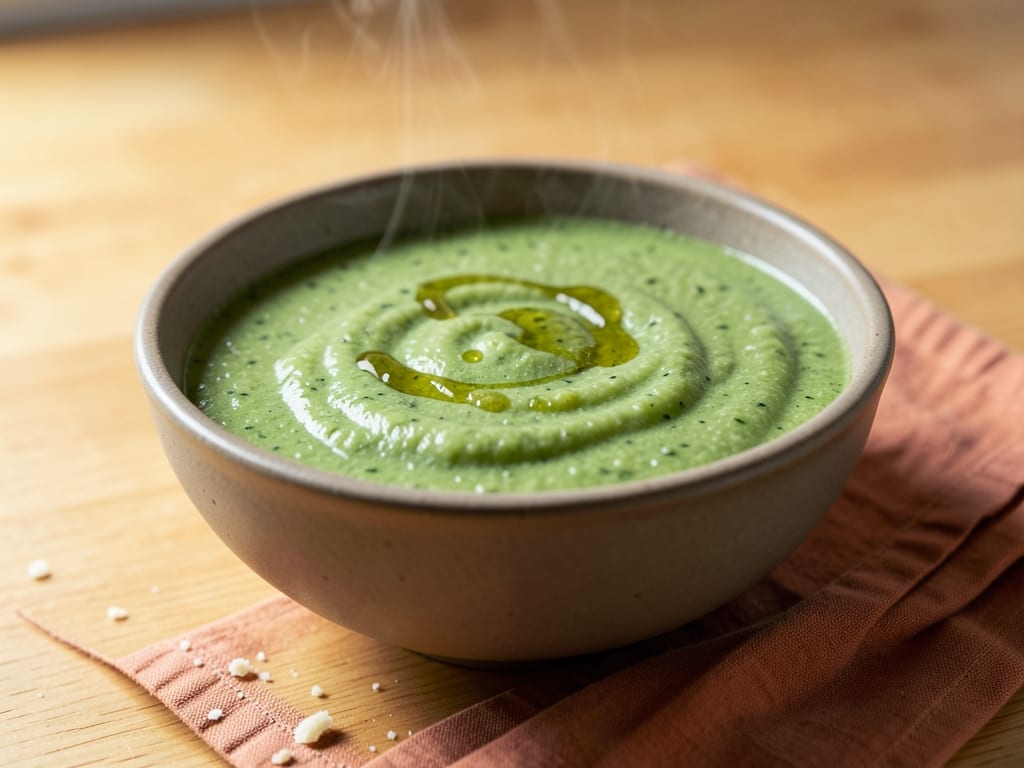
Celery Root and Leek Soup
A classic French-inspired creamy soup showcasing tender celery root, caramelized leeks, and potatoes blended into a silky puree. The subtle earthiness of celery root combines with the gentle sweetness of stewed leeks, finished with heavy cream. This elegant yet approachable soup is perfect for a weeknight dinner or elegant lunch, and it freezes beautifully.
- Prep
- 15 min
- Cook
- 35 min
- Total
- 50 min
- Makes
- 6 servings (about 1¾ cups per serving)
Steps
Before you start
- Wash your leeks thoroughly—sand hides between the layers and ruins the soup
- Have an immersion blender ready, or prepare a traditional blender for blending hot liquid
- Prep all vegetables (chop, peel, cut) before you start cooking—the cooking moves quickly once you begin
- Use a large pot that can accommodate 6 quarts (5.7 L)
Prep all vegetables
- Peel the celery root with a vegetable peeler or knife, removing all brown skin.
- Cut into ½-inch (1.3 cm) cubes.
- Clean the leeks by halving them lengthwise and rinsing thoroughly between the layers under running water to remove any trapped sand.
- Chop into ½-inch (1.3 cm) pieces, discarding the dark green tops.
- Peel the potato and cut into ½-inch (1.3 cm) cubes.
- Have all vegetables ready to use.
+ Show details− Hide details
Ready when: All vegetables are uniformly cut and ready to cook
Tip: Uniform size ensures vegetables cook evenly. Sand in leeks is a common culprit for gritty soup—clean thoroughly.
Cook leeks in butter
- Melt 2 tbsp (30 g) unsalted butter in a large 6-quart (5.7 L) pot over medium heat.
- Add the chopped leeks and cook for 5 minutes, stirring occasionally with a wooden spoon, until soft and just beginning to turn translucent around the edges.
- The leeks should smell sweet and fragrant.
+ Show details− Hide details
Ready when: Leeks are soft and light translucent, very fragrant
Tip: Leeks should soften gently without browning. This slow cooking develops their natural sweetness.
Add celery root and potato
- Add the celery root and potato cubes to the pot.
- Stir well with a wooden spoon, making sure all vegetables are coated with butter.
- Cook for 2 minutes, stirring occasionally.
+ Show details− Hide details
Ready when: All vegetables are coated with butter and beginning to soften
Add broth and aromatics
- Pour in 5 cups (1200 ml) vegetable broth all at once.
- If using fresh thyme and bay leaf, add them now.
- Stir well with a wooden spoon until everything is combined.
- Do not skip the herbs—they add depth to the broth.
+ Show details− Hide details
Ready when: Broth is evenly mixed with vegetables
Bring to a boil and simmer
- Increase the heat to medium-high and bring the soup to a boil, about 2 minutes.
- You'll see steam rise and bubbles breaking the surface rapidly.
- Once boiling, cover the pot with a lid and reduce heat to medium.
- Simmer gently for 20–25 minutes, until the celery root and potato are very tender and pierce easily with the tip of a knife.
- The broth should bubble gently, not roll at a vigorous boil.
+ Show details− Hide details
Ready when: Celery root and potato break apart easily when pierced; broth is clear and fragrant
Tip: A gentle simmer prevents the soup from becoming cloudy. If it boils too vigorously, reduce heat slightly.
Blend until smooth
- Remove the pot from heat.
- Using a slotted spoon, remove and discard the bay leaf and thyme sprigs if used.
- Place an immersion blender with its blade fully submerged in the soup and blend continuously for 2–3 minutes until the mixture is completely smooth with no visible vegetable chunks.
- If using a traditional blender, cool the soup for 5 minutes, then carefully blend in 2 batches, filling the blender no more than halfway.
- Hold the lid firmly with a kitchen towel to avoid splattering hot liquid.
- Return each batch to the pot.
+ Show details− Hide details
Ready when: Soup is completely smooth with no chunks; consistency is pourable
Tip: Immersion blending is safer and faster for hot liquids. If using a traditional blender, never fill more than halfway.
Stir in cream
- Add ¾ cup (180 ml) heavy cream to the pot and stir slowly and steadily for 1–2 minutes until fully incorporated.
- The soup will lighten in color and develop a luxurious, silky texture.
- Do not boil or stir too vigorously, or the cream may separate.
+ Show details− Hide details
Ready when: Cream is fully blended in; soup is pale and silky-smooth
Tip: Add cream off heat to prevent breaking or curdling. Gentle stirring is key.
Season to taste
- Taste the soup.
- Season generously with salt and freshly ground black pepper to taste, starting with ¾ tsp salt and ¼ tsp pepper and adjusting from there.
- Celery root has a subtle, earthy flavor, so salt is essential to bring it out.
- If the soup is too thick, thin it with a splash of warm broth or water until it reaches your desired consistency.
+ Show details− Hide details
Ready when: Soup is well-seasoned and flows easily from a spoon
Tip: Celery root is mild, so don't be shy with salt. Taste multiple times to get the flavor right.
Serve immediately
- Ladle the soup into warmed bowls.
- Serve hot.
- Optional garnishes include a drizzle of cream, crispy croutons, a sprinkle of fresh thyme leaves, or chives.
- For an elegant presentation, serve with crusty bread on the side.
+ Show details− Hide details
Ready when: Soup is ladled into bowls and steaming
Good to know
Tips
- Sand trapped between leek layers ruins the soup—halve them lengthwise and rinse thoroughly under running water, separating the layers with your fingers.
- Cut all vegetables to the same size (½-inch cubes) so they cook evenly. Unevenly sized pieces lead to some remaining hard while others fall apart.
- For a chunkier, rustic soup, blend only 75% of it, leaving the rest coarse. For a silky, elegant soup worthy of company, blend it completely smooth.
- Celery root is subtle and earthy. Don't undersalt—proper seasoning is essential to bring out its delicate flavor. Taste multiple times while seasoning.
- Add cream off the heat and stir gently to prevent it from breaking. If you're reheating the soup later, warm it over medium heat, not high, to avoid the cream separating.
Make ahead
Yes. This soup can be made up to 2 days ahead. Cool completely, cover, and refrigerate. Reheat gently on the stovetop over medium heat, stirring occasionally, until warmed through. Do not boil, or the cream may break.
Storage & reheating
Refrigerator: Keeps in an airtight container for 3–4 days. Freezer: Freezes up to 3 months. Thaw overnight in the refrigerator before reheating. After thawing, the texture may be slightly thinner due to ice crystals—thin or thicken with broth or cream as needed. Reheat gently on the stovetop to avoid breaking the cream.
Substitutions
- heavy cream → crème fraîche or sour cream. Adds a pleasant tang and cuts richness. Use the same amount; adjust to taste since these are more tart.
- celery root, peeled → parsnip or white cauliflower. Parsnip is slightly sweeter; cauliflower is milder. Use the same weight. Flavor profile will shift but remain creamy.
- vegetable broth, low-sodium → chicken broth or homemade stock. Adds richness and depth. Use a low-sodium variety to control overall saltiness.
- fresh thyme sprigs → dried tarragon or an extra bay leaf. Tarragon brings subtle anise notes. Use half the amount of dried herb, as dried is more concentrated.