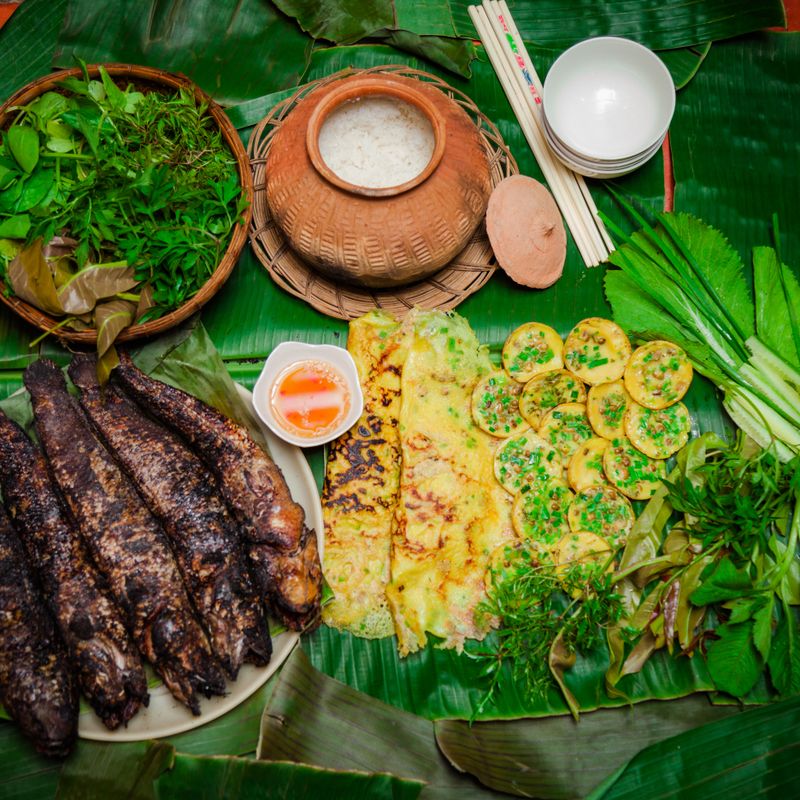
Vietnamese Turmeric Fish Cake and Cabbage Chowder
A warmly spiced Vietnamese chowder built on a turmeric-infused broth enriched with shrimp paste. Silky fish cakes simmer alongside tender cabbage, with fresh herbs and Vietnamese coriander adding brightness at the table. The soup balances earthy turmeric with umami from shrimp paste and a gentle heat that builds with each spoonful.
- Prep
- 15 min
- Cook
- 25 min
- Wait
- 5 min
- Total
- 45 min
- Makes
- 4 servings (about 8 cups)
Steps
Before you start
- Have all ingredients prepped and within arm's reach—this chowder comes together quickly on the stovetop
- If you cannot find Vietnamese coriander, prepare fresh cilantro and Thai basil as alternates
- Use store-bought fish cakes found in the Asian or frozen section of your market, or make your own ahead
Infuse oil with aromatics
- Heat 2 tablespoons (30 ml) vegetable oil in a large 4-quart (4-liter) pot over medium heat.
- When shimmering, add the sliced shallots and minced garlic.
- Stir constantly for 3–4 minutes until fragrant and light golden at the edges.
- The aromatics should soften and become translucent, releasing their gentle sweetness into the oil.
+ Show details− Hide details
Ready when: Shallots and garlic are light golden and fragrant
Tip: Stir continuously to prevent browning—you want softened, not caramelized, aromatics
Bloom turmeric and shrimp paste
- Add 2 teaspoons (5 g) ground turmeric and 1 tablespoon (15 g) shrimp paste to the pot.
- Stir for 1–2 minutes, breaking up the shrimp paste with the back of your spoon.
- The mixture will darken slightly and become very fragrant with earthy and umami notes.
- The spice will bloom and coat the oil.
+ Show details− Hide details
Ready when: Turmeric is fragrant and shrimp paste is fully incorporated
Tip: Keep heat at medium—high heat can scorch the spice and make it bitter
Build the broth
- Pour in 6 cups (1400 ml) chicken or seafood stock and add 2 tablespoons (30 ml) fish sauce.
- Stir well to combine, scraping up any aromatics from the bottom of the pot.
- Bring the broth to a gentle simmer over medium-high heat, then reduce to medium-low to maintain a steady simmer.
+ Show details− Hide details
Ready when: Broth reaches a gentle rolling simmer with small bubbles breaking the surface
Tip: Use fish sauce as your umami backbone—taste now and adjust before adding other components
Add cabbage
- Stir in 5 cups (600 g) sliced cabbage, pushing it gently into the broth.
- Simmer uncovered for 6–7 minutes, stirring occasionally, until the cabbage softens but still holds some texture.
- You should see it begin to wilt and turn a lighter green.
+ Show details− Hide details
Ready when: Cabbage is tender but not falling apart, with a slight bite remaining
Tip: Don't overcook the cabbage or it will become mushy—tender-crisp is the goal
Introduce the fish cakes
- Carefully add 12 ounces (340 g) sliced fish cakes to the simmering broth, stirring gently to distribute them evenly.
- They will sink at first, then float to the surface as they heat through.
- Simmer for 4–5 minutes until the fish cakes are warmed through.
- They should feel slightly firm when pressed but not tough.
+ Show details− Hide details
Ready when: Fish cakes are heated through and float or drift gently in the broth
Tip: Stir gently so the delicate fish cakes don't break apart—use a wooden spoon or silicone spatula
Finish with coconut milk (optional)
- If using coconut milk for richness, stir in 1 cup (240 ml) unsweetened coconut milk until fully incorporated.
- Simmer for 1 minute more to warm it through.
- The broth will become creamier and slightly pale, tempering the intensity of the turmeric and shrimp paste.
+ Show details− Hide details
Ready when: Coconut milk is fully incorporated and broth is warmed through
Tip: Skip the coconut milk for a lighter, more brothy version—both are authentic
Taste and adjust seasoning
- Taste the chowder and adjust the seasoning.
- Add more fish sauce for depth, a squeeze of lime juice for brightness, or a pinch more turmeric for earthiness.
- Remember that the fresh herbs will add their own notes, so go easy—you want balance, not dominance.
+ Show details− Hide details
Ready when: Chowder tastes balanced and flavorful
Tip: Taste as you adjust—it's easier to add more than to dilute if you oversalt
Serve with fresh herbs
- Ladle the chowder into bowls.
- Top each serving with generous sprigs of Vietnamese coriander, sliced Thai chilies, optional cilantro, and a lime wedge on the side.
- The fresh herbs are essential—they brighten the rich, spiced broth and are meant to be added to taste by each diner.
+ Show details− Hide details
Tip: Don't skip the fresh herbs—they transform the chowder from rich and heavy to lively and complete
Good to know
Tips
- Vietnamese coriander (rau ram) is worth seeking out in Asian markets—its peppery bite is irreplaceable. If you can only find it frozen, use it directly from the package; thaw it only if adding to the bowl cold.
- The broth's color should be a warm golden-yellow. If it looks too orange, you've added too much turmeric; if it's pale, add a tiny pinch more for authentic flavor.
- Fish cakes are often found in the frozen section. Buy pre-made ones from Vietnam or other Southeast Asian sources for best results. Some brands are softer and more delicate than others; adjust cooking time if needed.
- This chowder is meant to be served in a wide bowl with room for extra condiments. Set out lime wedges, extra Thai chilies, and extra fresh herbs so each diner can customize their heat and brightness.
Make ahead
Fish cakes can be sliced and stored in the fridge up to 2 hours ahead. The broth (through Step 3) can be made 1 day ahead, cooled, and refrigerated; reheat before adding cabbage. The full chowder is best eaten fresh, though it keeps for 1 day in the fridge.
Storage & reheating
Refrigerate in an airtight container for up to 1 day. The fish cakes will soften slightly over time but remain edible. To reheat, warm gently on the stovetop over medium heat until steaming; do not boil. Freeze the broth and cabbage (without fish cakes) for up to 2 months; thaw in the fridge and reheat, adding fresh fish cakes when ready to serve.
Substitutions
- Vietnamese coriander (rau ram) → fresh cilantro and Thai basil (half cup of each). Vietnamese coriander has a peppery, slightly medicinal flavor; this combination mimics it closely. Add at the table for best effect.
- shrimp paste (mắm tôm) → 1 tablespoon (15 ml) fish sauce added earlier in cooking. This gives umami without the funky intensity of shrimp paste. Use it if you dislike the paste's strong aroma, though the result will be less complex.
- Vietnamese fish cakes (chả cá) → firm tofu cut into slabs, or shrimp halved lengthwise. Tofu absorbs the broth beautifully; shrimp cooks quickly (2–3 minutes) and adds sweetness. Both are traditional Vietnamese alternatives.
- chicken or seafood stock → water plus 1 tablespoon extra fish sauce per 6 cups water. Not ideal but workable if stock is unavailable. The chowder will be lighter but still flavorful.
More chowders
See all →
Find more like this
- Meal
- Dinner
- Cuisine
- Vietnamese
- Main ingredient
- Fish
- Method
- Stovetop
- Quick & Easy
- Easy