
Vietnamese Bánh Bò Medusa Honey Sponge with Coconut
A light, airy steamed sponge cake from Vietnam with a distinctive honeycomb structure created by whipped egg whites. The delicate crumb is enriched with coconut milk and honey, topped with shredded coconut for texture and tropical flavor. The "medusa" name comes from the cake's tentacle-like appearance when inverted. Perfect for afternoon tea or a light dessert.
- Prep
- 20 min
- Cook
- 35 min
- Wait
- 10 min
- Total
- 1 hr 5 min
- Makes
- 1 cake (8 servings), 7-inch (18 cm) round
Steps
Before you start
- Bring eggs to room temperature (at least 1 hour)
- Set up a steamer with 2 inches of water and bring to a boil
- Line a 7-inch (18 cm) round cake pan with parchment paper, extending it 2 inches above the rim
- Have all ingredients measured and ready before starting to whip the eggs
Combine dry ingredients
- Sift together the tapioca starch, all-purpose flour, baking powder, and salt into a medium bowl.
- Set aside.
- This removes lumps and aerates the dry ingredients for a lighter crumb.
+ Show details− Hide details
Ready when: Mixture is combined and lump-free
Tip: Sifting is important here—it ensures the starch doesn't settle and create dense spots in the cake.
Whip egg whites to stiff peaks
- Using an electric mixer, whip the egg whites in a large, very clean bowl on medium-high speed for 4–5 minutes, until stiff, glossy peaks form.
- The whites should be bright white and firm enough that peaks stand upright when the beaters are lifted.
- This is crucial for the signature honeycomb texture.
+ Show details− Hide details
Ready when: Egg whites are glossy, stiff, and form upright peaks
Tip: Even a tiny speck of yolk will prevent whites from whipping properly. Use a clean bowl and beaters, and separate eggs carefully.
Whip yolks and honey
- In a separate large bowl, whip the egg yolks with the honey on medium-high speed for 3–4 minutes, until the mixture is pale, thick, and ribbon-like.
- It should triple in volume and fall in a ribbon when you lift the beaters.
+ Show details− Hide details
Ready when: Mixture is pale yellow, thick, and falls in a ribbon from the beaters
Tip: This step aerates the yolks, creating air bubbles that expand during steaming for a light, fluffy crumb.
Add coconut milk and oil to yolks
- Add the coconut milk, melted coconut oil, and vanilla extract to the yolk mixture.
- Fold gently with a rubber spatula until just combined, about 10–15 strokes.
- The mixture should be smooth and homogeneous.
+ Show details− Hide details
Ready when: Coconut milk and oil are fully incorporated with no streaks
Tip: Fold gently to preserve the air in the yolks. Do not overmix or the batter will deflate.
Add dry ingredients to yolk mixture
- Gently fold the sifted dry ingredients into the yolk mixture in two additions, using a rubber spatula.
- Make 10–12 folding strokes for the first addition, then add the remaining dry ingredients and fold another 10–12 strokes until just combined.
- A few small streaks of flour are okay; do not overmix.
+ Show details− Hide details
Ready when: Dry ingredients are mostly combined with minimal visible flour streaks
Tip: Gentle folding preserves the air bubbles that create the honeycomb structure. Stop folding before it looks perfectly smooth.
Fold in coconut and egg whites
- Add the 0.25 cup (25 g) of shredded coconut to the batter and fold 3–4 times to distribute.
- Then, in three additions, gently fold in the whipped egg whites.
- After the first addition, fold 8–10 strokes; after the second, fold 8–10 strokes; after the final addition, fold until just combined, about 8–10 more strokes.
- The batter should be fluffy and light, with no visible streaks of white.
+ Show details− Hide details
Ready when: Batter is pale, fluffy, and uniformly colored with no white streaks
Tip: Folding in the whites in stages helps preserve air and ensures even distribution. This is where the honeycomb texture forms.
Pour into prepared pan
- Pour the batter into the parchment-lined 7-inch (18 cm) round pan, smoothing the top gently with a spatula.
- The pan should be about three-quarters full.
- Tap the pan lightly on the counter a few times to release large air bubbles.
+ Show details− Hide details
Ready when: Batter is level and large air pockets have risen to the surface and popped
Tip: Do not overmix the batter during pouring. Parchment paper makes it easy to invert the cake later to show the honeycomb pattern.
Set up steamer
- Bring water in the steamer pot or wok to a rolling boil.
- Carefully place the cake pan on the steamer rack or trivet, ensuring the water level is at least 2 inches (5 cm) below the bottom of the pan.
- Cover the steamer with a lid.
+ Show details− Hide details
Ready when: Water is at a rolling boil and steamer is covered
Tip: If water boils too vigorously, it may splash into the cake and make it soggy. A gentle, steady boil is ideal.
Steam the cake
- Steam the cake over high heat for 32–35 minutes.
- The cake is done when a skewer inserted into the center comes out clean or with just a few moist crumbs, and the top is set and springs back lightly when touched.
- Do not open the lid during the first 25 minutes, as the temperature drop can cause the cake to collapse.
+ Show details− Hide details
Ready when: Skewer comes out clean, top is set and springs back when lightly touched
Tip: Resist the urge to peek early. Opening the lid releases steam and can cause the cake to collapse or develop a dry top.
Cool in pan
- Remove the cake from the steamer and let it cool in the pan for 10 minutes at room temperature.
- The cake will firm up slightly during this time, making it easier to invert without breaking.
+ Show details− Hide details
Ready when: Cake has cooled enough that the pan is comfortable to handle
Tip: This resting period is important for setting the structure before inversion, which exposes the honeycomb top.
Invert and finish
- Run a thin knife or spatula around the edge of the pan to loosen the cake.
- Place a serving plate over the pan and carefully invert the cake onto the plate, parchment-side up.
- Gently peel away the parchment paper to reveal the honeycomb underside, which is now the top.
- While still warm, sprinkle the remaining 0.25 cup (25 g) of shredded coconut over the honeycomb top, pressing gently so it adheres.
- Once cooled, dust lightly with powdered sugar if desired.
+ Show details− Hide details
Ready when: Parchment is removed and honeycomb pattern is visible; coconut topping is evenly distributed
Tip: Invert while the cake is still slightly warm so the honeycomb surface remains moist and the coconut topping sticks. If the cake cools completely, it becomes brittle and may crack.
Good to know
Tips
- The honeycomb structure is created by steam escaping from the whipped egg whites during cooking. Do not use a pressure cooker or oven; traditional steaming is essential for the characteristic texture.
- Room temperature eggs whip better and incorporate more air than cold eggs. Remove them from the refrigerator at least 1 hour before making the cake.
- If your steamer doesn't have a rack, you can place a small trivet, ceramic ring, or even crumpled aluminum foil under the cake pan to elevate it above the water level.
- The cake is best served within 1–2 days of making. Bánh bò is delicate and has a tender, open crumb that gradually dries out with storage, though it remains pleasant for up to 3 days in the refrigerator.
Make ahead
Bánh bò can be made up to 1 day ahead. Cool completely, wrap tightly in plastic wrap or place in an airtight container, and refrigerate. Bring to room temperature before serving, about 30 minutes. Do not freeze, as the delicate honeycomb structure becomes icy and loses its tender texture.
Storage & reheating
Room temperature (if serving the same day): store under a cake dome or in an airtight container for up to 6 hours. The cake will remain soft and moist. Refrigerator: wrap cooled cake in plastic wrap and store for up to 3 days. Bring to room temperature before serving for best texture and flavor. Not recommended for freezing due to the delicate, airy structure.
Substitutions
- tapioca starch (or cornstarch) → cornstarch or potato starch. Use the same weight (120 g). Tapioca starch produces the most authentic texture and gives the cake its signature slight translucency, but cornstarch is a reliable alternative with a slightly less delicate result.
- full-fat canned coconut milk → evaporated milk or heavy cream. Use the same volume (120 ml / 0.5 cup). The cake will be less distinctly coconut-flavored, but will still be tender and delicious.
- honey → light agave nectar or brown sugar dissolved in a little water. If using brown sugar, dissolve 115 g brown sugar with 1 tbsp water to create a liquid with the same viscosity as honey. The flavor will be slightly different, but the texture will be similar.
- unsweetened shredded coconut → toasted sesame seeds or sliced almonds. Use the same weight (50 g total, 25 g for batter and 25 g for topping). This changes the flavor profile but maintains a pleasant texture. Toast the topping slightly for more flavor.
More cakes
See all →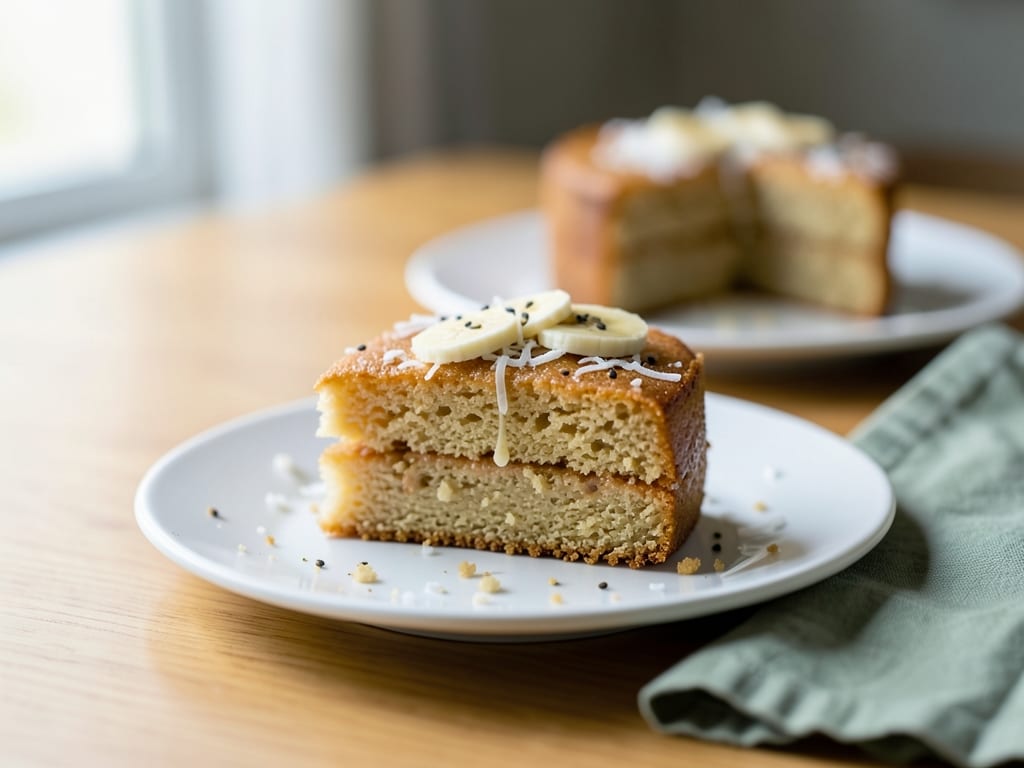
Find more like this
- Meal
- Dessert
- Cuisine
- Vietnamese
- Main ingredient
- Eggs
- Diet
- VegetarianHalal
- Method
- Stovetop