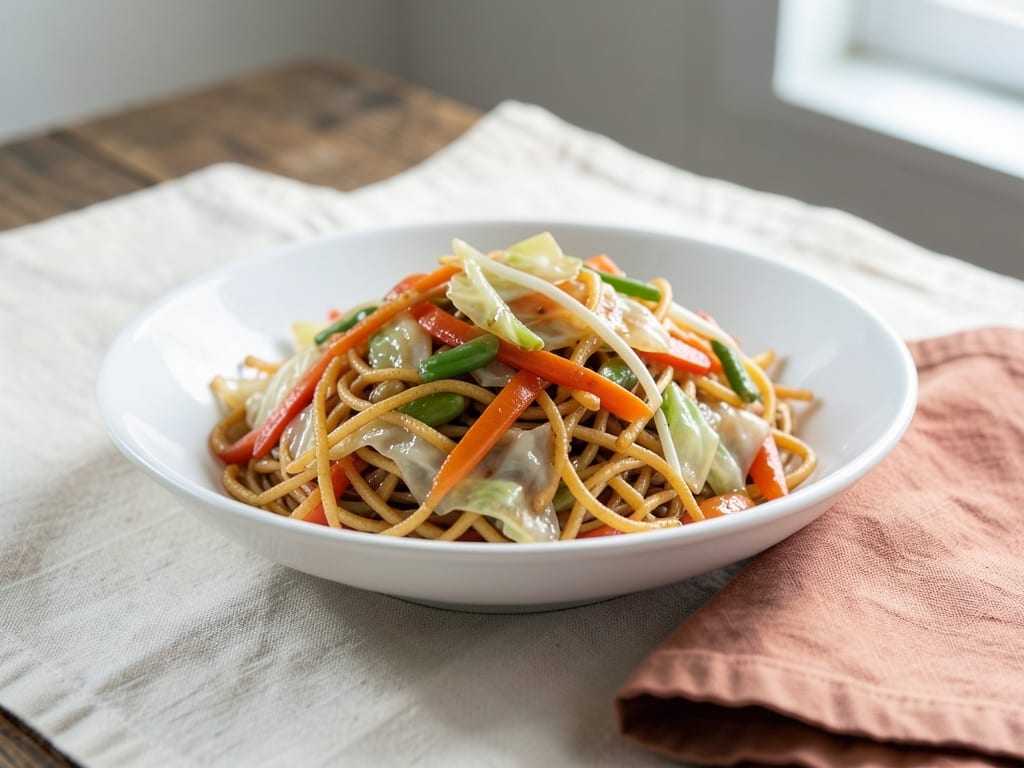
Vegetable Chow Mein with Crispy Noodles
Tender-crisp cabbage, carrots, peppers and bean sprouts tossed in a savory, glossy soy-sesame sauce with golden, crunchy-edged noodles. Pan-frying the noodles first gives you crisp texture in every bite, and the whole dish is on the table in under an hour.
- Prep
- 20 min
- Cook
- 22 min
- Wait
- 10 min
- Total
- 52 min
- Makes
- 4 main-course servings (about 6 cups total)
Steps
Before you start
- Use fresh, par-cooked chow mein noodles (refrigerated section). If you only have dried egg noodles, cook them according to the package for 1 minute less than directed.
- Cut all the vegetables before you turn on the heat. Stir-frying moves fast and you won't have time to chop midway.
- Dry noodles are the secret to crispness: plan on 10 minutes of air-drying after boiling and rinsing.
- Check that your soy sauce and vegetarian oyster sauce are labeled vegetarian or vegan if that matters to you, and gluten-free if needed.
Prep sauce and vegetables
- Whisk the soy sauce, vegetarian oyster sauce, sesame oil, sugar, white pepper, cornstarch and cold water in a small bowl until the cornstarch fully dissolves and no lumps remain.
- Shred the cabbage, cut the carrots into matchsticks, slice the bell pepper, and slice the scallions (whites and greens in separate piles).
- Mince the garlic and grate the ginger, and set everything within reach of the stove.
- Rinse and drain the bean sprouts.
+ Show details− Hide details
Ready when: Sauce is smooth and all vegetables are cut and lined up by the stove.
Tip: Stir the sauce again right before adding it to the pan, since the cornstarch settles quickly.
Boil and dry noodles
- Bring a large pot of water to a boil.
- Add the noodles and cook for 2 minutes, gently separating the strands with tongs, just until they loosen and are barely tender.
- Drain in a colander, rinse briefly under cold water to stop the cooking, and shake off as much water as you can.
- Spread the noodles in a thin layer on a large tray or plate lined with paper towels and let them air-dry for 10 minutes, blotting the tops with more paper towel.
+ Show details− Hide details
Ready when: Noodles are loose, flexible and feel dry, not wet or sticky, to the touch.
Tip: Do not overcook the noodles; they cook again in the pan and will turn mushy if they are soft now.
Crisp the noodles
- Heat 1½ tbsp (22 ml) of the oil in the 12-inch skillet over medium-high heat until it shimmers.
- Add half the noodles and spread them into an even layer about ½ inch (1 cm) thick.
- Cook without stirring for 3 to 4 minutes until the underside is deep golden.
- Flip in sections with a wide spatula and cook another 2 minutes on the second side.
- Slide onto a plate.
- Repeat with another 1½ tbsp (22 ml) oil and the remaining noodles, then combine both batches on the plate.
+ Show details− Hide details
Ready when: Edges and bottoms are deep golden brown and crunchy, with some softer noodles in the center.
Tip: Resist the urge to stir. Noodles only crisp where they sit in contact with the hot pan.
Stir-fry aromatics and firm vegetables
- Wipe out the wok or large skillet if needed and heat it over high heat for 1 minute until very hot.
- Add the remaining 2 tbsp (30 ml) oil, then the scallion whites, garlic and ginger.
- Stir constantly for 20 to 30 seconds until fragrant.
- Add the carrots and bell pepper and stir-fry for 2 minutes.
- Add the cabbage and stir-fry for 2 to 3 minutes more.
+ Show details− Hide details
Ready when: Garlic smells fragrant but is not browned; cabbage has wilted and has charred edges but still has a little crunch.
Tip: If the garlic starts to brown, lower the heat for a few seconds, since burnt garlic makes the whole dish bitter.
Add sauce and sprouts
- Stir the sauce again and pour it around the edge of the wok.
- Add the bean sprouts and toss for about 1 minute, until the sauce bubbles and thickens into a light glaze that coats the vegetables.
+ Show details− Hide details
Ready when: Sauce is glossy and clings to the vegetables, and the bean sprouts are just slightly translucent but still crisp.
Tip: Bean sprouts release water quickly, so don't cook them longer than a minute.
Toss and serve
- Add the crispy noodles and scallion greens to the wok.
- Using tongs, toss gently for 1 to 2 minutes just until the noodles are coated in sauce and heated through.
- Taste and add a splash of soy sauce if you'd like more seasoning.
- Serve immediately, while the edges are still crunchy.
+ Show details− Hide details
Ready when: Noodles are evenly coated and hot, with a mix of crunchy and tender strands.
Tip: For extra crunch, hold back a handful of crisped noodles and sprinkle them over each serving.
Good to know
Tips
- Use a very hot wok and don't overcrowd it. If your pan is smaller than 14 inches, stir-fry the vegetables in two batches so they sear instead of steam.
- Make sure the noodles are well dried before they hit the oil. Excess water causes splattering and prevents browning.
- Cut the vegetables to similar thin sizes so they cook evenly and stay tender-crisp.
- For protein, add 8 oz (225 g) pressed, cubed extra-firm tofu, pan-fried until golden, in the last step.
Make ahead
Boil, rinse and dry the noodles up to 1 day ahead; refrigerate uncovered on a lined tray for the driest result, then crisp them as directed. Vegetables can be cut and sauce mixed up to 24 hours ahead and stored separately in the refrigerator. Stir-fry and assemble just before serving.
Storage & reheating
Best eaten right away, as the noodles soften as they sit. Refrigerate leftovers in an airtight container up to 3 days. Reheat in a hot skillet with 1 tsp oil for 3 to 4 minutes, stirring occasionally, to partially revive the crispness (the microwave will leave the noodles soft). Freezing is not recommended because the vegetables turn watery.
Substitutions
- fresh chow mein noodles → dried thin egg noodles (8 oz / 225 g). Cook for 1 minute less than the package directs, then rinse and dry as in the recipe.
- vegetarian oyster sauce (mushroom-based) → hoisin sauce. Sweeter and thicker; reduce the sugar to ½ tsp.
- soy sauce → tamari. Makes the dish gluten-free when paired with gluten-free noodles and oyster sauce.
- green cabbage → napa cabbage. Milder and more tender; cut cooking time by about 1 minute.
More stir-fried noodles
See all →
Find more like this
- Meal
- Dinner
- Cuisine
- Chinese
- Diet
- Dairy-FreeHalal
- Method
- Stovetop