Vegan Moroccan Couscous with Butternut Squash and Zucchini
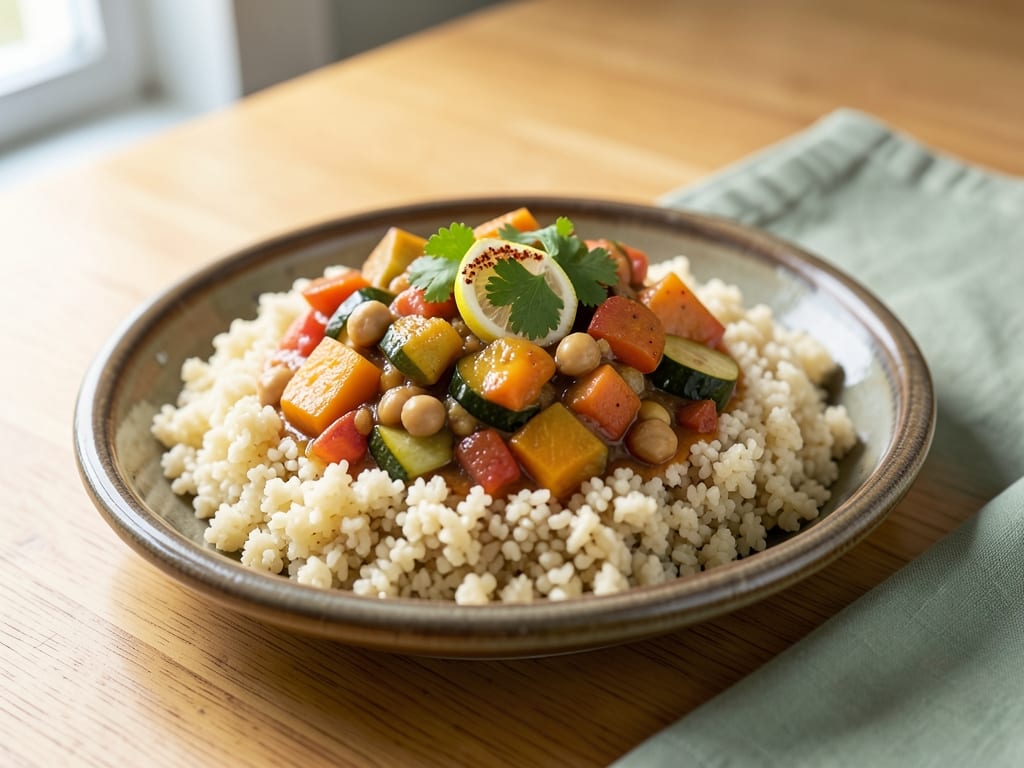
Fluffy, twice-steamed couscous crowned with a fragrant ras el hanout vegetable stew of sweet butternut squash, tender zucchini, carrots, chickpeas and tomato. The couscous steams right over the simmering stew and absorbs its aroma.
- Prep
- 25 min
- Cook
- 50 min
- Wait
- 10 min
- Total
- 1 hr 25 min
- Makes
- 6 generous main-course servings (about 8 cups total)
Steps
Before you start
- Check that your fine-mesh steamer basket or metal colander sits snugly on top of your pot without touching the stew below; the stew liquid should stay at least 2 inches (5 cm) below the base.
- Use medium-grain couscous, not pearl (Israeli) couscous. Instant couscous also works, but it will be softer and less distinct.
- Cut all vegetables before you start cooking; the steps move steadily once the onion goes in the pot.
- Ras el hanout varies in heat and saltiness by brand, so taste the stew before the final salt adjustment.
Prep the vegetables
- Peel and seed the squash and cut into 1½-inch (4 cm) chunks.
- Peel the carrots and cut into 2-inch (5 cm) pieces.
- Dice the onion, mince the garlic, chop the tomatoes and cut the zucchini into 1½-inch (4 cm) chunks.
- Keep the zucchini in a separate bowl because it goes in later.
- Drain and rinse the chickpeas.
+ Show details− Hide details
Ready when: Squash and carrot pieces are roughly the same size so they cook evenly.
Tip: Cut the squash pieces no smaller than 1½ inches (4 cm); smaller chunks turn to mush during the long simmer.
Moisten the couscous
- Put the couscous in a large bowl.
- Stir in ¾ tsp of the couscous salt and 1 tbsp of the couscous olive oil, rubbing the grains between your fingers to coat each one.
- Pour in 1 cup (240 ml) of the warm water and stir once.
- Let stand for 10 minutes.
- Rub the grains between your palms to break up clumps.
+ Show details− Hide details
Ready when: The water is fully absorbed and the grains look plump and separate, with no puddle in the bowl.
Tip: Oiling the grains before adding water helps keep them from sticking together.
Soften the onion
- Set the pot over medium heat and add the stew olive oil (3 tbsp / 45 ml).
- When it shimmers, add the onion and ½ tsp of the stew salt.
- Cook, stirring often, for 6 minutes.
+ Show details− Hide details
Ready when: Onion is soft, translucent and just starting to turn golden at the edges.
Tip: If the onion browns darkly, lower the heat; scorched onion makes the stew bitter.
Bloom the spices
- Add the garlic, ras el hanout, turmeric, cinnamon and black pepper.
- Stir constantly for 1 minute.
- Add the tomato paste and cook, stirring, for 2 minutes more.
- Stir in the chopped tomatoes with their juices and the raisins, if using, and cook for 3 minutes.
+ Show details− Hide details
Ready when: The spices smell toasty and fragrant, and the tomatoes start to break down into a thick, brick-red base.
Tip: Add a splash of broth if the spices start to stick to the bottom of the pot.
Start the stew
- Pour in the broth and add the carrots, squash and remaining 1 tsp stew salt.
- Bring to a boil over high heat (about 5 minutes), then reduce to a steady, gentle simmer, cover and cook for 10 minutes.
+ Show details− Hide details
Ready when: The liquid bubbles gently and the vegetables are partly tender when pierced with a knife.
Tip: Keep the liquid at least 2 inches (5 cm) below where the steamer will sit so it doesn't soak the couscous.
Steam the couscous
- Transfer the couscous to the steamer basket (lined with a damp towel if the holes are large) and set it on top of the simmering pot.
- Do not cover the couscous yet.
- Steam for 15 minutes, until you see steam rising up through the whole surface of the grains.
+ Show details− Hide details
Ready when: Steam rises evenly through the couscous and the grains feel hot and slightly firm.
Tip: Leave the couscous uncovered during the first steam so condensation doesn't make it gummy.
Fluff and re-moisten
- Lift the steamer off and tip the hot couscous into the large bowl.
- Dissolve the remaining ¼ tsp couscous salt in ½ cup (120 ml) warm water and sprinkle it over the grains.
- Add the remaining 1 tbsp couscous oil.
- Break up lumps with a fork and rub between your palms, working quickly while still hot.
+ Show details− Hide details
Ready when: The grains are separate, glossy and have no clumps.
Tip: Be careful, the couscous is very hot. Use a fork first and wait a moment before rubbing with your fingers.
Add zucchini and re-steam
- Stir the zucchini and chickpeas into the stew, then return the pot to a gentle simmer.
- Return the fluffed couscous to the steamer, set it on top and steam, uncovered, for 10 minutes more.
+ Show details− Hide details
Ready when: Squash and zucchini are fork-tender but still hold their shape, and the couscous is tender, light and fully cooked through when tasted.
Tip: Stir the stew gently so the squash doesn't break apart.
Finish the stew
- Remove the steamer.
- Stir the lemon juice and half of the cilantro into the stew.
- Taste and add more salt if needed.
+ Show details− Hide details
Ready when: The broth tastes bright, savory and lightly sweet, with no raw lemon edge.
Tip: Lemon juice added at the end keeps its fresh flavor and keeps the vegetables from turning dull.
Serve
- Fluff the couscous once more with a fork and mound it on a large platter, making a well in the center.
- Spoon the vegetables and chickpeas into the well and ladle some broth over the top.
- Scatter with the remaining cilantro and serve with extra broth and harissa on the side, if using.
+ Show details− Hide details
Ready when: Couscous is light and fluffy, and the vegetables are glistening in the broth.
Tip: Serve right away; couscous firms up as it cools.
Good to know
Tips
- Rubbing the grains with your hands between steams is the key to light, separate couscous; don't skip it.
- If the stew is too brothy to serve, simmer it uncovered for 5 minutes at the end. If it's too thick, add a splash of broth or water.
- Add the zucchini late. Zucchini cooks quickly and turns watery and soft if added with the squash.
- For extra depth, toast the dry ras el hanout in the oil for 30 seconds before adding the onion.
Make ahead
"The stew (through step 5, without the zucchini and lemon) can be made up to 2 days ahead and refrigerated. Reheat to a simmer, add the zucchini and chickpeas, then steam the couscous as written."
Storage & reheating
"Store the couscous and stew separately in airtight containers. Room temperature: up to 2 hours. Refrigerator: up to 4 days. Freezer: the stew freezes up to 3 months (zucchini will be softer); couscous up to 1 month. Reheat the stew on the stove over medium-low heat until steaming hot. Reheat the couscous covered in the microwave with 1 tbsp of water per cup, about 1–2 minutes, then fluff."
Substitutions
- ras el hanout → 1 tbsp ground cumin + 1 tbsp ground coriander + 1 tsp ground ginger + ½ tsp paprika. Approximates the warm, floral flavor; add a pinch of cayenne for heat.
- butternut squash → Sweet potato or kabocha squash. Use the same weight and cut size; cooking time is about the same.
- medium-grain couscous → Whole-wheat couscous. Use the same amount of water; it may need 2–3 extra minutes of steaming.
- ripe tomatoes → 1 can (14 oz / 400 g) diced tomatoes with juice. Handy when fresh tomatoes are out of season.