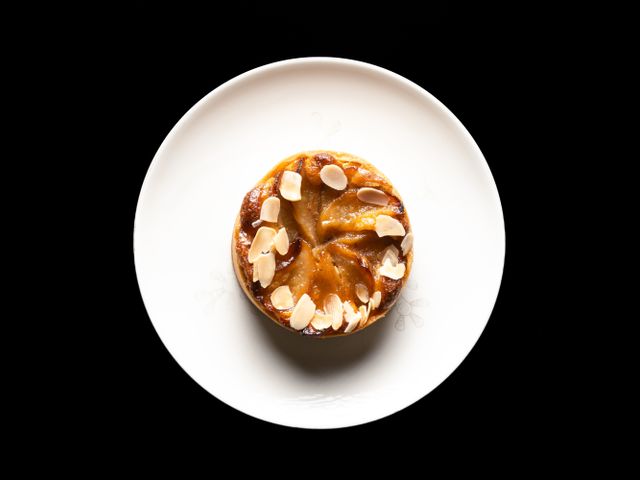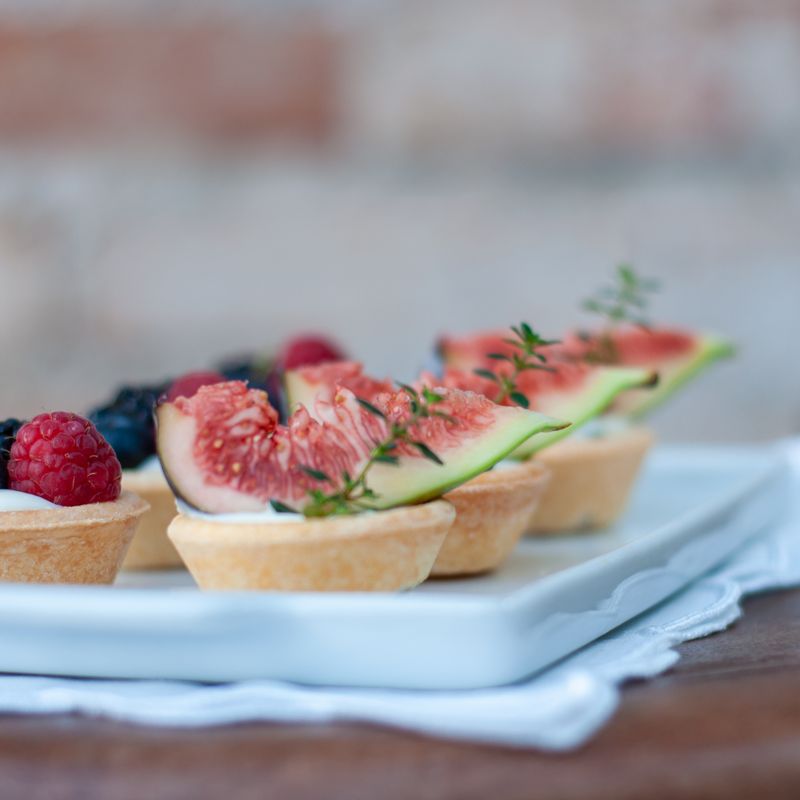
Vegan Elderflower and Blueberry Tartlets
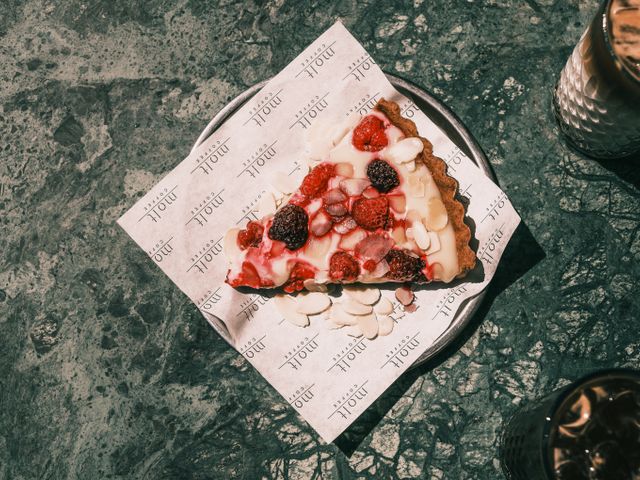
Delicate individual pastry tartlets with a tender vegan shortcrust base, topped with a light elderflower-infused coconut cream and fresh blueberries. The tartlets showcase bright floral notes balanced by tart fruit and a buttery, crisp pastry shell. Perfect for elegant entertaining or a refined dessert.
- Prep
- 45 min
- Cook
- 28 min
- Wait
- 1 hr 30 min
- Total
- 2 hr 43 min
- Makes
- 6 tartlets (4 inches / 10 cm each)
Steps
Before you start
- Remove coconut cream from the refrigerator 30 minutes before starting so it reaches room temperature
- Preheat your oven to 400°F (200°C) and position a rack in the middle
- Have 6 tartlet pans (4-inch / 10 cm with removable bottoms) ready and lightly oiled
- Chill all pastry ingredients and tools for at least 30 minutes
Make the tartlet dough
- In a food processor, combine 1.5 cups (180 g) all-purpose flour, 2 tbsp (15 g) cornstarch, and ¼ tsp (1.5 g) fine sea salt.
- Pulse 2–3 times to combine.
- Add 6 oz (170 g) cold vegan butter cubes and pulse until the mixture resembles coarse breadcrumbs with some pea-sized pieces of butter still visible, about 8–10 pulses.
- Add 2 tbsp (30 ml) agave syrup and pulse once to combine.
- Drizzle in 3 tbsp (45 ml) ice water while pulsing gently until the dough just comes together when pinched, but is still crumbly.
- Do not overwork.
+ Show details− Hide details
Ready when: Dough is crumbly but holds together when pinched; no dry flour remains
Tip: Keep butter and water ice cold to ensure a flaky pastry. Work quickly and avoid warming the dough with your hands.
Chill the dough
- Turn the dough out onto a clean work surface and gently press it together into a ball without kneading.
- Wrap tightly in plastic wrap and refrigerate for at least 45 minutes, until the dough is firm and easy to handle.
+ Show details− Hide details
Ready when: Dough is firm and holds its shape when pressed
Tip: If time is short, you can chill for 30 minutes, but longer chilling ensures better texture.
Line tartlet pans
- Divide the chilled dough into 6 equal pieces.
- Working with one piece at a time (keep the rest covered), flatten the dough slightly and press it evenly into a 4-inch (10 cm) tartlet pan, pushing it up the sides and across the bottom to form an even shell about ⅛ inch (3 mm) thick.
- Trim excess dough at the rim by pressing the rolling pin across the top.
- Repeat with remaining dough.
- Place lined pans on a baking sheet.
+ Show details− Hide details
Ready when: All tartlet shells are evenly lined and fitted snugly in their pans
Tip: Keep unused dough pieces covered with plastic wrap while you work to prevent drying. If dough becomes too soft, return to the refrigerator for 5 minutes.
Blind-bake the shellsOven 400°F / 205°C
- Prick the bottom of each tartlet shell all over with a fork.
- Line each with a small piece of parchment paper and fill with pie weights, dried beans, or sugar (about 2 tbsp per shell).
- Place the baking sheet in a preheated 400°F (200°C) oven and bake for 12 minutes.
- Carefully remove the parchment and weights.
- Return to the oven and bake for another 5–6 minutes, until the shells are golden and set but not browned, and the bottoms are dry to the touch.
+ Show details− Hide details
Ready when: Shells are pale golden, set, and no longer wet; bottoms feel dry when touched lightly
Tip: Do not let the shells brown too much or they will taste bitter. If edges are browning too quickly, cover with foil in the second bake.
Cool the shells
- Remove the baking sheet from the oven and let the tartlet shells cool in their pans for 5–10 minutes on a wire rack.
- The pastry will set further as it cools.
- Once cool enough to handle safely, run a thin knife around the inside edge of each shell and carefully pop them out of their pans.
- Let cool completely on the rack, about 15–20 minutes.
+ Show details− Hide details
Ready when: Shells are completely cool, firm, and can be handled without flexing
Tip: Be gentle when popping shells out to avoid cracking. If they crack slightly, you can use them but handle carefully when filling.
Make the elderflower cream filling
- In a mixing bowl, whisk together 1 can (400 ml) room-temperature full-fat coconut cream with 3 tbsp (45 ml) elderflower cordial, 1 tbsp (15 ml) agave syrup, and the zest of ½ lemon (3 g).
- Whisk until smooth and well combined, about 1–2 minutes.
- The mixture should be thick, creamy, and pale with a subtle purple-pink tint.
+ Show details− Hide details
Ready when: Filling is smooth, thick, and homogeneous with no lumps; color is pale and creamy
Tip: If coconut cream is not fully smooth, warm the can slightly in hot water for 2 minutes before opening, or strain it through a fine sieve.
Assemble the tartlets
- Spoon or pipe about 3 tbsp (45 ml) of elderflower cream filling into each cooled tartlet shell, mounding it slightly in the center.
- Use the back of a spoon to spread it evenly, leaving a thin border of pastry visible around the edge.
+ Show details− Hide details
Ready when: Each tartlet is filled evenly with cream, mounded slightly, with pastry rim visible
Tip: Work quickly if the cream is soft; refrigerate for 15 minutes if needed to make it easier to spread.
Top with blueberries and garnish
- Gently arrange 6–8 fresh blueberries on top of each tartlet, pressing them lightly into the cream.
- If using edible elderflowers, place 1–2 tiny flowers in the center of each tartlet for an elegant garnish.
- Serve immediately or chill for up to 2 hours before serving.
+ Show details− Hide details
Ready when: Blueberries are arranged and lightly set into the cream; tartlets look balanced and elegant
Tip: Arrange blueberries just before serving to keep them plump and fresh. If making ahead, add blueberries no more than 2 hours before serving.
Good to know
Tips
- Vegan butter matters: use a butter with high fat content (not a spread) for the flakiest pastry. Miyoko's, Earth Balance, or similar perform best.
- Prick the pastry shells thoroughly during blind-baking to prevent large air bubbles that will collapse when filling is added.
- Full-fat coconut cream separates naturally; the thick cream rises to the top. Stir well before using, or use the thick portion for a richer cream and save the liquid for another use.
- Elderflower cordial varies in strength by brand; start with 2 tbsp (30 ml) if you are sensitive to strong floral flavors, and add more to taste.
Make ahead
The tartlet shells can be made up to 1 day ahead and stored in an airtight container at room temperature. The elderflower cream can be made up to 4 hours ahead and refrigerated. Assemble tartlets with blueberries no more than 2 hours before serving to keep them at their best.
Storage & reheating
Room temperature: Filled tartlets can sit at room temperature for up to 3 hours before the cream softens too much. Refrigerator: Store unfilled shells in an airtight container for up to 2 days. Store filled tartlets loosely covered for up to 1 day; they will soften slightly but remain delicious. Freezer: Baked shells can be frozen in an airtight container for up to 2 weeks; reheat gently in a 300°F (150°C) oven for 5 minutes to crisp before filling. Do not freeze filled tartlets.
Substitutions
- elderflower cordial (or syrup) → Rose water or lavender syrup. Use the same amount (3 tbsp / 45 ml). Rose or lavender will give a different floral note but equally elegant results.
- fresh blueberries → Fresh raspberries, blackberries, or a mix of berries. Use the same weight (225 g). Raspberries are more delicate; add just before serving to prevent crushing.
- vegan butter, cold, cut into ½-inch cubes → Coconut oil or refined coconut oil, cold and solidified. Use the same weight (170 g). Coconut oil will yield a slightly more tender, less flaky crust with a subtle coconut flavor.
- full-fat coconut cream, room temperature → Cashew cream (1 cup / 240 ml blended raw cashews with ¼ cup water and 1 tbsp agave). Whip cashew cream gently before mixing with elderflower cordial for a lighter texture. Flavor will be milder and less tropical.