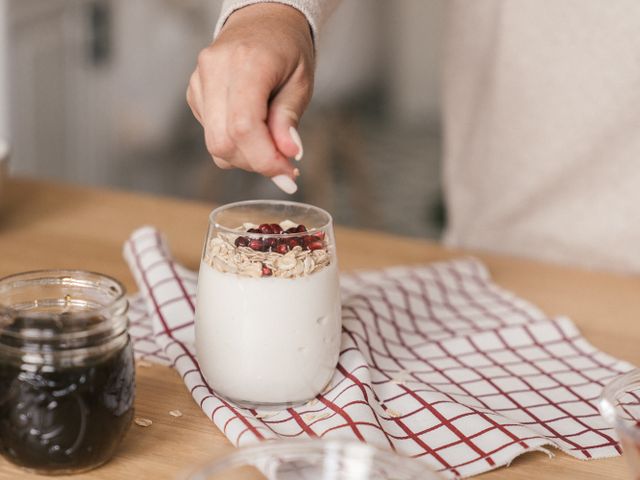
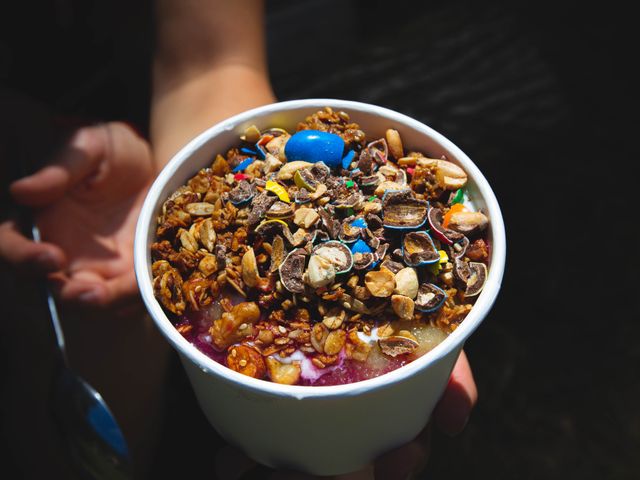
Vegan Coconut Yogurt with Berry Compote and Chia-Sunflower Granola
A complete vegan breakfast featuring creamy fermented coconut yogurt made with live cultures and tapioca starch for body, topped with a quick berry compote and a crispy homemade granola studded with chia seeds and sunflower seeds. The tangy yogurt contrasts beautifully with sweet berries and nutty, crunchy granola—all entirely plant-based and naturally delicious.
- Prep
- 20 min
- Cook
- 35 min
- Wait
- 9 hr
- Total
- 9 hr 55 min
- Makes
- 4 servings (about 2 cups yogurt, 1 cup compote, 2 cups granola)
Steps
Before you start
- Gather your probiotic yogurt cultures or dairy-free starter 24 hours ahead; store at cool room temperature.
- Preheat oven to 350°F (175°C) about 15 minutes before granola goes in.
- Have a thermometer or yogurt maker available to maintain 100–110°F (38–43°C) during fermentation.
- Read the full method; yogurt fermentation takes 8–12 hours, so plan accordingly.
Prepare Yogurt BaseOven 180°F / 80°C
- Pour the 2 cans (800 ml) of well-shaken full-fat coconut milk into a heavy-bottomed saucepan (3–4 quart).
- Whisk in 2 tablespoons (16 g) tapioca starch and 1.5 tablespoons (19 g) coconut sugar until no lumps remain.
- Heat over medium, stirring frequently, to 180°F (82°C)—this pasteurizes the milk and dissolves the starch.
- This should take about 8–10 minutes.
- Watch closely to prevent scorching on the bottom.
+ Show details− Hide details
Ready when: Mixture reaches 180°F (82°C) and is steaming but not boiling
Tip: Stir the bottom and sides often so tapioca starch doesn't clump or scorch. A thermometer is essential here.
Cool Milk to Fermentation Temperature
- Remove the saucepan from heat.
- Let the mixture cool to 105–110°F (40–43°C).
- This takes 25–35 minutes at room temperature, or you can speed it up by setting the warm saucepan in a bowl of cool water and stirring occasionally.
- Once it reaches the target temperature, it's ready for the starter.
+ Show details− Hide details
Ready when: Thermometer reads 105–110°F (40–43°C)
Tip: If the milk cools below 100°F, gently reheat it. Cultures thrive at 105–110°F; too cold and they won't activate, too hot and they die.
Activate Starter
- While the milk cools, prepare the dairy-free probiotic starter according to its package directions.
- Some packets require rehydrating with a small amount of coconut milk or water; follow exactly as instructed on your specific starter.
+ Show details− Hide details
Ready when: Starter is fully activated per package instructions
Tip: Timing matters: activate the starter about 10 minutes before the milk reaches 105–110°F so it's ready to go.
Inoculate Milk with Cultures
- When the cooled milk reaches 105–110°F (40–43°C), stir in the activated starter with a whisk until fully combined and no streaks remain.
- This is now your yogurt culture.
- Leave it undisturbed.
+ Show details− Hide details
Ready when: Starter is evenly mixed throughout the milk
Tip: Avoid aggressive stirring after this point; gentle motion is fine, but don't disturb the milk during fermentation or the curd structure weakens.
Ferment Yogurt 8–12 Hours
- Transfer the inoculated milk to a warm, undisturbed environment.
- Use a yogurt maker set to 100–110°F (38–43°C), a food dehydrator on low, or an insulated cooler with a heating pad at the bottom.
- You can also wrap the saucepan in blankets and place it in a turned-off oven.
- The yogurt needs to stay at this temperature for 8–12 hours.
- Start checking at 8 hours: tilt the jar gently—when set, it should move as one mass, not slosh like milk.
- If it's still pourable, give it another 1–2 hours and check again.
- Longer fermentation (10–12 hours) yields tangier yogurt; shorter (8–9 hours) is milder.
+ Show details− Hide details
Ready when: Yogurt jiggles gently as one mass when tilted, not liquid; desired tanginess achieved after 8–12 hours
Tip: The fermentation time depends on ambient warmth and your starter strength. Coconut yogurt sets slower than dairy; patience is key. Cover the fermenting yogurt loosely to prevent condensation from dripping into it.
Make Berry Compote
- While yogurt ferments, prepare the compote.
- Combine 1.5 cups (225 g) mixed berries, 2 tablespoons (30 ml) maple syrup, and 1.5 teaspoons (8 ml) lemon juice in a small saucepan (1 quart).
- Heat over medium, stirring gently, until the berries soften and release their juice, about 8–10 minutes.
- Some berries should break down; others can stay mostly whole for texture.
- If using vanilla extract, stir in 0.25 teaspoon (1 ml) at the end.
- Remove from heat and let cool to room temperature.
- The compote will thicken slightly as it cools.
+ Show details− Hide details
Ready when: Berries are soft, sauce coats the back of a spoon, flavors meld
Tip: Don't over-stir or the compote becomes too smooth. You want chunks of berry for texture and visual appeal.
Make Granola: Mix Dry IngredientsOven 350°F / 175°C
- Preheat your oven to 350°F (175°C).
- In a large bowl, combine 1.5 cups (150 g) rolled oats, 0.75 cup (100 g) sunflower seeds, 0.5 cup (80 g) chia seeds, 0.5 teaspoon (3 g) sea salt, 0.5 teaspoon (1 g) ground cinnamon, and mix well with a wooden spoon.
+ Show details− Hide details
Ready when: All dry ingredients are evenly distributed
Tip: Chia seeds are tiny; stir well to prevent clumping when you add the wet ingredients.
Make Granola: Combine Wet and Dry
- In a small bowl, whisk together 0.33 cup (80 ml) melted coconut oil, 0.25 cup (60 ml) maple syrup, and 1 teaspoon (5 ml) vanilla extract until smooth.
- Pour this mixture into the dry ingredients and stir with a wooden spoon until all the oats, seeds, and chia are evenly coated.
- Make sure there are no dry pockets at the bottom of the bowl.
+ Show details− Hide details
Ready when: All ingredients are evenly coated with wet mixture; no dry spots remain
Tip: Wet ingredients tend to pool at the bottom; scrape and fold the mixture several times to coat everything uniformly.
Spread and Bake GranolaOven 350°F / 175°C
- Spread the granola mixture in a single, even layer on a sheet pan or baking tray.
- Bake at 350°F (175°C) for 25–30 minutes, stirring once or twice with a wooden spoon halfway through (at about 12 minutes), moving the center to the edges and vice versa to ensure even browning.
- The granola is done when the oats and seeds are lightly golden and fragrant, but not dark brown.
+ Show details− Hide details
Ready when: Oats and seeds are lightly golden; mixture is fragrant and beginning to crisp
Tip: Stir at least once so edges don't over-brown. Watch carefully in the final 5 minutes; granola can go from golden to burnt quickly.
Cool and Crisp Granola
- Remove the pan from the oven and spread the hot granola on a clean sheet of parchment or a cooling rack.
- Let it cool completely at room temperature, about 20–30 minutes.
- As it cools, it will crisp up further.
- Once completely cool, break any clumps gently with your fingers into bite-sized pieces.
- Store in an airtight container at room temperature.
+ Show details− Hide details
Ready when: Granola is completely cool and crunchy to the bite
Tip: Don't stir the hot granola too much or it will break apart unevenly. Let it cool undisturbed first, then gently break it up.
Assemble Bowls
- Once the yogurt has fermented and set (8–12 hours later), give the jar a gentle tilt to confirm it's thick and creamy.
- If you prefer thicker yogurt, you can strain it through cheesecloth for 1–2 hours to remove some liquid, but coconut yogurt is naturally creamier than dairy yogurt and straining is optional.
- Divide the yogurt equally among 4 bowls or jars.
- Top each serving with 3–4 tablespoons (45–60 ml) of the cooled berry compote and 0.5 cup (about 60 g) of the cooled granola.
- Serve immediately.
+ Show details− Hide details
Ready when: Bowls are filled and ready to eat
Tip: Store yogurt and granola separately; assemble just before eating so the granola stays crispy and doesn't absorb moisture from the yogurt.
Good to know
Tips
- Fermentation time is key: the warmer your environment, the faster the yogurt sets. A yogurt maker or dehydrator ensures consistent temperature. Without these tools, an insulated cooler with a heating pad or thermal blanket in the oven works fine.
- Tapioca starch is essential for coconut yogurt—it gives body and creaminess that mimics dairy yogurt. Don't skip it or use cornstarch as a direct swap; results will be thinner and less satisfying.
- Taste the yogurt after fermentation: if it's too mild, let it ferment longer (up to 13–14 hours for very tangy); if it's very sour, reduce next batch's fermentation time by 1–2 hours. Fermentation strength varies by starter and temperature.
- Granola stays crispest when stored separately and added just before eating. If you prefer softer granola, store it in the yogurt and compote for a few hours or overnight—the yogurt's moisture will gradually soften it.
Make ahead
The yogurt, compote, and granola can each be made 3–4 days ahead, stored separately, and assembled when ready to serve. This makes for easy grab-and-go breakfasts throughout the week. Do not mix them together in advance or the granola will soften.
Storage & reheating
Yogurt: Store in an airtight glass jar in the refrigerator for up to 7 days. Compote: Keep in a sealed container in the refrigerator for up to 5 days. Reheat gently in a saucepan over low heat or serve cold. Granola: Store in an airtight container at room temperature for up to 10 days; it will stay crispy. Freeze granola in an airtight bag for up to 3 months; no thawing needed—eat straight from the freezer for extra crunch, or let sit at room temperature for 10 minutes to soften slightly.
Substitutions
- dairy-free probiotic yogurt starter (vegan varieties like GEM Cultures or Cultures for Health) → 1/4 cup (60 ml) of store-bought unsweetened vegan yogurt or coconut yogurt containing active cultures (instead of a dry packet starter). If using store-bought yogurt as starter, whisk it into the cooled milk without pre-activating. You may need to ferment for 9–13 hours. Ensure the yogurt you choose contains live and active cultures.
- chia seeds → 1/2 cup (50 g) raw almonds, chopped, or 1/2 cup (60 g) raw pumpkin seeds. Both alternatives add crunch and nutrition. Omit one for a lighter granola, or reduce the overall seed quantity if substituting multiple at once.
- fresh or frozen mixed berries (blueberries, blackberries, raspberries, or strawberries) → 1.5 cups (225 g) fresh or frozen stone fruit (peaches, plums, apricots, cherries), diced, or 1.5 cups (225 g) diced mango or pineapple. Stone fruit and tropical fruit make equally delicious compotes. Cook times are similar (8–10 minutes). Adjust maple syrup to taste based on the fruit's natural sweetness.
- coconut oil, unrefined → 1/3 cup (80 ml) melted vegan butter or light olive oil. Both work well and will bind the granola effectively. Olive oil will make the granola less sweet-smelling but equally crunchy. Vegan butter creates a richer, more buttery texture.