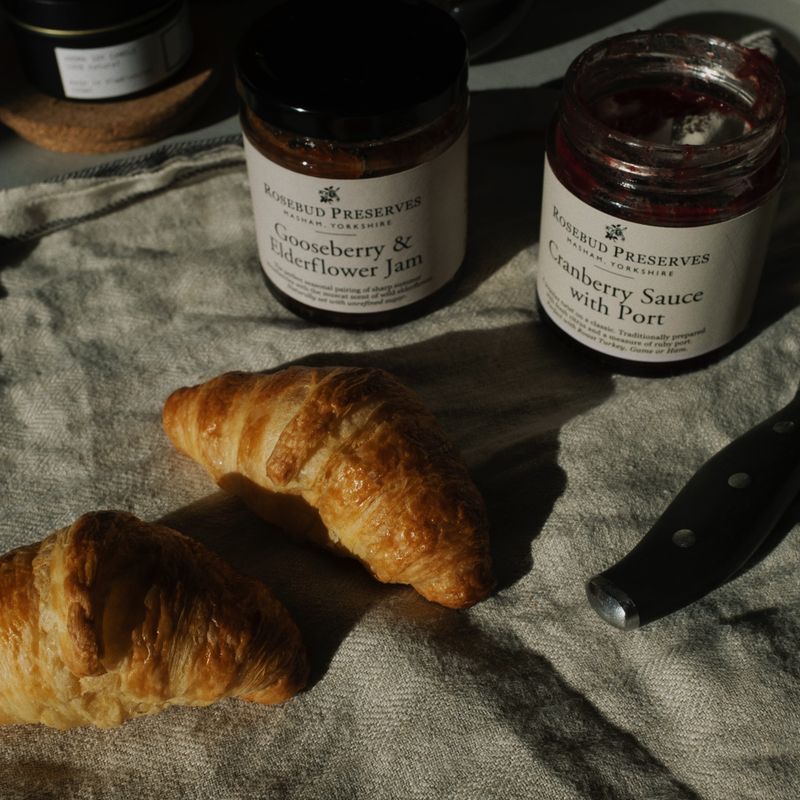
Vegan Coconut Oil Croissants with Jam Filling
Flaky, buttery croissants made entirely plant-based using refined coconut oil instead of traditional butter. The dough is laminated through multiple folds to create dozens of delicate layers that puff and crisp in the oven. Each croissant is filled with jam and baked until golden brown with a shatteringly crisp exterior and tender, airy interior.
- Prep
- 1 hr
- Cook
- 25 min
- Wait
- 6 hr 30 min
- Total
- 7 hr 55 min
- Makes
- 8 croissants
Steps
Before you start
- Chill all equipment and work surfaces in the freezer for 15 minutes before starting.
- Soften the coconut oil slightly so it's pliable but still cold and firm (around 65°F / 18°C).
- Have your jam ready at room temperature so it's spreadable.
- Read through the lamination steps completely—precision in temperature and folding is essential for flaky results.
Mix the dough
- In the bowl of a stand mixer fitted with the dough hook, combine the whole wheat flour, all-purpose flour, instant yeast, caster sugar, and fine sea salt.
- With the mixer running on low speed, slowly add the chilled plant milk until a shaggy dough forms, about 3–4 minutes.
- The dough should come together into a rough ball but should not be wet or sticky.
- Stop and scrape down the bowl as needed.
+ Show details− Hide details
Ready when: Dough is rough and shaggy, holds together loosely
Tip: Use chilled plant milk and cold equipment; this keeps the dough from warming up, which is critical for lamination.
Knead and rest
- Increase the mixer speed to medium and knead for 8 minutes until the dough becomes smooth and slightly elastic.
- It should pull away from the sides of the bowl but still feel cool to the touch.
- Transfer the dough to a lightly floured work surface, shape it into a ball, wrap it tightly in plastic wrap, and refrigerate for 30 minutes.
+ Show details− Hide details
Ready when: Dough is smooth, elastic, and pulls back slightly when stretched
Tip: Do not skip this rest—it allows gluten to relax and makes rolling the first fold much easier.
Create lamination envelope
- On a lightly floured work surface, roll out the chilled dough into a 9×12-inch (23×30 cm) rectangle about ¼ inch thick.
- Lay it landscape-wise in front of you.
- Distribute the chilled coconut oil pats evenly across the right two-thirds of the dough rectangle, leaving a ½-inch border around the edges.
- Fold the uncovered left third over the center, then fold the right third over the top—this is a letter fold.
- Seal the edges gently with your fingers.
+ Show details− Hide details
Ready when: Oil is fully enclosed in three-layered envelope, edges are sealed
Tip: Keep the dough and oil as cold as possible. If the dough becomes warm or soft (above 70°F / 21°C), wrap it and refrigerate for 10 minutes before continuing.
First book fold (turn)
- With the seam facing right, roll the envelope into a 9×12-inch (23×30 cm) rectangle again, rolling gently and evenly to distribute the oil.
- Fold the top third down and the bottom third up in another letter fold.
- Wrap the laminated dough tightly in plastic wrap and refrigerate for 20 minutes.
+ Show details− Hide details
Ready when: Dough is rolled into an even rectangle with sealed edges
Tip: This is your first of four book folds. Consistency in size and fold technique creates even lamination.
Second and third folds
- Repeat the rolling and folding process two more times: roll to 9×12 inches (23×30 cm), perform a letter fold, wrap, and refrigerate for 20 minutes between each fold.
- After the fourth fold (third roll-and-fold cycle), refrigerate for at least 1 hour before shaping.
+ Show details− Hide details
Ready when: After each fold, edges are sealed and dough is chilled; after final fold, dough shows very fine layers when cut
Tip: Mark your fold direction with a small notch on the edge of the dough so you know which way to fold each time. Always fold perpendicular to the previous fold.
Shape croissants
- On a lightly floured surface, roll the laminated dough into a 10×16-inch (25×40 cm) rectangle about ⅛ inch thick.
- Using a sharp knife, trim the edges to make them even.
- Cut the dough in half lengthwise to create two 5×16-inch (12×40 cm) strips.
- Cut each strip into four triangles by making diagonal cuts every 4 inches (10 cm).
- You will have 8 triangles with slightly uneven shapes—this is normal.
+ Show details− Hide details
Ready when: Eight roughly equal triangles are cut cleanly without crushing the layers
Tip: A dull knife will compress the layers and prevent the croissants from rising properly. Use a very sharp knife and cut with confident, single strokes.
Fill and roll croissants
- Working with one triangle at a time, place it with the long point facing away from you.
- Dab about 1 teaspoon (5 g) of jam in the center of the base (the wide edge).
- Working from the base toward the tip, roll the dough tightly around the jam, keeping the jam centered.
- As you finish rolling, tuck the pointed tip underneath so it holds.
- Place each rolled croissant seam-side down on a parchment-lined baking sheet, spacing them about 2 inches (5 cm) apart.
+ Show details− Hide details
Ready when: All eight croissants are rolled, seam-side down, with jam tucked inside
Tip: Don't overfill—jam can leak during baking and prevent proper rising. If jam escapes, wipe it off before proofing.
Final proof
- Cover the baking sheet loosely with plastic wrap or a clean kitchen towel.
- Let the croissants proof at room temperature (68–72°F / 20–22°C) for 2 to 2.5 hours.
- They should increase by about 50% in size and feel slightly puffy and soft when gently pressed.
- They will not double like bread dough; some of the rise happens in the oven.
+ Show details− Hide details
Ready when: Croissants are about 50% larger, feel airy and slightly springy when poked gently
Tip: Avoid warm spots in the kitchen—if the dough gets too warm, the coconut oil will start to melt and you'll lose the lamination. If your kitchen is very warm, proof in the refrigerator for 3–4 hours instead.
Apply egg wash and scoreOven 400°F / 205°C
- About 20 minutes before baking, preheat your oven to 400°F (204°C).
- Gently brush each proofed croissant with plant milk wash, working carefully so you don't deflate them.
- If using coarse sugar, sprinkle a light amount on top of each croissant.
- Let them sit for 5 minutes.
+ Show details− Hide details
Ready when: All croissants are evenly brushed with a light coating; no visible drips
Tip: Plant milk wash is lighter than egg but still provides shine. Don't brush too vigorously or you'll compress the dough.
Bake until goldenOven 400°F / 205°C
- Bake the croissants at 400°F (204°C) for 22–25 minutes.
- They should be deeply golden brown on all surfaces, and the interior should feel slightly firm when pressed (the jam will be hot).
- If the tops brown too quickly before the insides cook through, tent loosely with foil for the last 5 minutes.
+ Show details− Hide details
Ready when: Croissants are deep golden brown; interior feels firm but not hard when gently pressed; jam is hot
Tip: Oven temperature is critical—too low and the croissants will be doughy; too high and they'll brown before the inside cooks. An oven thermometer is helpful.
Cool and serve
- Transfer the baking sheet to a cooling rack or place it on a trivet.
- Let the croissants cool for at least 15 minutes before serving—the jam inside is extremely hot and will cool as the pastry sets.
- Enjoy warm or at room temperature.
+ Show details− Hide details
Ready when: Croissants are no longer steaming; they feel set but still warm
Tip: Biting into a freshly cooled croissant will give you the best contrast between crispy exterior and tender layers. Waiting is hard but worth it.
Good to know
Tips
- Lamination is all about temperature control. If your dough or oil ever feels warm (above 70°F / 21°C), stop, wrap, and chill for 10 minutes. Warm layers will merge into one and you'll lose the flaky structure.
- Use a ruler to ensure your folds are as even as possible. Consistent size and fold direction create even layers that puff uniformly in the oven.
- Don't skip the final proof—underproofed croissants will be dense and tough. Proofing may take longer in a cool kitchen, which is actually good; slower fermentation develops better flavor.
- Refined coconut oil is essential; virgin or extra-virgin coconut oil has a strong flavor that will overpower the pastry. Ensure it's completely solid but still slightly pliable before lamination.
Make ahead
You can prepare the laminated dough up to 2 days ahead: after the final fold, wrap it tightly and refrigerate. Defrost at room temperature for 20 minutes before shaping. Alternatively, shape the croissants and freeze them on the baking sheet for up to 3 weeks; bake directly from frozen, adding 5–10 minutes to the bake time.
Storage & reheating
Store cooled croissants in an airtight container at room temperature for up to 2 days. Reheat in a 350°F (175°C) oven for 8–10 minutes to restore crispness. Freeze baked croissants in an airtight container for up to 1 month; thaw at room temperature and reheat as above.
Substitutions
- whole wheat flour → Use 3 cups (375 g) of all-purpose flour instead. The whole wheat adds a subtle nutty flavor and texture, but all-purpose flour alone creates a lighter, more traditional croissant. If substituting, reduce the plant milk slightly (to ⅔ cup / 160 ml) as all-purpose flour absorbs less water.
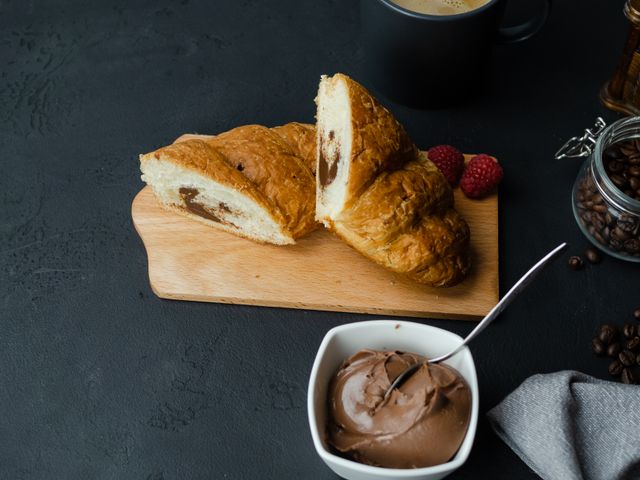
- fruit jam or preserves (any flavor) → Use almond butter, chocolate paste, or vegan pastry cream (about 1 teaspoon per croissant). Any spreadable filling at room temperature works. Avoid very wet fillings, which can leak and prevent proper rising.
- refined coconut oil, solid but pliable → Use cold vegan butter (such as Earth Balance or Miyoko's) instead. Vegan butter behaves almost identically to coconut oil in lamination and may create slightly flakier results, though coconut oil gives a more neutral flavor.
- unsweetened plant milk (oat or soy) → Use unsweetened almond or soy milk instead of oat or soy. Any unsweetened plant milk works; almond milk tends to make a slightly drier dough, so you may need to reduce the flour by 1–2 tablespoons (8–16 g).
More pastries
See all →




Find more like this
- Meal
- Breakfast
- Cuisine
- French
- Diet
- VegetarianHalal
- Method
- Oven
- Quick & Easy
- Make Ahead