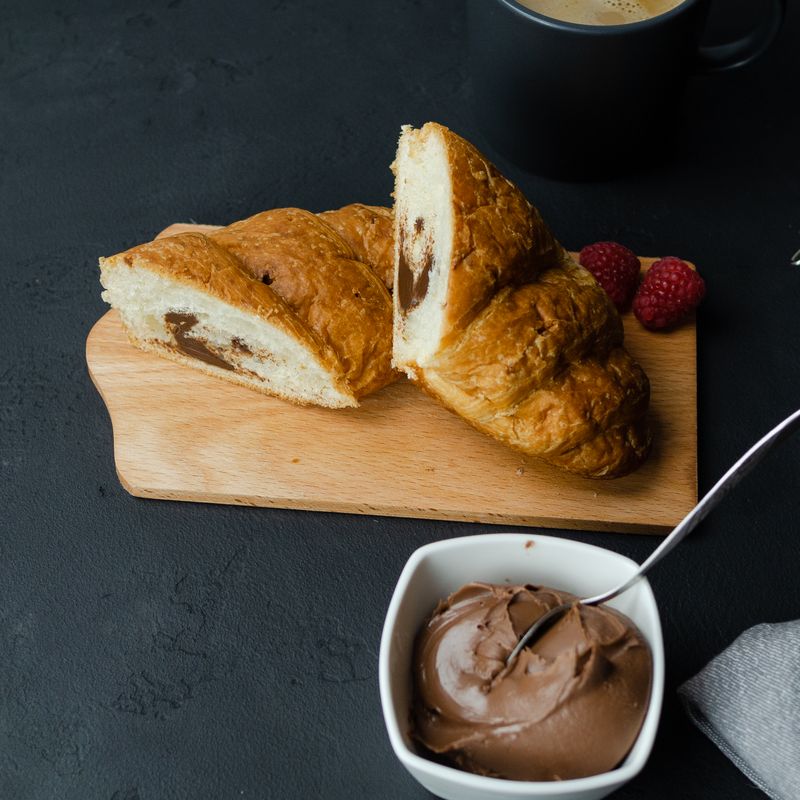
Vegan Dark Chocolate Avocado Croissants
Delicate, flaky laminated croissants filled with silky vegan avocado cream and dark chocolate, delivering French-style pastry indulgence in a fully plant-based form. The lamination creates dozens of butter-enriched layers, while the avocado filling provides richness and the chocolate adds subtle depth. A showstopper breakfast or dessert pastry.
- Prep
- 1 hr 20 min
- Cook
- 20 min
- Wait
- 5 hr
- Total
- 6 hr 40 min
- Makes
- 8 large croissants
Steps
Before you start
- Chill a marble slab or baking sheet for at least 30 minutes before starting lamination
- Remove vegan butter from the fridge 45 minutes before beginning the recipe so it's pliable but still firm
- Have all equipment, flour, and ingredients weighed and ready—lamination moves quickly
- Read through all lamination steps before starting; cold butter and dough are critical
Mix the dough
- In a stand mixer fitted with the dough hook, combine bread flour, salt, sugar, and instant yeast.
- Mix on low speed for 30 seconds to distribute the yeast evenly.
- Add the cold water and 3 tablespoons (45 g) vegan butter cubes.
- Mix on low speed for 3 minutes until a shaggy dough forms, then increase to medium speed and knead for 4 minutes.
- The dough should be cool, smooth, and just slightly sticky.
- Do not overmix; the dough should have some firmness to accept the laminated butter later.
- Transfer to a bowl and refrigerate for at least 30 minutes, covered.
+ Show details− Hide details
Ready when: Dough is smooth, cool, and slightly tacky
Tip: Keeping the dough cool is crucial; if it warms, the lamination will fail. Work in a cool kitchen or place your bowl over an ice bath.
Prepare the butter sheet
- Remove the 1.25 cups (300 g) cold vegan butter from the refrigerator.
- Place it between two sheets of parchment paper and, using a rolling pin or meat mallet, pound it into a thin, even ½-inch (1.25 cm) thick square approximately 8 inches × 8 inches (20 × 20 cm).
- The butter must be pliable enough to spread without cracking but still very cold and firm.
- Place it on the chilled marble slab or baking sheet and refrigerate for 15 minutes.
+ Show details− Hide details
Ready when: Butter is uniform, ½-inch thick, and cold to the touch
Tip: Vegan butter is softer than dairy butter; work quickly and keep it cold. If it becomes too soft, refrigerate for 5 minutes.
Encase the butter (first lock-in)
- Remove the chilled dough from the bowl and place it on a cool, lightly floured surface.
- Roll it into a 10-inch × 10-inch (25 × 25 cm) square about ¼ inch (6 mm) thick.
- Remove the butter sheet from the refrigerator and carefully peel away one sheet of parchment.
- Invert it onto the center of the dough so the butter is now on top, then peel away the second sheet of parchment.
- The dough should extend slightly beyond the butter on all sides.
- Fold the four corners of dough over the butter, overlapping them slightly in the center to fully encase the butter.
- Seal the seams gently by pressing with your fingers.
- Wrap in plastic wrap and refrigerate for 15 minutes.
+ Show details− Hide details
Ready when: Dough corners meet in the center and cover the butter completely
Tip: Keep your work surface cool and lightly dust with flour to prevent sticking. Work calmly and deliberately; rushing leads to tears in the dough.
First roll and fold (turn one)
- Remove the dough package from the refrigerator and place it on a cool, floured surface with a seam facing you.
- Roll it into a 16-inch × 8-inch (40 × 20 cm) rectangle about ¼ inch (6 mm) thick, working gently and evenly.
- Brush away excess flour.
- Fold the dough into thirds: fold the right third toward the center, then fold the left third over it, like folding a business letter.
- Wrap in plastic and refrigerate for 20 minutes.
+ Show details− Hide details
Ready when: Rectangle is even and folds align neatly
Tip: If the dough resists rolling, let it relax for 5 minutes. Vegan dough can be slightly more delicate; avoid aggressive pressure.
Second roll and fold (turn two)
- Remove from the refrigerator and orient the dough so a fold is on your left.
- Roll again into a 16-inch × 8-inch (40 × 20 cm) rectangle.
- Fold into thirds again.
- Wrap and refrigerate for 20 minutes.
+ Show details− Hide details
Ready when: Second folded rectangle is smooth and even
Tip: Rotate the dough 90 degrees from the previous turn so each roll is perpendicular to the last. This creates more even lamination.
Third and fourth rolls and folds
- Repeat the roll-and-fold process two more times, refrigerating for 20 minutes between each turn.
- These final two turns (three and four) complete the lamination.
- After the fourth fold, wrap the dough and refrigerate for at least 2 hours, preferably overnight, to fully develop the layers and chill thoroughly.
+ Show details− Hide details
Ready when: Dough feels firm, cold, and has a subtle sheen when folded
Tip: An overnight rest is ideal for flavor and easier shaping. You can refrigerate the folded dough for up to 24 hours.
Prepare the filling
- While the dough chills, prepare the avocado filling.
- In a small bowl, mash the ripe avocado flesh with a fork until mostly smooth but still slightly textured.
- Stir in the lemon juice, maple syrup, vanilla extract, and a small pinch of sea salt.
- Mix gently until just combined; avoid overmixing, which can make the avocado bitter and oxidized.
- Fold in the finely chopped dark chocolate.
- Cover the filling with plastic wrap pressed directly onto the surface to prevent browning.
- Refrigerate until ready to use.
+ Show details− Hide details
Ready when: Filling is chunky-smooth and the chocolate is evenly distributed
Tip: Prepare this filling no more than 2 hours before shaping the croissants to prevent the avocado from oxidizing and browning.
Shape the croissants
- Remove the laminated dough from the refrigerator.
- On a cool, lightly floured surface, roll it into a large rectangle approximately 24 inches × 10 inches (60 × 25 cm).
- Using a ruler and sharp knife or pastry wheel, cut the dough into 8 equal triangles: first cut the rectangle in half lengthwise (two 12-inch × 10-inch / 30 × 25 cm strips), then cut each strip diagonally into 4 equal triangles.
- You should have 8 isosceles triangles with a 5-inch (12.5 cm) base and 12-inch (30 cm) sides.
- Place a small spoonful (about 1 tablespoon / 15 ml) of avocado-chocolate filling on the base of each triangle, leaving a ½-inch (1.25 cm) margin.
- Roll each triangle tightly from the base toward the point, tucking the filling slightly as you roll, and shape into a crescent.
- Place seam-side down on a parchment-lined baking sheet, spacing them 2.5 inches (6 cm) apart.
+ Show details− Hide details
Ready when: Eight uniform croissants are shaped and filled, arranged on baking sheets
Tip: Don't overfill the croissants; excess filling will leak out during baking. If the dough becomes warm and soft while shaping, refrigerate for 10 minutes.
Final proof
- Cover the shaped croissants loosely with plastic wrap or a clean kitchen towel.
- Let them proof at warm room temperature (72–75°F / 22–24°C) for 1.5 to 2 hours.
- They should increase in size by about 50%, become slightly puffy, and feel delicate when touched.
- You should be able to see the laminated layers slightly puffing at the edges.
- They are ready when a gentle poke springs back slowly.
+ Show details− Hide details
Ready when: Croissants are 50% larger, puffy, and a gentle poke springs back slowly
Tip: Avoid proofing in direct sunlight or near heat sources, which will soften the butter and deflate the lamination. If your kitchen is cool, place the baking sheet in a turned-off oven with the light on.
Apply egg wash and scoreOven 400°F / 205°C
- About 30 minutes before baking, preheat your oven to 400°F (200°C).
- In a small bowl, whisk together the aquafaba and water to make a vegan egg wash.
- Once the croissants have finished proofing, gently brush each one with the aquafaba wash using a soft pastry brush.
- Apply two thin coats, allowing the first coat to dry slightly before the second, for a glossy finish.
- Do not apply wash to the side edges where laminated layers are visible, as this prevents proper puffing.
+ Show details− Hide details
Ready when: Croissants are evenly coated with a glossy egg wash
Tip: A light, even egg wash is key. Heavy application can seal the dough and prevent rising. Work quickly and gently so the egg wash doesn't deflate the proofed dough.
Bake the croissantsOven 400°F / 205°C
- Place the baking sheet on the middle rack of the preheated oven.
- Bake at 400°F (200°C) for 18–22 minutes, until the croissants are deep golden brown and crispy on the outside.
- Rotate the baking sheet halfway through baking (at about 11 minutes) if your oven has a hot spot.
- The croissants are done when they sound hollow when tapped on the bottom and the internal temperature at the thickest part reaches 190°F (88°C).
+ Show details− Hide details
Ready when: Croissants are deep golden brown, sound hollow, and reach 190°F (88°C) internally
Tip: If the croissants brown too quickly on top, tent them loosely with aluminum foil for the last 5 minutes. They should be golden, not dark brown.
Cool and serve
- Remove the croissants from the oven and transfer them to a wire rack.
- Let them cool for 5–10 minutes before serving.
- The filling will set slightly as the croissants cool.
- Serve warm or at room temperature.
- These are best eaten within a few hours of baking, while the layers are still crispy and the filling is soft and luxurious.
+ Show details− Hide details
Ready when: Croissants are cool enough to handle but still warm to the touch
Tip: Avoid stacking warm croissants, which traps steam and softens the exterior. Serve immediately for the best texture.
Good to know
Tips
- Temperature is everything: keep your work surface, tools, butter, and dough cold throughout the lamination process. A marble slab and chilled tools make a real difference.
- Vegan butter varies in water and fat content by brand. Test your butter's lamination properties beforehand: it should be spreadable when cold but hold its shape. If your croissants rise unevenly or leak butter, the butter was either too soft or too hard.
- The avocado filling oxidizes quickly. Coat it thoroughly in lemon juice, add it to the croissants shortly before baking, and keep it covered until you're ready to shape.
- Do not skip the overnight rest after lamination. It allows the gluten to relax, the dough to flavor-develop, and the layers to set firmly, resulting in superior height and flake.
Make ahead
Laminate the dough completely through step 6 and refrigerate or freeze for up to 24 hours before shaping. You can freeze the folded dough for up to 2 weeks; thaw overnight in the refrigerator before continuing. Shaped, unbaked croissants can be frozen for up to 5 days; bake directly from the freezer without thawing, adding 2–3 minutes to the baking time.
Storage & reheating
Store cooled croissants in an airtight container at room temperature for 1 day, in the refrigerator for up to 3 days, or freeze for up to 2 weeks. Reheat by wrapping in foil and warming in a 325°F (165°C) oven for 5–7 minutes to revive the crispy exterior.
Substitutions
- dark chocolate (70% cacao), finely chopped → melted dark chocolate (drizzled over the filled pastry just before baking) or vegan chocolate chips. For a richer chocolate element, drizzle 1 tablespoon (10 g) melted dark chocolate over each croissant immediately after removing from the oven. Alternatively, use vegan chocolate chips instead of chopped chocolate in the filling.
- ripe avocado, flesh only → coconut cream whipped with the same flavorings, or cashew cream. If avocado is unavailable or you prefer a different flavor, whip chilled full-fat coconut cream (the thick part of a can) with the lemon juice, maple syrup, vanilla, and salt, or use soaked, blended cashews. Omit the chocolate or keep it for richness.
- aquafaba (liquid from canned chickpeas) → non-dairy milk mixed with a small amount of cornstarch or arrowroot (1 tablespoon / 10 g per 3 tablespoon / 45 ml milk). Aquafaba is the easiest vegan egg wash, but non-dairy milk thickened with starch will also create a glossy finish. Apply lightly to avoid excess moisture.
- vegan butter, cold → refined coconut oil (frozen solid) or a specialty vegan lamination fat. Coconut oil is trickier to work with because it melts faster; keep it extremely cold and work quickly. Some suppliers sell vegan lamination butters specifically designed for croissants, which may yield more consistent results.