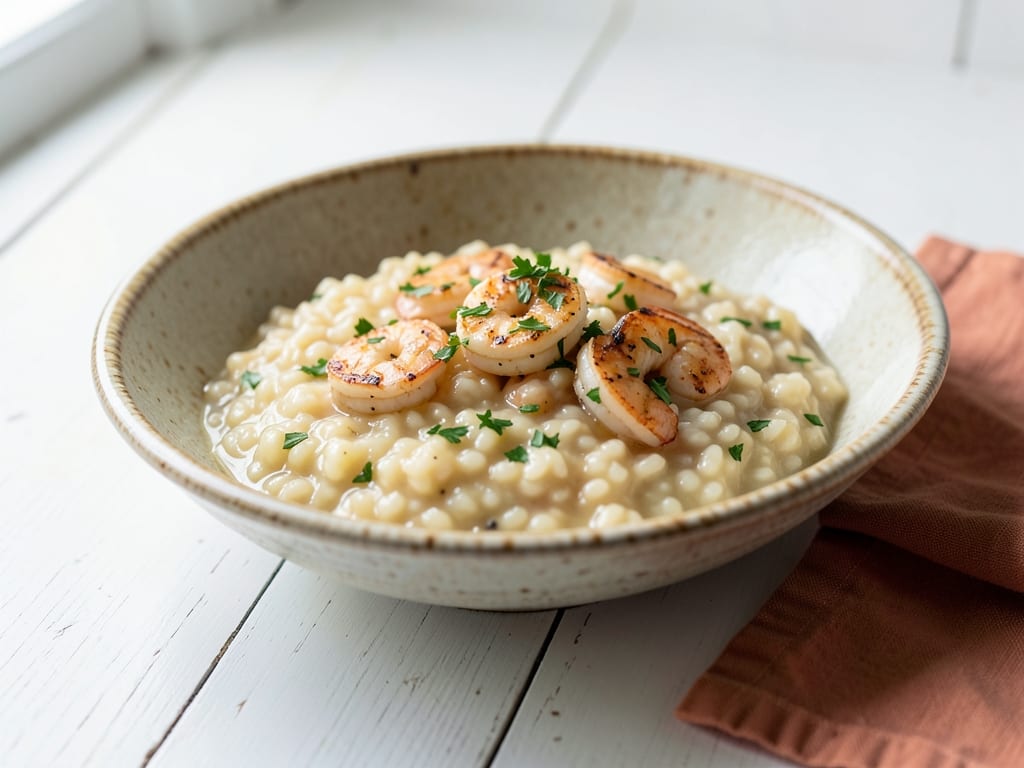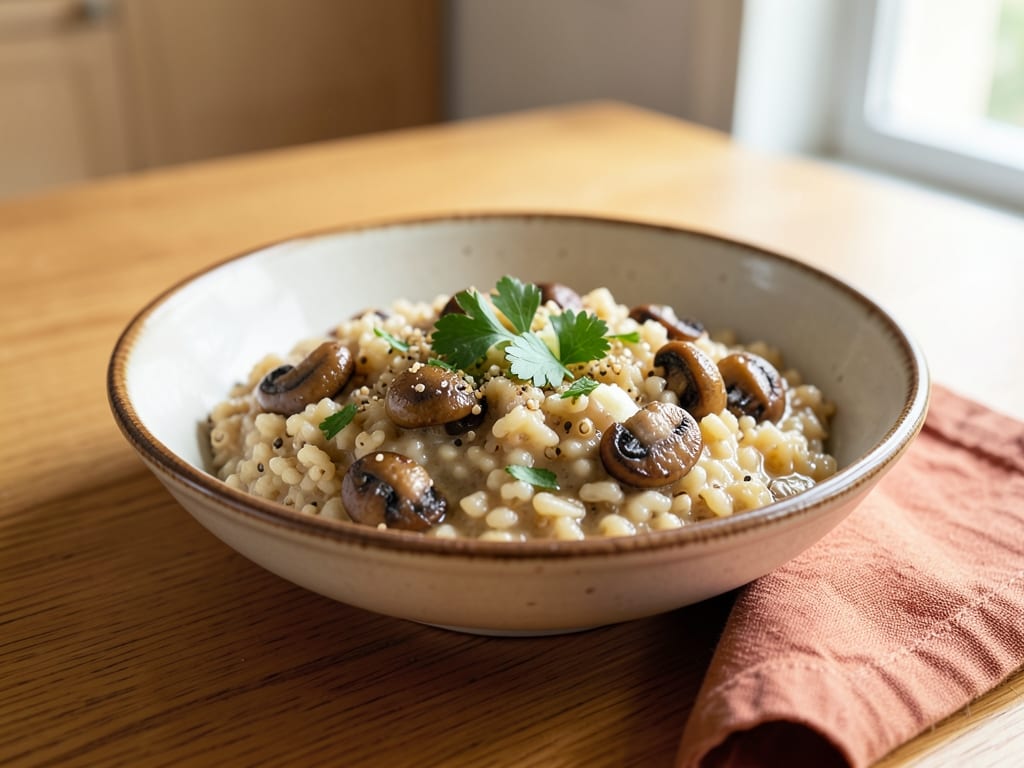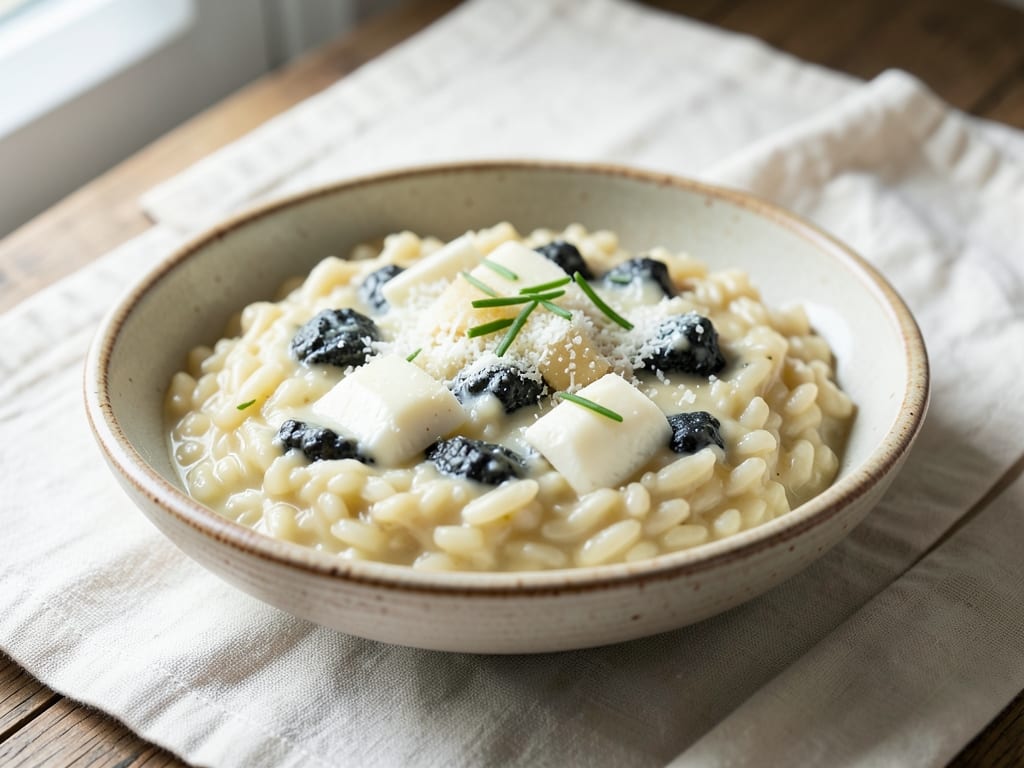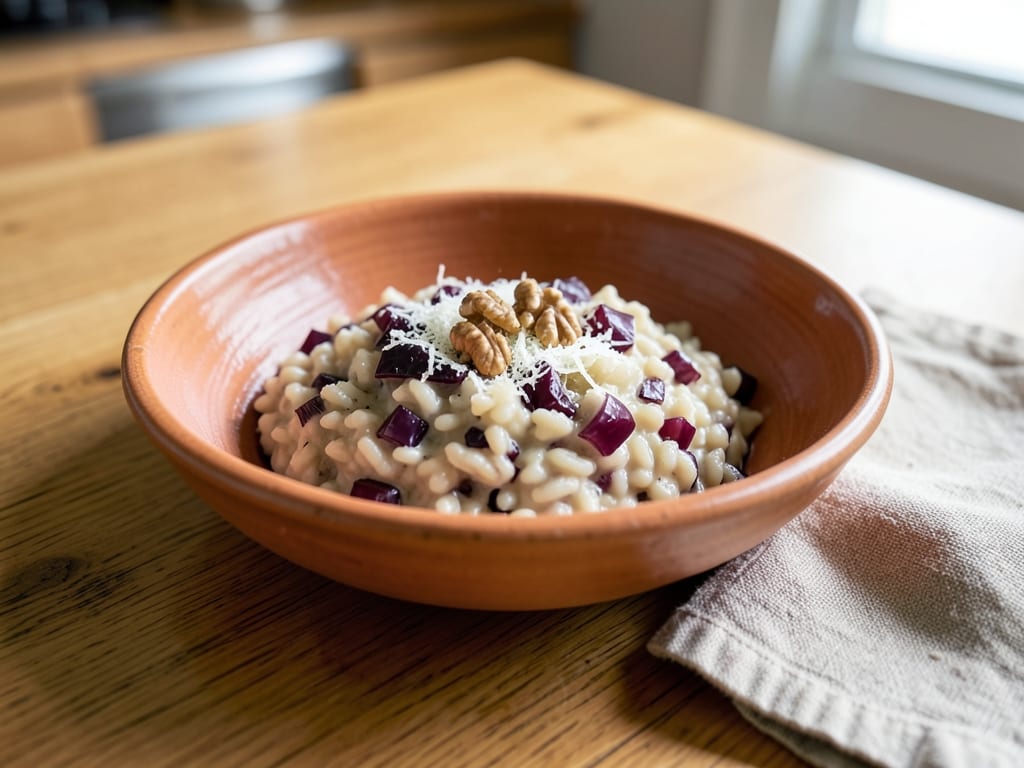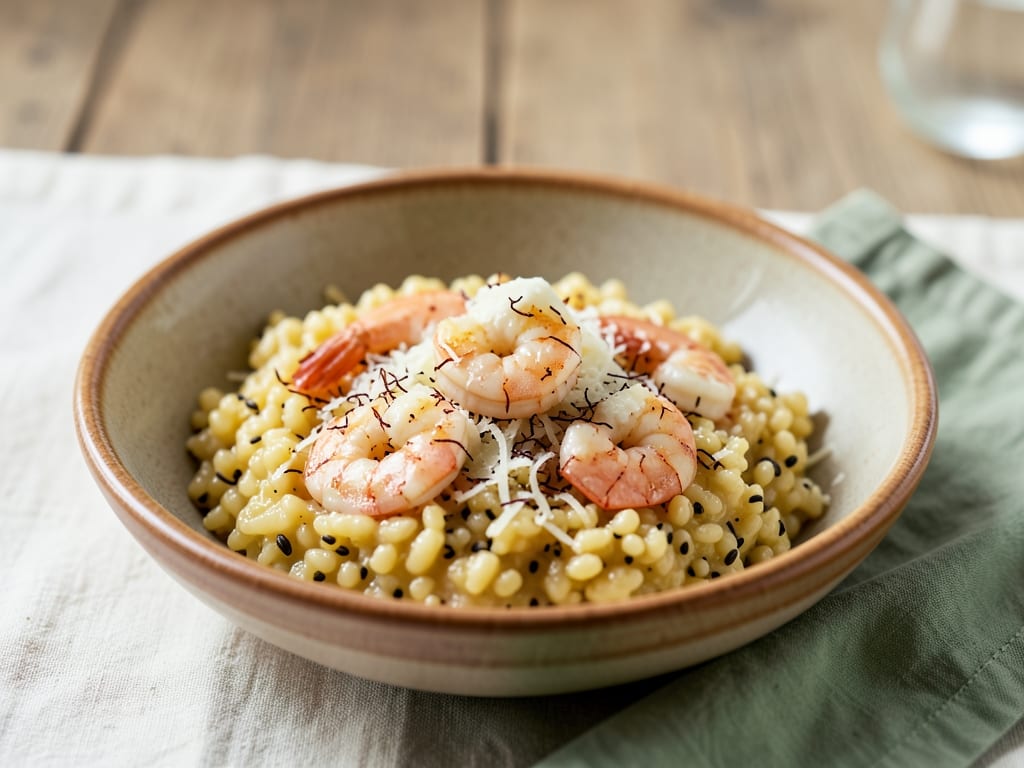
Valentine's Day Shrimp and Saffron Quinoa Risotto
A luxurious, romantic twist on classic risotto—velvety saffron-infused quinoa topped with tender pink shrimp, finished with cold butter and Parmesan for ultimate creaminess. Made for two, this elegant main course is ready in less than an hour.
- Prep
- 10 min
- Cook
- 35 min
- Total
- 45 min
- Makes
- 2 generous servings (about 1.5 cups each)
Steps
Before you start
- Warm the vegetable or seafood broth to a gentle simmer in a separate pot before you start cooking—you'll need it warm throughout
- Peel and devein the shrimp and pat completely dry with paper towels—dry shrimp will cook better and develop proper color
- Prepare mise en place: mince the shallots, garlic, and lemon zest; chop the parsley; and measure all other ingredients
- Read through the full recipe once, especially the frequent-stirring section for the simmering stage
- Have two warm bowls ready to serve into
Toast the quinoa
- Heat a large, heavy-bottomed saucepan (12 inches / 30 cm diameter) over medium heat.
- Add 1 tablespoon of the olive oil, then add the quinoa.
- Stir constantly for 2–3 minutes, until the seeds are fragrant, light golden, and some pop audibly.
- This toasting deepens the quinoa's flavor and helps prevent mushiness.
+ Show details− Hide details
Ready when: Quinoa is fragrant, light golden, and some seeds are popping audibly
Tip: Don't skip toasting—it prevents the risotto from becoming gummy and adds nutty depth
Bloom the saffron threads
- While the quinoa toasts, bring the broth to a gentle simmer in another pot.
- Place the saffron threads in a small bowl and add 1/4 cup of the warm broth.
- Let sit undisturbed for 3–4 minutes until the broth turns golden yellow and smells distinctly floral.
- This 'blooming' releases the saffron's color, fragrance, and deep flavor.
+ Show details− Hide details
Ready when: Broth has turned golden yellow and smells distinctly floral
Sauté shallots and garlic
- Add the remaining 1 tablespoon of olive oil to the saucepan with the toasted quinoa.
- Add the minced shallots and stir occasionally for 1–2 minutes until softened and translucent.
- Add the minced garlic and stir constantly for 30 seconds until fragrant and light golden.
+ Show details− Hide details
Ready when: Shallots are translucent and soft; garlic is light golden and fragrant
Tip: Keep heat at medium to prevent the garlic from burning, which would make it bitter
Deglaze with white wine
- Pour in the white wine and stir frequently, scraping the bottom and sides of the pan with a wooden spoon to release any browned bits (fond).
- Continue cooking for 2–3 minutes, stirring constantly, until the wine is mostly absorbed and reduced by about half.
- The pan should smell fragrant with less of the sharp alcohol smell.
+ Show details− Hide details
Ready when: Wine is reduced by about half; fond is released from the pan; sharp alcohol smell has mellowed
Tip: Scraping up the fond adds deep, caramelized flavor, so don't skip this step
Add saffron broth and simmer
- Pour the bloomed saffron and its golden liquid into the pan, stirring well to combine evenly.
- Then add 2 cups of the remaining warm broth (you should have about 3.75 cups left).
- Stir well, then bring to a gentle simmer over medium heat.
- Once simmering, reduce heat to medium-low.
- The mixture should bubble gently and steadily, not rapidly.
- Adjust heat as needed to maintain a gentle simmer.
+ Show details− Hide details
Ready when: Mixture is at a gentle, steady simmer; no vigorous boiling
Simmer risotto until nearly tender
- Stir the risotto frequently—every 1 to 2 minutes—for about 8 minutes.
- The frequent stirring prevents sticking and helps release the quinoa's starches, which create a creamy sauce.
- After about 8 minutes, when most of the liquid is absorbed, add another 1.5 cups of warm broth and continue stirring frequently every 1–2 minutes.
- After another 5–7 minutes (total simmering time of about 13–15 minutes), the quinoa should be tender and the mixture creamy, with a small amount of liquid still visible.
- Add the final 0.5 cup of broth and stir gently.
+ Show details− Hide details
Ready when: Quinoa is tender; risotto is creamy with visible liquid; individual grains are distinct
Tip: Resist the urge to stop stirring—frequent stirring is essential for creating the creamy texture
Add shrimp and cook through
- When the quinoa is tender and the risotto is creamy (around 15–18 minutes total simmering), carefully add the shrimp directly to the pan, spreading them in a single layer.
- Stir gently to distribute them evenly.
- Simmer for 3–4 minutes, stirring occasionally, until the shrimp turn bright pink and opaque throughout.
- To test for doneness, cut the thickest shrimp in half; the inside should be fully opaque white with no translucent gray.
- Internal temperature should reach 145°F / 63°C.
+ Show details− Hide details
Ready when: Shrimp are bright pink and opaque throughout; internal temperature reaches 145°F / 63°C
Tip: Don't overcook the shrimp or they'll become rubbery; 3–4 minutes is usually perfect for large shrimp
Finish with butter and Parmesan
- Remove the pan from heat immediately.
- Add the cold butter cubes and finely grated Parmesan cheese all at once.
- Stir vigorously and constantly for about 1 minute until the butter is fully melted and the cheese is completely incorporated.
- The risotto will become noticeably creamier and glossier.
- Stir in the lemon zest and 2 tablespoons of fresh lemon juice (taste and adjust to your preference).
- Finally, fold in the chopped parsley gently.
+ Show details− Hide details
Ready when: Butter is melted; cheese is fully incorporated; risotto is creamy and glossy
Tip: Keep the pan off heat when adding butter and cheese—residual heat from the pan is enough. Adding them off-heat prevents the emulsion from breaking
Season and serve immediately
- Taste the risotto and adjust salt and pepper as needed.
- Remember that the broth and Parmesan cheese already provide saltiness, so taste before adding much salt.
- Add a pinch of black pepper and stir gently.
- Divide the risotto between two warm bowls, distributing the shrimp evenly.
- Serve immediately while hot and creamy.
- If desired, drizzle with a little extra olive oil, sprinkle with extra Parmesan, and garnish with a lemon wedge and additional parsley.
+ Show details− Hide details
Tip: Risotto waits for no one—serve immediately or it will begin to thicken and congeal as it cools, losing its luxurious, creamy texture
Good to know
Tips
- Toast the quinoa before cooking it into a risotto—this simple step prevents mushiness and adds a lovely, subtle nutty flavor
- The frequent stirring of the risotto isn't just for texture; it helps release the starches that create that signature creamy sauce, even without cream added
- Prepare mise en place (measure and prep all ingredients) before you start cooking, especially important for the risotto stage where you're stirring constantly
- Saffron is expensive but a little goes a long way; store threads in an airtight container away from light and heat, and they'll last for years
Make ahead
You can prep all components ahead of time: shrimp can be peeled and deveined up to 1 day ahead and stored covered in the refrigerator; shallots, garlic, Parmesan, lemon zest, and parsley can be prepped and stored in separate containers for up to 8 hours. The risotto itself is best made fresh and served immediately for optimal creamy texture.
Storage & reheating
This dish is best enjoyed immediately. If you have leftovers, cover and refrigerate for up to 2 days. Reheat gently on the stovetop over medium-low heat with a splash of warm broth, stirring frequently, until warmed through. The texture will be thicker than freshly made; thin with additional warm broth as needed. Do not freeze, as the creamy texture will not be preserved.
Substitutions
- large shrimp, 16–20 count per pound → large sea scallops (about 10 oz / 280g) or boneless, skinless white fish such as halibut or cod (about 10 oz / 280g). Scallops cook similarly to shrimp and can be added at the same time, cooking for 3–4 minutes until opaque. White fish should be cut into 1-inch cubes and added in the final 2–3 minutes of cooking to prevent overcooking.
- Parmesan cheese → Grana Padano or Asiago cheese (same amount). Both provide similar nutty, salty notes. Asiago may be slightly more pungent.
- dry white wine → dry vermouth (1/2 cup / 120 ml) or additional vegetable broth (1/2 cup / 120 ml). Vermouth adds herbal notes; extra broth makes the dish alcohol-free but slightly milder in flavor.
- quinoa → arborio rice or carnaroli rice (3/4 cup / 150g). Traditional risotto rice will create a creamier, more authentic result. The cooking time may be slightly longer (18–22 minutes). Stir frequently as you would with quinoa.