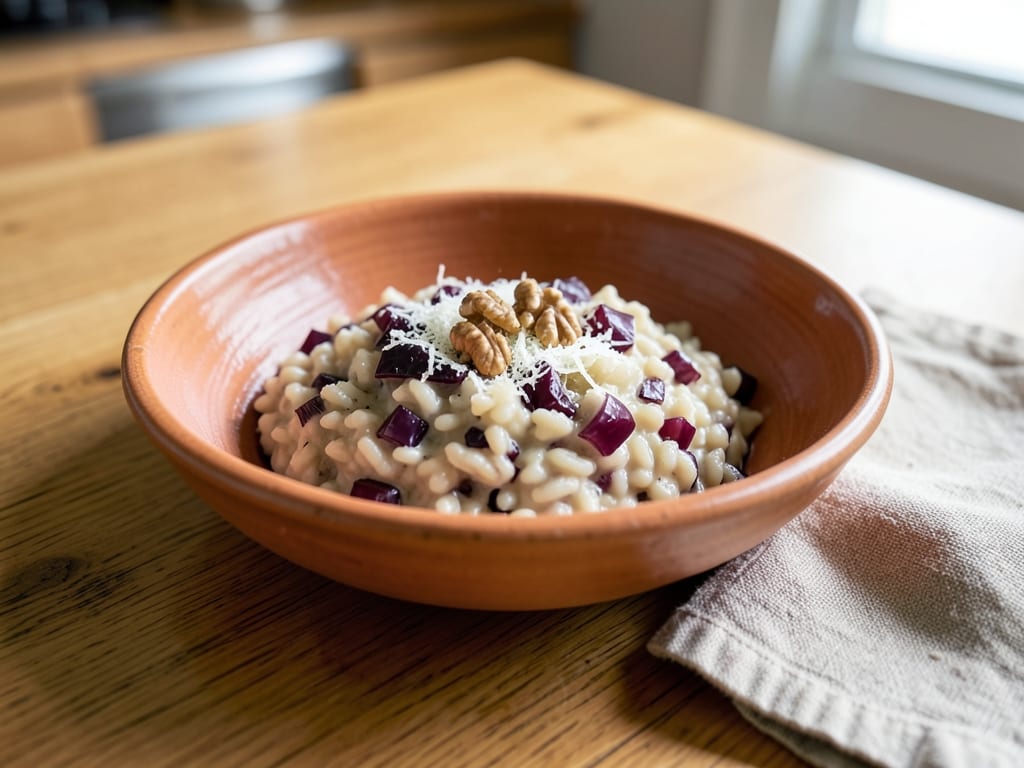
Radicchio and Red Wine Risotto
Creamy Italian risotto simmered in dry red wine, with radicchio cooked down until sweet and stirred in fresh at the end for a gentle bitter bite. Finished with butter and Parmesan, it's a deep burgundy, vegetarian main course.
- Prep
- 15 min
- Cook
- 40 min
- Wait
- 3 min
- Total
- 58 min
- Makes
- 4 main-course servings (about 5 cups / 1.2 liters total)
Steps
Before you start
- Risotto needs near-constant attention for about 20 minutes once the stock goes in, so chop everything and measure all ingredients before you turn on the heat.
- Use a dry red wine you would happily drink (such as Merlot, Chianti or Pinot Noir). Avoid anything sweet or labeled 'cooking wine'.
- Use low-sodium or unsalted vegetable stock so you can control the seasoning. The Parmesan adds salt at the end.
- Do not rinse the rice. The surface starch is what makes the risotto creamy.
Heat the stock
- Pour the vegetable stock into a 3-quart (2.8 liter) saucepan and bring it to a bare simmer over medium-low heat.
- Turn the heat to low and keep it hot, with a ladle or measuring cup nearby, for the whole recipe.
+ Show details− Hide details
Ready when: Stock is steaming with only occasional small bubbles.
Tip: Cold stock added to the rice drops the pan temperature and makes the cooking uneven, so keep it hot.
Soften the onion
- Set a 12-inch (30 cm) deep skillet over medium heat.
- Add the olive oil and 1 tablespoon butter.
- When the butter foams, add the diced onion and ½ teaspoon salt.
- Cook, stirring often, for 5 to 6 minutes.
+ Show details− Hide details
Ready when: Onion is soft and translucent with no browned edges.
Tip: If the onion starts to brown, lower the heat. Browned onion will turn the risotto bitter.
Wilt half the radicchio
- Stir in the garlic and cook for 30 seconds until fragrant.
- Add half of the sliced radicchio and cook, stirring, for 3 minutes.
+ Show details− Hide details
Ready when: Radicchio has collapsed to a deep reddish-brown, with no stiff white ribs left. Garlic smells sweet, not sharp.
Tip: Keep the second half of the radicchio in the fridge or covered so it stays crisp for the finish.
Toast the rice
- Add the arborio rice and stir constantly for 1½ to 2 minutes so every grain is coated in oil.
+ Show details− Hide details
Ready when: Grain edges look translucent while each center is still opaque white, and the rice makes a faint clicking sound against the pan.
Cook in the wine
- Pour in the red wine.
- It will bubble and turn the rice purple.
- Stir steadily until the pan looks almost dry when you drag a spoon across the bottom, 3 to 4 minutes.
+ Show details− Hide details
Ready when: The spoon leaves a clear trail along the bottom of the pan, and the sharp smell of alcohol has faded.
Add stock gradually
- Add 1 cup (240 ml) hot stock and stir until it is mostly absorbed.
- Continue adding ½ cup (120 ml) at a time, stirring often and waiting until the pan is nearly dry before each addition.
- Keep the heat so the risotto bubbles gently, not violently.
- This takes 18 to 20 minutes.
- Start tasting a grain at 16 minutes.
+ Show details− Hide details
Ready when: Rice is tender with a slight firmness (al dente) at the very center, and the risotto is loose and creamy. It should slowly spread when you tilt the pan.
Tip: You may not need all the stock. If you run out before the rice is tender, add hot water ¼ cup (60 ml) at a time.
Finish off the heat
- Remove the pan from the heat.
- Stir in the remaining radicchio, the cold butter cubes, the Parmesan, and the balsamic vinegar if using.
- Beat vigorously with a wooden spoon for about 1 minute.
+ Show details− Hide details
Ready when: Butter and cheese have melted into a glossy, creamy sauce, and the fresh radicchio has just started to wilt.
Tip: Add a splash of hot stock if the risotto looks stiff. It should be looser than you think, because it thickens as it sits.
Rest and season
- Cover the pan and let it stand for 2 minutes.
- Taste, then add salt and black pepper as needed.
+ Show details− Hide details
Ready when: Risotto is creamy and flows slowly, with seasoning that tastes balanced between bitter, sweet and salty.
Tip: Season at the end. The Parmesan and stock add salt, so early over-salting is easy.
Serve immediately
- Spoon the risotto into warm shallow bowls.
- Top with extra Parmesan, black pepper and toasted walnuts if using.
- Serve right away.
+ Show details− Hide details
Tip: Warm the bowls under hot tap water and dry them first, since risotto cools and stiffens quickly.
Good to know
Tips
- Stir often but not constantly. Regular stirring releases starch for creaminess, while stirring nonstop can make the risotto gluey.
- Dividing the radicchio gives two flavors: the first half cooks down until sweet, and the second half adds fresh color and a bitter edge.
- Cold butter added off the heat (mantecatura) gives the risotto a glossy, silky finish, so don't add it while the pan is still bubbling.
- If the radicchio tastes too bitter, add the balsamic vinegar and a little more Parmesan, which balances bitterness.
Make ahead
"You can slice the radicchio, dice the onion and mince the garlic up to 1 day ahead and refrigerate in separate covered containers. The stock can be heated just before cooking. Risotto itself is best made and served right away."
Storage & reheating
"Room temperature: no more than 2 hours. Fridge: cool quickly and store in an airtight container for up to 3 days. Freezer: not recommended for the best texture, but you can freeze up to 1 month and use it for arancini-style cakes. Reheat in a skillet over medium-low heat with a splash of stock or water, stirring until hot and creamy again, 4 to 5 minutes."
Substitutions
- radicchio (Chioggia, the round type) → Treviso radicchio (the elongated type) or 8 oz (225 g) radicchio plus 2 oz (60 g) baby arugula stirred in at the end. Treviso is slightly milder and sweeter, so you may want the balsamic vinegar.
- arborio rice → Carnaroli or vialone nano rice. Use the same weight. Carnaroli stays slightly firmer and is more forgiving.
- Parmigiano-Reggiano → Grana Padano or aged pecorino. Pecorino is saltier, so reduce the added salt. For a vegan version, use nutritional yeast and olive oil in place of the cheese and butter.
- dry red wine → 1 cup (240 ml) additional hot stock plus 1 tablespoon balsamic vinegar. Lacks wine depth but adds acidity. Add the vinegar at the end of cooking.