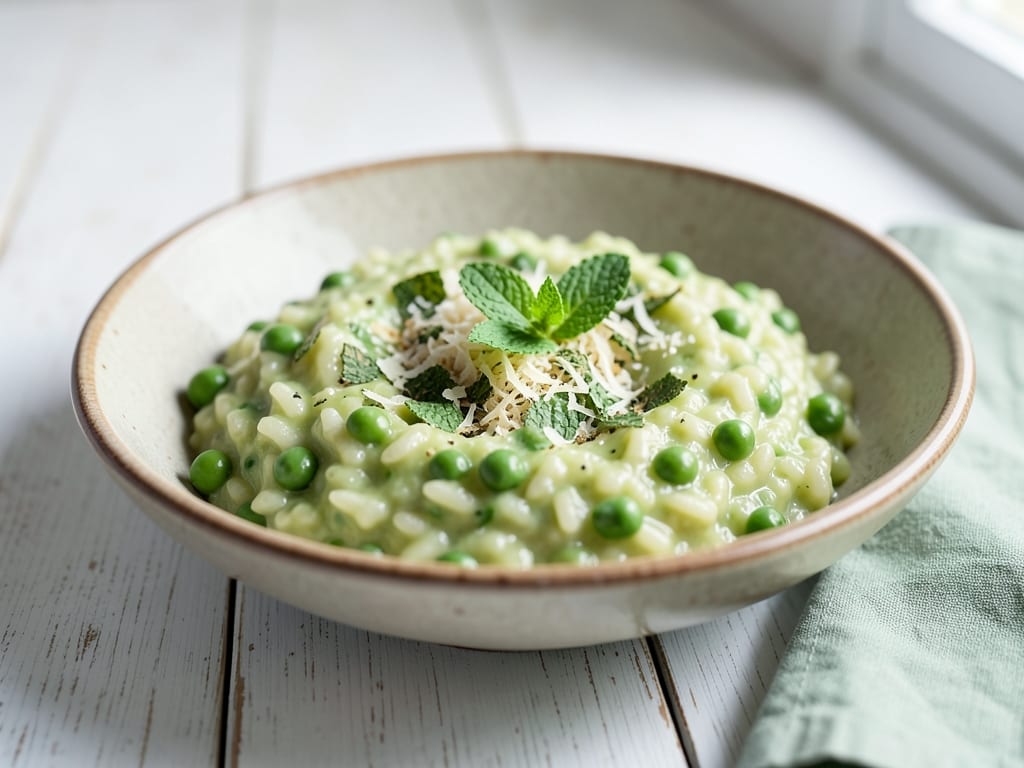
Pea and Mint Risotto with Lemon Zest
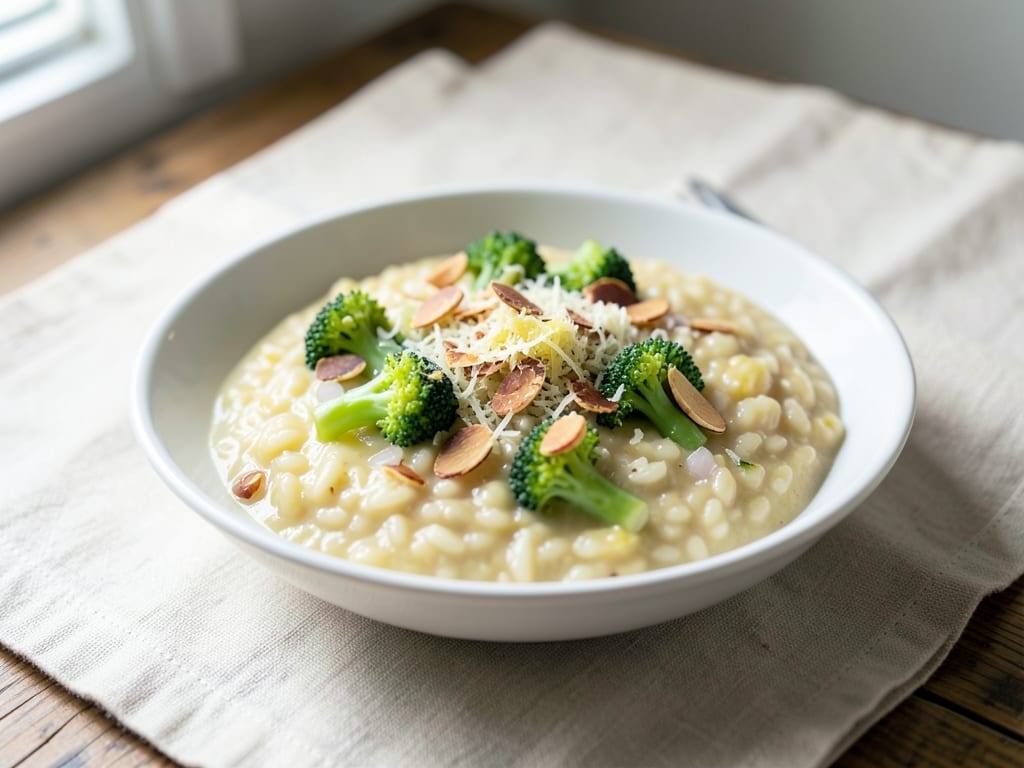
A creamy, spring-green Italian risotto where half the peas are blended with fresh mint into a bright purée and the rest stay whole for sweet pops of texture. Finished with butter, Parmesan and plenty of lemon zest.
- Prep
- 12 min
- Cook
- 32 min
- Wait
- 2 min
- Total
- 46 min
- Makes
- 4 generous main-course servings (about 1½ cups / 300 g each)
Steps
Before you start
- Risotto needs near-constant stirring for about 20 minutes, so measure and prep everything before you turn on the heat.
- Thaw the frozen peas by running them in a colander under warm tap water for 1 minute, then drain well.
- Finely grate the Parmesan and zest the lemon before cooking; you'll need both quickly at the end.
- Keep the broth hot on a back burner the whole time. Cold broth slows cooking and makes the rice gummy.
- Use a wide, heavy-bottomed pan so the rice cooks in a shallow, even layer.
Heat the broth
- Pour all 5 cups (1200 ml) vegetable broth into a medium saucepan and bring to a gentle simmer over medium-low heat.
- Keep it hot, with just a few small bubbles, for the entire recipe.
+ Show details− Hide details
Ready when: Small bubbles break at the edges and steam rises, but it is not at a rolling boil.
Tip: Cover the pan if the broth reduces too quickly; too much evaporation makes it saltier.
Blend the pea purée
- Ladle ½ cup (120 ml) of the hot broth into a blender.
- Add 1 cup (140 g) of the thawed peas and half of the mint leaves (about 2 tbsp, 5 g).
- Blend 30–45 seconds until completely smooth and bright green.
- Set aside.
- Finely chop the remaining mint and set aside for the end.
+ Show details− Hide details
Ready when: The purée is smooth with no visible pea skins and pours like thick cream.
Tip: Hold the blender lid down with a towel when blending hot liquid so steam doesn't pop it off.
Soften the onion
- Set the wide pan over medium heat and add the olive oil and 1 tbsp butter.
- When the butter foams, add the diced onion and a pinch of salt.
- Cook, stirring often, for 5–6 minutes.
+ Show details− Hide details
Ready when: Onion is soft, translucent and glossy with no browned edges.
Tip: If the onion starts to brown, lower the heat. Browning adds a flavor that fights with the fresh peas.
Toast the rice
- Stir in the garlic and cook 30 seconds until fragrant.
- Add the arborio rice and stir constantly for 2 minutes so every grain is coated in fat and heated through.
+ Show details− Hide details
Ready when: Grain edges look translucent while the center of each grain stays opaque white, and the rice smells nutty.
Tip: Don't let the garlic brown; it turns bitter.
Deglaze with wine
- Pour in the white wine and stir steadily.
- Cook 1–2 minutes until the wine is almost completely absorbed and the sharp alcohol smell has faded.
+ Show details− Hide details
Ready when: The pan bottom shows a clear trail when you drag the spoon through the rice, and little liquid remains.
Add broth gradually
- Add one ladle (about ¾ cup / 180 ml) of hot broth and stir.
- Keep the heat at a lively simmer.
- When the rice has absorbed nearly all the liquid, add another ladle.
- Repeat, stirring frequently, for 16–18 minutes, using about 4 cups (950 ml) of broth total.
- Season lightly with salt after about 10 minutes.
+ Show details− Hide details
Ready when: The risotto looks creamy and loose; when you drag a spoon through it, the trail closes slowly. Grains are tender but still have a firm bite at the center.
Tip: Add broth only when the pan looks almost dry. Too much liquid at once boils the rice instead of building creaminess.
Add whole peas
- When the rice has 3–4 minutes left and is just short of al dente, stir in the remaining 1 cup (140 g) whole peas along with one more ladle of broth.
- Cook, stirring, until the broth is mostly absorbed.
+ Show details− Hide details
Ready when: Taste a grain: it should be tender with a slight firmness in the very center, and the peas should be hot and bright green.
Tip: Adding peas earlier makes them dull and wrinkled.
Stir in the purée
- Turn the heat to low.
- Stir in the pea-mint purée and mix for 1 minute until the risotto turns a uniform pale green and is heated through.
- Remove the pan from the heat.
+ Show details− Hide details
Ready when: The color is evenly green and the risotto is steaming and loose, like thick porridge.
Tip: Don't boil after adding the purée; high heat dulls the green color.
Finish and rest
- Off the heat, vigorously stir in the cold cubed butter, the Parmesan, all the lemon zest and 1 tbsp lemon juice until glossy and creamy.
- Taste and add salt and pepper.
- Cover and let rest for 2 minutes.
+ Show details− Hide details
Ready when: Butter and cheese are fully melted and the risotto looks glossy and flows slowly when the pan is tilted.
Tip: Taste before adding more salt; Parmesan and broth both contribute plenty.
Loosen and serve
- If the risotto looks stiff, stir in 2–4 tbsp (30–60 ml) hot broth to loosen it to a soft, flowing consistency.
- Divide among 4 warm shallow bowls.
- Top with the chopped mint, extra Parmesan and a little more black pepper.
- Serve immediately.
+ Show details− Hide details
Ready when: The risotto spreads gently across the bowl in a soft wave (all'onda).
Tip: Risotto firms up quickly as it cools, so serve right away.
Good to know
Tips
- Stir often but not frantically; regular stirring releases starch from the rice for creaminess.
- Season gradually. The broth, Parmesan and wine all add flavor, so wait until the end for the final salt adjustment.
- Zest the lemon before juicing it, and add the zest off the heat so the fragrant oils stay fresh.
- For the best texture, stop cooking when the rice is slightly firm in the center; it keeps softening during the rest.
Make ahead
"The pea-mint purée can be made up to 1 day ahead and refrigerated in an airtight container; press plastic wrap onto its surface to keep the color bright. You can also dice the onion and grate the Parmesan a day ahead. The risotto itself is best cooked just before serving."
Storage & reheating
"Room temperature: up to 1 hour (do not leave rice out longer). Fridge: cool quickly and refrigerate in an airtight container within 1 hour for up to 3 days. Freezer: not recommended, as the texture turns grainy, but it can be frozen up to 1 month if needed (best used for arancini). Reheat in a pan over low heat with a splash of broth or water, stirring until hot and creamy, then add a squeeze of lemon and fresh mint."
Substitutions
- dry white wine → Additional vegetable broth plus 1 tbsp lemon juice. Use ½ cup (120 ml) broth and add the lemon juice with it for a similar acidity if you avoid alcohol.
- arborio rice → Carnaroli or vialone nano rice. Same amount; carnaroli is slightly more forgiving and may need 1–2 extra minutes.
- Parmigiano-Reggiano cheese → Grana Padano or pecorino romano. Use the same weight; pecorino is saltier, so add salt more carefully. For a vegan option, use nutritional yeast and olive oil in place of butter and cheese.
- frozen green peas → Fresh shelled peas. Use 2⅓ cups (about 300 g) shelled peas; blanch the purée portion for 2 minutes in the simmering broth before blending.