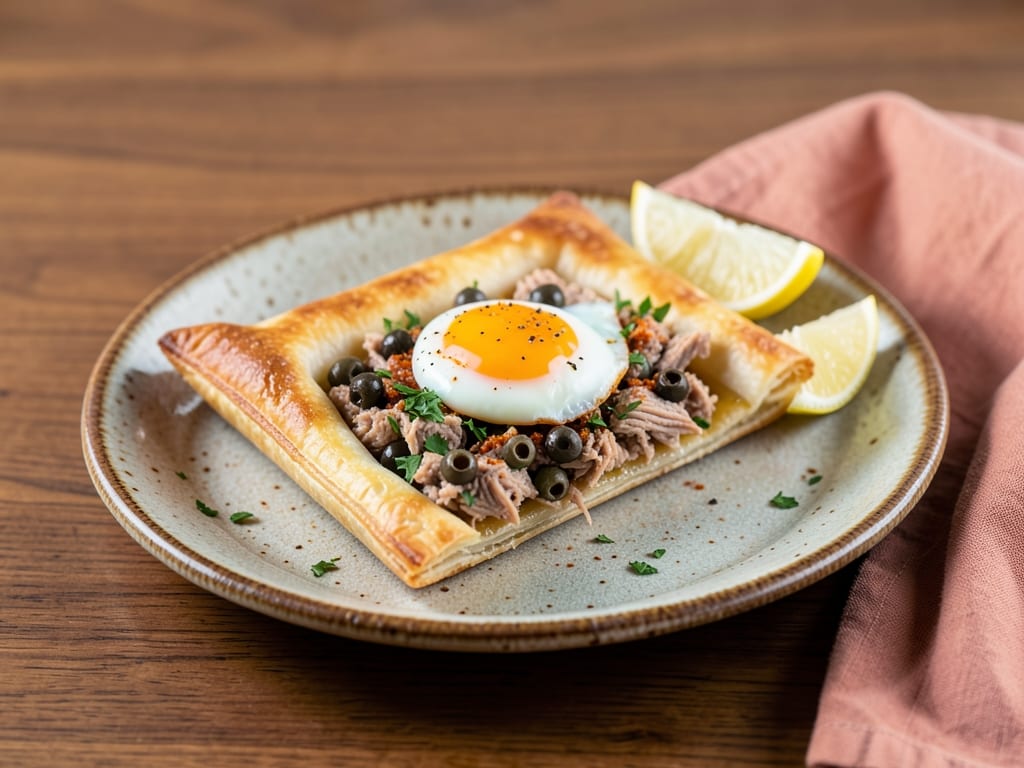
Tunisian Baked Brik with Tuna, Capers and Egg
Crisp, golden layers of brik pastry cradle a savory tuna, caper, parsley and harissa filling with a soft-set egg in the center. Baking instead of deep-frying keeps this Tunisian classic light and much easier to manage.
- Prep
- 20 min
- Cook
- 18 min
- Wait
- 5 min
- Total
- 43 min
- Makes
- 4 pastries (1 per person)
Steps
Before you start
- Thaw frozen brik (malsouka) sheets in the fridge overnight, or on the counter for 30 minutes, in their wrapper. Keep unused sheets covered with a damp towel, since they dry out and crack within minutes.
- Heat the oven to 425°F (220°C) with a rack in the center. Line a large rimmed baking sheet with parchment paper.
- Crack each egg into its own small cup before you start, and keep the cups nearby. This lets you check for shell bits and slide each egg in gently.
- Brik sheets are thin and tear easily. Use 2 sheets per pastry, so you have a spare if one rips. If you can't find brik, see the substitutions.
Heat oven, prep panOven 425°F / 220°C
- Position a rack in the center and heat the oven to 425°F (220°C).
- Line a large rimmed baking sheet with parchment paper.
- Crack each egg into a separate small cup and set them aside.
+ Show details− Hide details
Ready when: Oven fully preheated and the eggs are ready in cups.
Tip: Let the oven preheat fully, since the pastry needs strong initial heat to crisp.
Mix the filling
- In a medium bowl, combine the flaked tuna, chopped capers, parsley, scallions, harissa, grated cheese, lemon juice from half the lemon and the black pepper.
- Stir with a fork until evenly mixed and cohesive.
- Don't add salt: the tuna, capers and cheese are already salty.
- Divide into 4 equal portions of about 95 g (a heaping ⅓ cup).
+ Show details− Hide details
Ready when: Filling looks uniformly orange-flecked and holds together when pressed.
Tip: Drain the tuna very well and press it with a fork against a sieve; excess oil makes the pastry soggy.
Layer the pastry
- Lay 1 brik sheet on the parchment-lined pan and brush it lightly with olive oil.
- Lay a second sheet directly on top, slightly rotated so the edges don't align.
- Brush lightly with oil again.
- Build the other 3 pastries the same way, spacing them at least 2 inches (5 cm) apart.
- Keep the remaining sheets under a damp towel.
- Reserve about 1 tbsp of the oil for brushing the folded edges.
+ Show details− Hide details
Ready when: Each stack is evenly glossy with no dry patches.
Tip: If a sheet tears, patch it with a torn piece and a dab of oil; the layers hide small tears.
Shape the nests
- Mound one portion of filling in the center of each stack and shape it into a 4-inch (10 cm) ring with a shallow well in the middle, about 1½ inches (4 cm) across.
- Fold the outer 2 inches (5 cm) of pastry up and over the filling edge, pleating loosely like a rustic tart so the center well stays open.
- Brush the folded edges with the reserved oil.
+ Show details− Hide details
Ready when: Each pastry has a pleated border and an open center well for the egg.
Tip: Make the filling walls slightly higher than the center so the egg stays contained.
Set the shellsOven 425°F / 220°C
- Bake the shaped pastries on the center rack for 6 minutes at 425°F (220°C) to start crisping the pastry and firm up the filling walls so the egg stays in place.
+ Show details− Hide details
Ready when: Edges are light golden and the filling feels set.
Tip: Don't skip this step. Raw egg poured into unbaked nests tends to leak under the pastry.
Add the eggs
- Pull the pan out and set it on a heatproof surface, leaving the oven on.
- Re-press the wells with the back of a spoon if they've puffed.
- Slide one egg from its cup into each well, then sprinkle each with a tiny pinch of salt.
- Some white may spill over onto the filling, which is fine.
+ Show details− Hide details
Ready when: Each yolk is sitting in the center well, surrounded by filling.
Tip: Hold the cup right against the filling as you slide the egg in, to avoid breaking the yolk.
Bake until setOven 425°F / 220°C
- Return the pan to the oven and bake at 425°F (220°C) for 8 to 10 minutes, rotating the pan after 5 minutes.
- For a runny yolk, stop when the whites are fully opaque and just firm but the yolk still jiggles.
- For a fully set yolk, bake 2 minutes longer.
+ Show details− Hide details
Ready when: Whites are opaque with no clear jelly, pastry is deep golden brown and crisp.
Tip: Eggs keep cooking from residual heat, so take them out when the yolk is still slightly wobbly.
Rest and serve
- Let the pastries rest on the pan for 3 to 5 minutes so the pastry crisps further and the egg firms slightly.
- Transfer to plates with a wide spatula and serve hot, with lemon wedges for squeezing over.
+ Show details− Hide details
Ready when: Pastry crackles when tapped and the bottom feels dry and firm.
Tip: Serve promptly; the pastry is crispest in the first 15 minutes.
Good to know
Tips
- Keep the brik sheets covered with a damp towel while you work; exposed sheets turn brittle and crack within a couple of minutes.
- Drain the tuna thoroughly. Wet filling steams the underside of the pastry and prevents crisping.
- Bake the shells before adding eggs so the egg stays in the well rather than leaking out beneath the pastry.
- Taste the filling before shaping and adjust lemon or harissa; the finished pastry is hard to season afterward.
Make ahead
Make the filling up to 1 day ahead and refrigerate it covered. Bring it to room temperature for 15 minutes before shaping. Assemble and bake the pastries just before serving, since the sheets dry out and the eggs must go in fresh.
Storage & reheating
Best eaten within 15 minutes of baking. Leftovers keep in the fridge, covered, for up to 1 day; the pastry will soften. Reheat on a baking sheet at 375°F (190°C) for 8 to 10 minutes to re-crisp, which will cook the yolk through. Not recommended for freezing once the eggs are added; the unbaked filling can be frozen for up to 1 month.
Substitutions
- brik pastry sheets (malsouka) → Phyllo dough (3 sheets per pastry, brushed with oil) or spring roll wrappers (2 per pastry). Phyllo bakes up flakier and lighter; trim sheets to about 9-inch squares and layer with oil between each.
- Gruyère or Emmental cheese → Grated mozzarella or mild cheddar. Mozzarella is milder and stretchier; cheddar adds more sharpness. Use the same weight.
- harissa paste → 1 tsp sriracha plus ¼ tsp ground cumin, or ½ tsp hot paprika. Gives a similar heat and smoky depth; start with less and taste the filling.
- oil-packed tuna → Canned salmon or drained, flaked canned sardines. Use the same drained weight and remove any large bones.
More stuffed bites
See all →
Find more like this
- Meal
- Brunch
- Cuisine
- Tunisian
- Main ingredient
- Canned TunaEggs
- Diet
- HalalSugar-Free