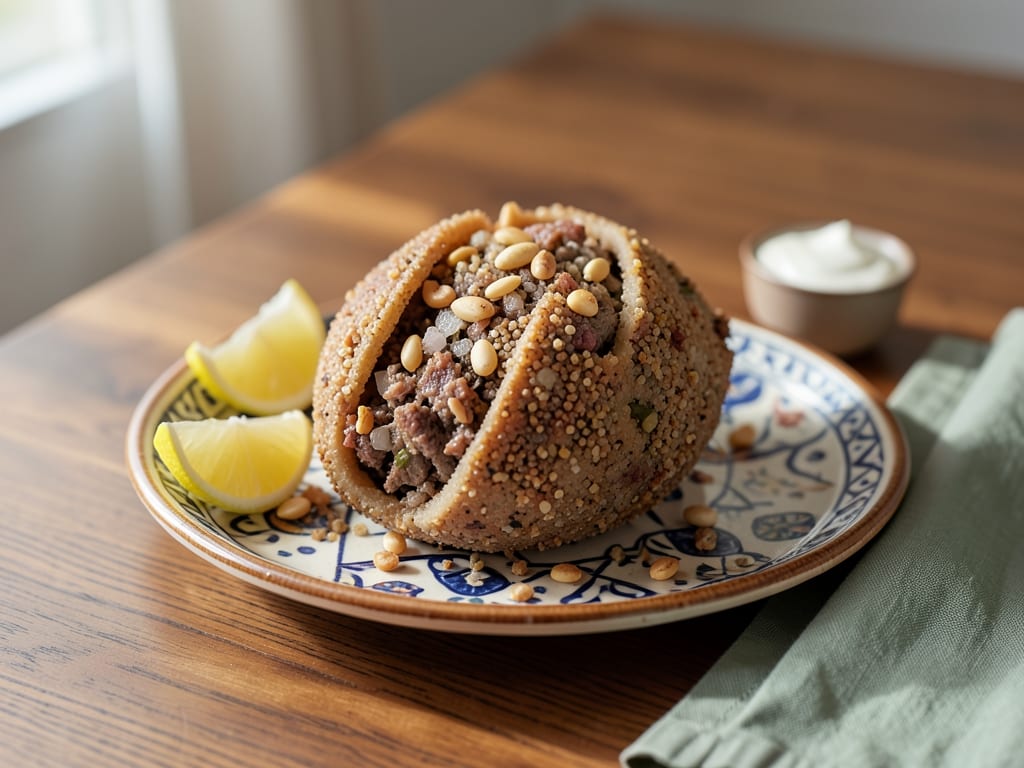
Lebanese Meat Kibbeh with Pine Nuts
Crisp, football-shaped shells of spiced lamb and fine bulgur hide a savory filling of sautéed lamb, onion, toasted pine nuts and warm allspice. Deep-fried until deep brown and shatteringly crisp outside, tender and juicy within.
- Prep
- 1 hr 15 min
- Cook
- 35 min
- Wait
- 1 hr
- Total
- 2 hr 50 min
- Makes
- 24 kibbeh (about 3 per serving)
Steps
Before you start
- Buy lamb from a butcher and ask for lean leg or shoulder, trimmed of fat and sinew, ground twice (or grind it yourself). Keep it very cold.
- Use fine (#1) bulgur, not coarse. If you only have medium, pulse it in a food processor to a fine texture first.
- The filling must be completely cool before stuffing, so make it first. The shells also need 30 minutes of chilling before shaping.
- Read the whole recipe: you will need a bowl of ice water for wetting your hands while shaping, and a thermometer for the frying oil.
Toast pine nuts
- Set the 12-inch skillet over medium-low heat without oil.
- Add the pine nuts and cook, stirring constantly, for 3–4 minutes.
- Tip them onto a plate as soon as they are golden.
+ Show details− Hide details
Ready when: Nuts are evenly golden and smell nutty.
Tip: Pine nuts burn within seconds of turning golden, so remove them from the hot pan right away.
Cook the filling
- Return the skillet to medium-high heat with the olive oil.
- Cook the chopped onion for 5 minutes, stirring, until soft and lightly golden.
- Add the 8 oz (225 g) lamb, breaking it into small crumbles, and cook 5–6 minutes until no pink remains and the liquid has evaporated.
- Stir in the allspice, cinnamon, salt, pepper and pomegranate molasses, if using, and cook 1 minute.
- Fold in the toasted pine nuts.
+ Show details− Hide details
Ready when: Lamb is browned, crumbly and the pan looks dry, not wet.
Tip: Wet filling makes the kibbeh burst in the fryer, so cook off all the moisture.
Cool the filling
- Spread the filling on a plate and refrigerate for at least 30 minutes, until completely cold and no longer steaming.
+ Show details− Hide details
Ready when: Filling is cold to the touch.
Soak the bulgur
- Rinse the bulgur in a fine sieve under cold water for 30 seconds.
- Press out as much water as you can with your hand, then leave it in the sieve to drain and swell while you prepare the lamb.
+ Show details− Hide details
Ready when: Grains are tender enough to squish between your fingers and feel damp, not dripping.
Process the shell paste
- In the food processor, pulse the quartered onion with the allspice, cinnamon, salt and pepper into a wet paste, about 10 pulses.
- Add the cold lamb and process 1 minute, scraping down once, until a smooth paste forms.
- Add the drained bulgur and 2 tablespoons of the ice water and process 1–2 minutes more, adding the remaining ice water a spoonful at a time if needed.
+ Show details− Hide details
Ready when: The mixture is a smooth, tacky, pliable paste like soft clay that holds together when pinched.
Tip: Keep everything cold. Warm lamb makes the shell greasy and prone to cracking.
Chill the shell
- Scrape the paste into a bowl, cover and refrigerate for 30 minutes so it firms up and becomes easier to shape.
+ Show details− Hide details
Ready when: Paste is cold and firm.
Shape the shells
- Set up a bowl of ice water.
- Wet your hands, then roll a golf-ball-size portion of paste (about 1½ oz / 40 g) into a smooth ball.
- Hold it in your palm and poke a hole in the center with your wet index finger.
- Rotate and press gently to widen it into a thin-walled cup, about ⅛ inch (3 mm) thick, with an oval shape about 3 inches (7.5 cm) long.
+ Show details− Hide details
Ready when: Walls are even and thin with no cracks or holes.
Tip: If the shell cracks, wet your fingers and smooth it. Re-roll any torn shell and start again.
Fill and seal
- Spoon about 1 tablespoon of cold filling into each cup.
- Pinch the opening closed, wetting your fingers, then roll gently between your palms into a football shape with pointed ends.
- Place on the parchment-lined baking sheet.
- Repeat to make about 24 kibbeh, then refrigerate 15 minutes while the oil heats.
+ Show details− Hide details
Ready when: Each kibbeh is fully sealed, smooth and torpedo-shaped.
Tip: Do not overfill, or the seam will split in the oil.
Heat the oilOven 350°F / 175°C
- Pour the oil into the heavy pot to a depth of about 2½ inches (6 cm), leaving at least 3 inches (7.5 cm) of space at the top.
- Heat over medium-high to 350°F (175°C) on the thermometer.
+ Show details− Hide details
Ready when: Thermometer reads 350°F (175°C).
Tip: Never leave hot oil unattended, and keep a lid nearby.
Fry in batchesOven 350°F / 175°C
- Lower 5–6 kibbeh into the oil with the slotted spoon, without crowding.
- Fry 4–5 minutes, turning occasionally, until deep brown and crisp.
- Adjust the heat to hold 340–350°F (170–175°C).
- Lift out with the slotted spoon and drain on the wire rack.
- Let the oil return to 350°F (175°C) between batches.
+ Show details− Hide details
Ready when: Kibbeh are dark golden-brown and crisp all over, and the center of one reads at least 160°F (71°C).
Tip: If the oil is too cool, the shells absorb grease and can fall apart. If too hot, they brown before the lamb cooks. Fry one test kibbeh first.
Rest and serve
- Let the kibbeh rest on the rack for 5 minutes so the crust stays crisp.
- Serve warm with lemon wedges and cold yogurt for dipping, if using.
+ Show details− Hide details
Ready when: Surface is dry and crackly.
Good to know
Tips
- Test one kibbeh in the oil first. If it opens, the shell is too wet or too thin: add a spoonful of drained bulgur to the paste, or thicken the walls.
- Keep your hands wet but not dripping. Too much water makes the shell slippery and weak.
- Fry in small batches so the oil temperature stays steady and the kibbeh brown evenly.
- Cut one open to check doneness: the shell should be cooked through, with no raw pink paste near the filling.
Make ahead
Shape and fill the kibbeh up to 1 day ahead; refrigerate in a single layer, covered, and fry straight from the fridge. Or freeze unfried on a tray until solid, then bag, and fry from frozen for 6–7 minutes at 340°F (170°C).
Storage & reheating
Fried kibbeh keep at room temperature up to 2 hours. Refrigerate in an airtight container up to 3 days, or freeze up to 2 months. Reheat from the fridge on a rack in a 375°F (190°C) oven for 10–12 minutes, or from frozen for 18–20 minutes, until hot and crisp and 160°F (71°C) inside.
Substitutions
- lean ground lamb → lean ground beef (90% lean). Milder flavor but works well; keep it very cold.
- pine nuts → slivered almonds or chopped walnuts. Toast the same way; walnuts are traditional in some regions.
- ground allspice → baharat or seven-spice blend. Use the same amount for a more complex flavor.
- neutral oil such as sunflower or canola → peanut oil. Has a high smoke point and fries cleanly.
More stuffed bites
See all →


Find more like this
- Meal
- Snack
- Cuisine
- Lebanese
- Main ingredient
- Ground Lamb
- Diet
- Halal
- Method
- Stovetop