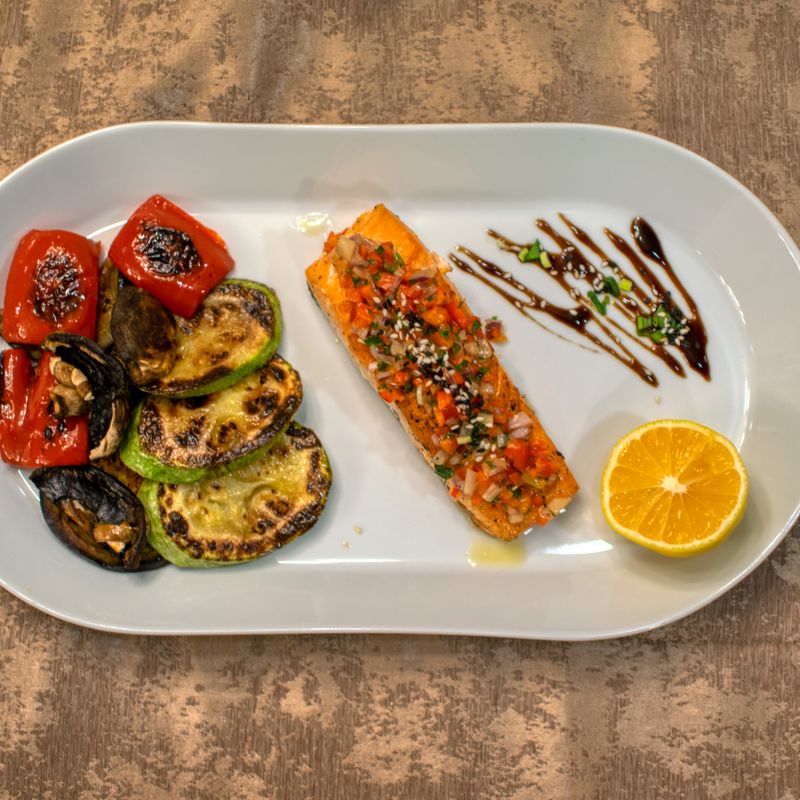
Thai Curry Roasted Salmon
Succulent salmon fillets roasted in a fragrant red curry and coconut sauce infused with lime and fresh Thai basil. The fish cooks gently in the oven while the sauce reduces to a silky glaze, creating a restaurant-quality dish that's ready in under 30 minutes.
- Prep
- 10 min
- Cook
- 18 min
- Wait
- 2 min
- Total
- 30 min
- Makes
- 4 salmon fillets with sauce
Steps
Before you start
- Preheat your oven to 400°F (205°C)
- Pat salmon fillets dry with paper towels before cooking
- Have all ingredients measured and prepped—the cooking happens fast
Mix curry sauce
- In a small bowl, whisk together the red curry paste, coconut milk, fish sauce, lime juice, and palm sugar.
- Stir until the paste is fully dissolved and no lumps remain.
- The sauce should be smooth and fragrant.
+ Show details− Hide details
Ready when: curry paste is fully dissolved
Tip: Whisk well to break up the paste; lumps won't cook out evenly and will result in harsh spots of curry flavor
Arrange salmon and sauce
- Lightly brush a 13×9-inch baking dish with olive oil.
- Arrange the salmon fillets skin-side down in a single layer.
- Pour the curry-coconut mixture over and around the salmon, ensuring each fillet is partially submerged in the sauce.
+ Show details− Hide details
Ready when: salmon is arranged and covered with sauce
Tip: Don't skip patting the salmon dry—wet skin steams instead of developing flavor
Roast salmonOven 400°F / 205°C
- Transfer the baking dish to a preheated 400°F (205°C) oven and roast for 14–16 minutes, until the salmon is opaque throughout and flakes easily when pressed with a fork.
- The thickest part of each fillet should reach an internal temperature of 145°F (63°C).
+ Show details− Hide details
Ready when: salmon is opaque and flakes easily; internal temperature reaches 145°F (63°C)
Tip: Don't overcook—overcooked salmon becomes dry and loses its buttery texture. Check at 14 minutes
Rest and finish
- Remove the baking dish from the oven and let rest for 2 minutes.
- Scatter the fresh Thai basil over the salmon and sauce.
- Serve immediately with lime wedges on the side, and garnish with sliced red chilies if desired.
+ Show details− Hide details
Ready when: basil is scattered and salmon is ready to serve
Tip: Add the basil just before serving so it stays bright and fragrant rather than wilting in residual heat
Good to know
Tips
- Pat the salmon fillets completely dry with paper towels before roasting. Moisture on the skin prevents browning and steams the fish instead of gently cooking it.
- Do not skip the resting period—it allows carryover cooking to finish gently without drying out the salmon.
- Full-fat coconut milk creates the richest, silkiest sauce. Lite versions are thinner and won't coat the fish as well.
- For a deeper curry flavor, use a tablespoon of curry paste in step 1, then taste the sauce; you can always add more, but you can't remove it.
Make ahead
Prepare the curry-coconut sauce (step 1) up to 2 days ahead and store in an airtight container in the refrigerator. Bring to room temperature before roasting. The finished dish does not reheat well.
Storage & reheating
Serve immediately. Leftovers can be stored in an airtight container in the refrigerator for up to 1 day. Reheat gently in a 300°F (150°C) oven for 5–8 minutes until just warmed through, but the salmon texture will not be as tender as when freshly cooked.
Substitutions
- Thai red curry paste → yellow or green curry paste. Use the same amount. Yellow curry is milder and more floral; green curry is spicier. Both work beautifully with salmon.
- fresh Thai basil leaves → fresh cilantro or mint. Use the same amount. Cilantro adds brightness; mint adds coolness. Thai basil has a distinct licorice flavor that's harder to replicate, but these are good alternatives if unavailable.
- palm sugar or light brown sugar → honey or agave nectar. Use the same amount. Both add gentle sweetness to balance the salt and spice.
- fish sauce → soy sauce or tamari. Use the same amount. You'll lose some umami depth, but the dish remains tasty. Start with 2 teaspoons and taste the sauce before roasting.