
Chinese Black Bean Roasted Beef Brisket
A tender, deeply savory beef brisket rubbed with fermented black beans, garlic, and ginger, then slow-roasted until the exterior caramelizes and the meat becomes melt-in-your-mouth tender. The pan sauce develops into a rich, umami-forward glaze that coats every slice. Serve with steamed rice and bok choy for an elegant Chinese-inspired dinner.
- Prep
- 25 min
- Cook
- 3 hr 30 min
- Wait
- 30 min
- Total
- 4 hr 25 min
- Makes
- 1 beef brisket, 10–12 slices
Steps
Before you start
- Remove the brisket from the refrigerator 1 hour before roasting so it reaches room temperature
- Preheat the oven to 325°F (163°C)
- Pat the brisket dry with paper towels—this helps the surface brown
- Read the full recipe; the brisket needs 3.5 hours total in the oven
Make the spice paste
- In a small bowl, combine the minced garlic, minced ginger, fermented black bean sauce, soy sauce, rice wine, and brown sugar (if using).
- Stir until the mixture forms a thick paste.
- This will be your aromatic rub.
+ Show details− Hide details
Tip: Make the paste just before roasting so the garlic and ginger stay fresh and pungent.
Sear the brisketOven 375°F / 190°C
- Heat the oil in a large roasting pan over medium-high heat (about 375°F / 190°C if using a stovetop-safe pan).
- Once shimmering, place the brisket fat-side down in the pan.
- Sear for 5–6 minutes until the surface is deeply browned and caramelized.
- Flip and sear the other side for 5–6 minutes.
- Transfer the brisket to a plate temporarily.
+ Show details− Hide details
Ready when: Surface is dark golden-brown with caramelized spots
Tip: Don't move the meat while searing—let it develop a crust for deeper flavor.
Build the aromatic base
- Return the brisket to the roasting pan, fat-side up.
- Spread the black bean paste all over the top and sides of the meat, rubbing it in evenly.
- Scatter the star anise and cinnamon stick around the brisket in the pan.
- Pour the water around the brisket (not over it, to preserve the paste coating).
+ Show details− Hide details
Tip: Keep the paste on top of the brisket; it will caramelize in the oven and develop deep, complex flavor.
Roast low and slowOven 325°F / 165°C
- Cover the pan tightly with aluminum foil.
- Place in the preheated 325°F (163°C) oven for 2.5 hours without opening.
- The brisket will slowly braise in the liquid and steam, becoming very tender.
- After 2.5 hours, remove the foil carefully (hot steam will escape).
+ Show details− Hide details
Ready when: Meat is fork-tender and the tip of a knife slides through easily
Tip: Resist opening the oven door—each peek extends cooking time and lets heat escape.
Uncover and reduceOven 400°F / 205°C
- Remove the foil.
- If there's more than ½ inch of liquid in the pan, spoon off excess carefully (leaving about ¾ cup / 180 ml).
- This prevents the brisket from becoming too stewy.
- Increase the oven temperature to 400°F (204°C) and return the pan to the oven, uncovered, for 30–45 minutes.
- The exposed surface will caramelize further, the paste will darken, and the remaining liquid will reduce into a glossy glaze.
+ Show details− Hide details
Ready when: The sauce is thick and sticky; internal temperature reaches 190–200°F (88–93°C)
Tip: Watch carefully during the final phase so the sauce doesn't burn—if it darkens too quickly, reduce oven temp to 375°F (190°C).
Check doneness and restOven 200°F / 95°C
- Insert a meat thermometer into the thickest part of the brisket without touching bone.
- It should read 190–200°F (88–93°C).
- The meat should yield easily when pierced with a fork.
- Remove the pan from the oven and let the brisket rest, uncovered, for 20–30 minutes before slicing.
- This allows juices to redistribute throughout the meat.
+ Show details− Hide details
Ready when: Internal temperature is 190–200°F (88–93°C); fork pierces meat with no resistance
Tip: Don't skip the rest—it makes a significant difference in tenderness and juiciness.
Slice and serve
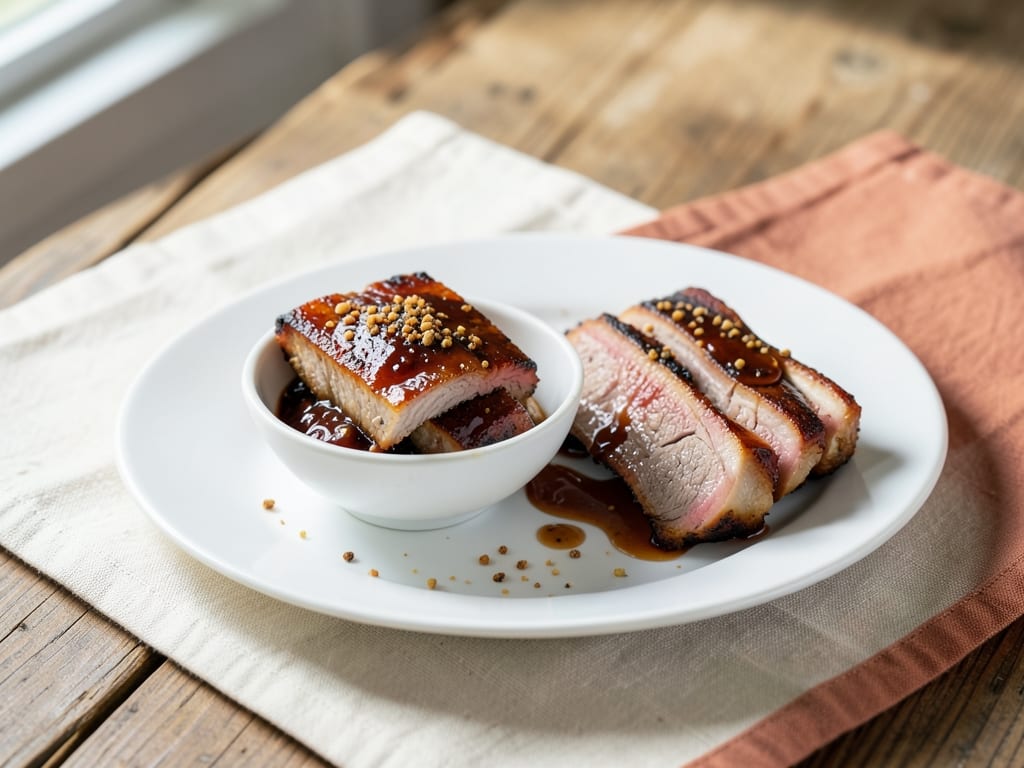
- Using a sharp knife, slice the brisket against the grain into ¼- to ½-inch-thick slices.
- (The grain runs in one direction; slicing perpendicular to it makes the meat more tender.) Arrange slices on a platter.
- Spoon the pan sauce over the slices, then scatter the chopped scallions over top.
- Serve immediately with steamed rice and vegetables.
+ Show details− Hide details
Tip: Slicing against the grain shortens muscle fibers, making each bite tender. Look at the meat's surface to identify the grain direction.
Good to know
Tips
- The key to tender brisket is low temperature (325°F) and sufficient time (3.5 hours). Rushing with higher heat will toughen the meat.
- Fermented black bean sauce (or whole black beans) is essential—it's the signature umami that makes this dish authentic. Find it at any Asian market or online.
- Save the pan drippings: they're liquid gold. If there's excess, strain out the spices and skim fat, then freeze for future braises or soups.
- For a deeper mahogany color and sweeter edge, brush the rested brisket with honey mixed with soy sauce before the final 15 minutes in the oven.
Make ahead
The brisket can be fully roasted 1–2 days ahead. Cool completely, wrap tightly in plastic wrap or foil, and refrigerate. To serve, reheat gently in a 325°F (163°C) oven, covered with foil, for 30–45 minutes until warmed through. Or slice cold and serve at room temperature with reheated pan sauce on the side.
Storage & reheating
Room temperature: up to 2 hours. Refrigerator: up to 4 days, wrapped tightly or in an airtight container. Freezer: up to 3 months, sliced or whole. Thaw overnight in the refrigerator, then reheat in a 325°F oven for 30–45 minutes, covered with foil.
Substitutions
- fermented black bean sauce (or whole fermented black beans) → whole fermented black beans (douchi), rinsed and chopped. Use the same amount. Whole beans are slightly grainier but equally flavorful; mash some of them into the paste for better texture.
- rice wine or dry sherry → dry sherry or mirin. Sherry is neutral; mirin adds a touch of sweetness. Use the same quantity.
- whole star anise → fennel seeds or omit entirely. Fennel seeds are milder; use half the amount. The dish will taste slightly less aromatic but still delicious.
- cinnamon stick → a 1-inch (2.5 cm) piece of star anise for a licorice note, or 2–3 whole cloves. Cloves are spicier; use sparingly. Either option shifts the flavor profile subtly but complements the black beans.
More roasts
See all →


Find more like this
- Meal
- Dinner
- Cuisine
- Chinese
- Main ingredient
- Beef Roast
- Diet
- Dairy-Free
- Method
- Oven
- Quick & Easy
- Make Ahead