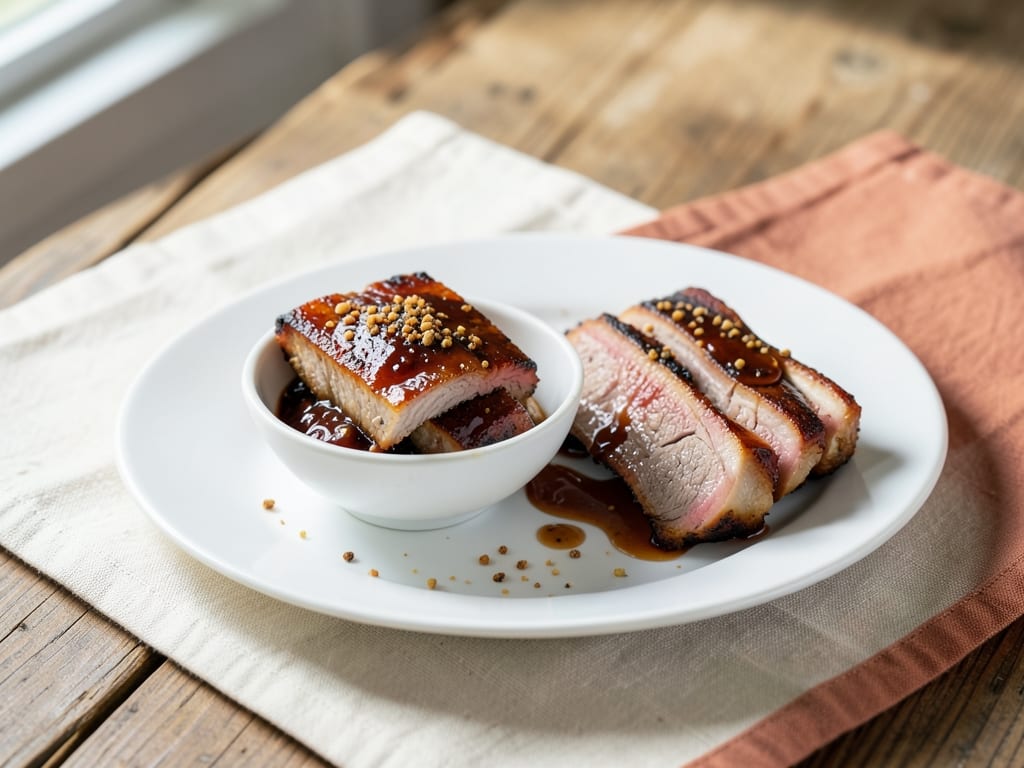
Overnight Char Siu Pork with Hoisin, Five-Spice and Red Fermented Tofu Marinade
Strips of pork shoulder soak overnight in a sweet, savory, deeply fragrant marinade of hoisin, honey, five-spice, Shaoxing wine and red fermented tofu. They roast to a sticky, lacquered, lightly charred finish that is tender enough to slice thick for rice, noodles or buns.
- Prep
- 50 min
- Cook
- 43 min
- Wait
- 12 hr 40 min
- Total
- 14 hr 13 min
- Makes
- About 1½ lb (680 g) cooked char siu, 6 servings
Steps
Before you start
- Plan ahead: the pork needs 12 to 24 hours in the marinade. Start the evening before, or the morning before for dinner the next day.
- Buy red fermented tofu (nam yu, 'red bean curd') at an Asian grocery. It comes in a jar with brine and gives the pork its color and its deep savory flavor.
- Use boneless pork shoulder (Boston butt) with visible marbling. Lean cuts such as loin turn dry.
- Set aside part of the marinade before the raw pork touches it. You will boil that portion into the basting glaze, so it is safe to use.
Cut the pork
- Pat the pork shoulder dry with paper towels.
- Trim off any fat cap thicker than ¼ inch (6 mm), but leave the marbling.
- Cut the pork with the grain into strips about 2 inches (5 cm) thick and 6 to 8 inches (15 to 20 cm) long.
- You should get 4 to 6 strips of roughly even thickness.
+ Show details− Hide details
Ready when: Strips are all about the same thickness so they cook at the same rate.
Tip: Cutting with the grain keeps the strips from falling apart after roasting. Slice across the grain only at the end.
Whisk the marinade
- In a medium bowl, mash the red fermented tofu with the brine until it forms a smooth paste with no lumps.
- Add the hoisin, 3 tablespoons honey, Shaoxing wine, light soy sauce, dark soy sauce, five-spice, garlic, sugar, white pepper, sesame oil and salt.
- Whisk for about 1 minute until the sugar dissolves and the marinade is thick, glossy and brick red.
+ Show details− Hide details
Ready when: The marinade is smooth and uniform, with no visible tofu chunks or sugar granules.
Tip: Mash the tofu with the brine first. If you add it to the other ingredients, it stays in lumps.
Reserve glaze base
- Before the pork touches the marinade, spoon 3 tablespoons (45 ml) into a small lidded container.
- Refrigerate it.
- This portion is kept clean so it can be turned into the basting glaze later.
+ Show details− Hide details
Tip: Never baste with marinade that has touched raw pork unless you boil it first. Reserving a clean portion is safer and gives a better glaze.
Marinate overnight
- Put the pork strips in a 1-gallon zip-top bag and pour in the remaining marinade.
- Press out the air, seal, and massage the bag for 1 minute so every strip is fully coated.
- Lay the bag flat on a plate or tray and refrigerate for at least 12 hours and up to 24 hours.
- Flip the bag once partway through.
+ Show details− Hide details
Ready when: The pork is a deep mahogany red and the marinade clings to it like a thick paste.
Tip: Don't go past 24 hours. The salt and wine will start to make the meat texture mushy.
Preheat and temperOven 425°F / 220°C
- Take the pork out of the fridge and let it sit in the bag at room temperature for 30 minutes.
- Meanwhile, set one oven rack in the upper third and one on the lowest position.
- Preheat the oven to 425°F (220°C).
- Line a rimmed baking sheet with foil and set a wire rack inside.
- Put a small pan of 1 cup (240 ml) hot water on the lowest rack to create steam.
+ Show details− Hide details
Ready when: Oven reaches 425°F (220°C) and the pork no longer feels icy.
Tip: Steam keeps the surface of the pork from drying out before the interior is tender.
Make the glaze
- Pour the reserved 3 tablespoons marinade into a small saucepan.
- Add 2 tablespoons honey and 1 tablespoon water.
- Set over medium-low heat and stir.
- Simmer gently for 2 minutes, until it bubbles around the edges and coats the back of a spoon.
- Remove from the heat.
- It thickens as it cools.
+ Show details− Hide details
Ready when: The glaze is glossy and coats the back of a spoon, and a finger drawn through it leaves a clear line.
Tip: Honey burns easily. Stay at the stove and keep the heat low.
Roast first sideOven 425°F / 220°C
- Lift the pork from the bag and let the excess marinade drip off.
- Discard the bag and leftover marinade.
- Arrange the strips on the wire rack with at least 1 inch (2.5 cm) between them.
- Roast on the upper rack at 425°F (220°C) for 20 minutes, until the surface is dark and tacky and sizzling at the edges.
+ Show details− Hide details
Ready when: The surface is dark red-brown and sticky, with a few darker spots at the edges.
Tip: If drips on the foil begin to smoke heavily, add a splash of water to the foil.
Baste and flipOven 425°F / 220°C
- Pull the sheet out and close the oven door.
- Brush the top of each strip with glaze, flip with tongs, and brush the other side.
- Return to the oven and roast for 10 more minutes at 425°F (220°C).
+ Show details− Hide details
Ready when: The glaze is bubbling and sticky, and the pork has started to caramelize.
Tip: Close the oven door while basting so the oven doesn't lose heat.
Glaze and check temperatureOven 425°F / 220°C
- Brush both sides with glaze again and flip once more.
- Roast 10 minutes longer at 425°F (220°C).
- Insert an instant-read thermometer into the thickest strip.
- It should read 175°F (80°C).
- Pork is safe at 145°F (63°C), but shoulder is more tender at 175°F.
- If it reads lower, roast in 5-minute increments.
+ Show details− Hide details
Ready when: The thermometer reads 175°F (80°C) in the thickest part, and the juices run clear.
Tip: Thicker strips may need 5 to 10 extra minutes. Judge by temperature, not the clock.
Broil for charOven 500°F / 260°C
- Move the sheet to the upper rack.
- Switch the oven to broil on high (about 500°F / 260°C).
- Brush the strips with the last of the glaze.
- Broil for 2 to 3 minutes, watching the whole time, until the edges are lightly charred and the glaze is bubbling.
+ Show details− Hide details
Ready when: Edges show dark brown to black spots and the glaze is shiny and bubbling.
Tip: Don't walk away. The honey glaze can go from charred to burnt in under 30 seconds.
Rest and slice
- Transfer the strips to a cutting board and rest for 10 minutes so the juices redistribute.
- Slice across the grain into ¼-inch (6 mm) slices.
- Spoon any pan juices over the slices and serve.
+ Show details− Hide details
Ready when: Slices hold together, with a glossy dark crust and a pink-tinged edge from the marinade.
Tip: Slicing right away lets the juices run out onto the board.
Good to know
Tips
- Roast on a wire rack so hot air reaches every side and the pork browns evenly instead of stewing in its own drippings.
- Cut strips of even thickness. A thin strip dries out while a thick one is still underdone.
- Foil-lined pans make cleanup easy because the sugary drippings burn onto bare metal.
- Serve over steamed jasmine rice with blanched greens, or fold into steamed buns, fried rice or noodle soup.
Make ahead
"The marinade can be whisked and refrigerated up to 3 days ahead. Raw pork can marinate up to 24 hours. Cooked char siu can be roasted a day ahead, cooled, and refrigerated whole. Slice and reheat when needed."
Storage & reheating
"Room temperature: no more than 2 hours. Refrigerator: store sliced or whole in an airtight container for up to 4 days. Freezer: wrap tightly, or freeze in portions, for up to 3 months and thaw overnight in the fridge. Reheat covered with foil at 350°F (175°C) for 10 to 15 minutes, or sliced in a skillet with a splash of water over medium heat for 2 to 3 minutes."
Substitutions
- Shaoxing wine → dry sherry. Use the same amount. Avoid cooking wine, which has added salt.
- red fermented tofu cubes → 1 extra tablespoon hoisin plus 1 tablespoon miso. The pork will be less red and a bit less funky, but will still taste savory and rich.
- honey → maltose or light brown sugar syrup. Maltose gives a more traditional glassy shine. Warm it first so it can be measured and stirred.
- boneless pork shoulder (Boston butt) → boneless pork belly or country-style ribs. Belly is richer and needs about 10 minutes longer. Country-style ribs cook in about the same time as shoulder.