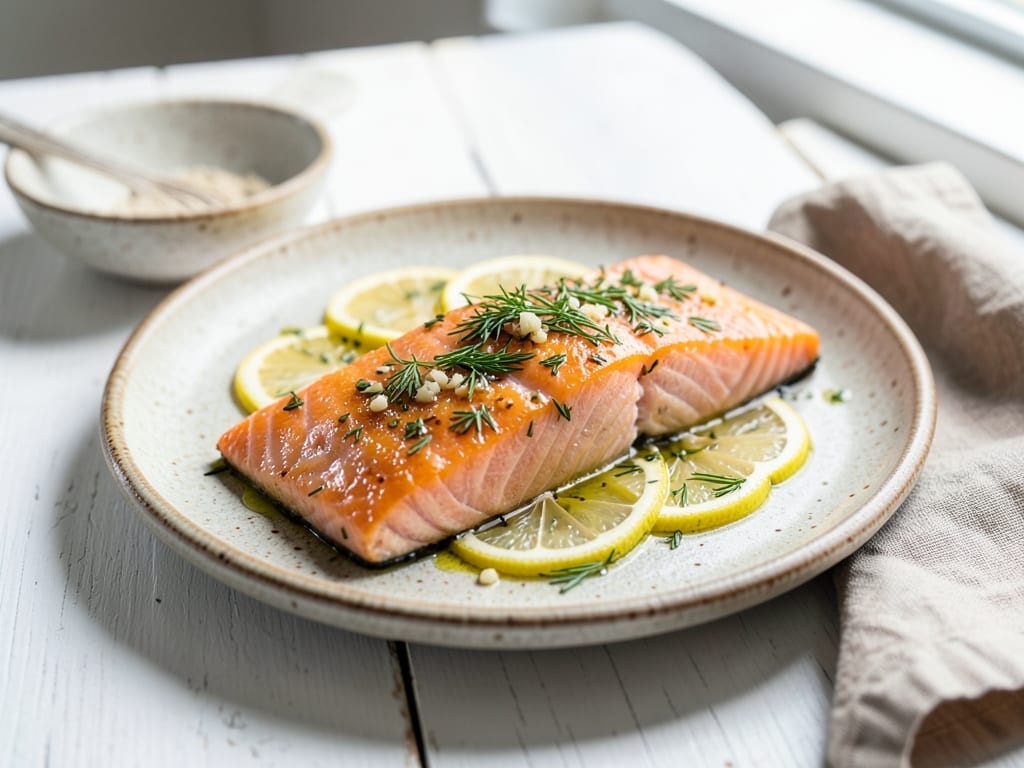
Low-Sodium Lemon Dill Salmon, Marinated and Baked
Salmon fillets soaked briefly in a bright marinade of lemon, fresh dill, garlic, olive oil and Dijon, then baked on lemon slices until tender and flaky. There's no added salt, so lemon, herbs and mustard supply the flavor in a Scandinavian style.
- Prep
- 20 min
- Cook
- 14 min
- Wait
- 25 min
- Total
- 59 min
- Makes
- 4 fillets (6 oz / 170 g each)
Steps
Before you start
- Buy fillets of even thickness (about 1 to 1¼ inches / 2.5 to 3 cm) so they cook at the same rate.
- Choose a Dijon labeled low-sodium or reduced-sodium if you're watching salt closely. Regular Dijon adds roughly 90 mg sodium per serving here.
- Take the salmon out of the fridge when you start prepping. Don't marinate longer than 30 minutes, because the lemon juice starts to turn the flesh firm and chalky.
- Start preheating the oven about 10 minutes before the marinating time ends (see step 5).
Dry the salmon
- Set the salmon fillets on a plate lined with paper towels and pat the tops and sides very dry.
- Run your fingertip along the center of each fillet and pull out any pin bones with clean tweezers.
- Place the fillets skin-side down in the 9×13-inch baking dish, leaving a little space between them.
+ Show details− Hide details
Ready when: Surface of the fish feels dry and no bones are felt along the center line.
Tip: Dry fish holds the marinade better and browns lightly in the oven.
Zest and juice lemon
- Using a fine grater, zest 1 large lemon until you have 2 teaspoons, taking only the yellow and none of the white pith.
- Cut the zested lemon in half and squeeze it, along with a second lemon if needed, until you have 3 tablespoons (45 ml) juice.
- Remove seeds.
- Cut the remaining medium lemon into ¼-inch rounds and set aside.
+ Show details− Hide details
Ready when: 2 tsp zest, 3 tbsp juice and about 4 even lemon rounds ready.
Tip: Zest before juicing. A squeezed lemon is nearly impossible to zest.
Whisk the marinade
- In a small bowl, whisk together the olive oil, lemon zest, lemon juice, Dijon, chopped dill, minced garlic, black pepper and honey (if using) for about 30 seconds.
- Don't add salt, because the mustard and fish already supply a little sodium.
+ Show details− Hide details
Ready when: Marinade looks thick, cloudy and evenly blended with no streaks of mustard or pooled oil.
Marinate the fillets
- Spoon the marinade over the salmon, using the back of the spoon to spread it across the tops and sides.
- Turn the fillets once to coat both sides, then finish skin-side down.
- Cover the dish and refrigerate for 20 minutes.
+ Show details− Hide details
Ready when: Fillets are evenly glossy with flecks of dill and garlic clinging to the top.
Tip: Never exceed 30 minutes. Longer in lemon juice makes the surface mushy and dry once baked.
Preheat and prep panOven 400°F / 205°C
- About 10 minutes before the marinating time ends, heat the oven to 400°F (200°C) with a rack in the center.
- Line the rimmed baking sheet with parchment paper.
+ Show details− Hide details
Ready when: Oven reaches 400°F (200°C) and the pan is lined flat.
Arrange on lemon slices
- Lay the lemon rounds on the parchment in 4 small groups, overlapping slightly, each about the size of a fillet.
- Lift each salmon fillet out of the dish and set it skin-side down on a lemon bed, spacing the fillets 2 inches (5 cm) apart.
- Spoon any remaining marinade, with its dill and garlic, over the tops.
+ Show details− Hide details
Ready when: Each fillet sits flat on its lemon rounds with marinade and herbs on top.
Tip: Lemon slices lift the fish off the pan so the bottoms don't stick or overcook.
Bake the salmonOven 400°F / 205°C
- Bake at 400°F (200°C) for 12 to 14 minutes for fillets about 1 inch (2.5 cm) thick, or up to 16 minutes for 1¼ inches (3 cm).
- Check at 12 minutes by inserting an instant-read thermometer into the thickest part sideways.
+ Show details− Hide details
Ready when: Flesh turns from translucent to opaque, flakes easily with a fork, and reads 140°F (60°C) in the thickest part, rising to 145°F (63°C) as it rests.
Tip: Pull the fish out right at 140°F (60°C). Carryover heat finishes it, and waiting longer gives dry salmon.
Rest, garnish, serve
- Let the salmon rest on the pan for 5 minutes.
- Transfer to plates with a wide spatula, sliding it between the flesh and the skin if you'd like to leave the skin behind.
- Spoon the juices from the pan over the top, add the torn dill fronds, and serve with the baked lemon slices.
+ Show details− Hide details
Ready when: Fillets read 145°F (63°C) and flake into large, moist, opaque pieces.
Tip: Fresh dill added at the end tastes brighter than dill that has baked.
Good to know
Tips
- Zest the lemon first, then juice it, and use a fine grater so no bitter white pith ends up in the marinade.
- Measure thickness at the fattest part. Thin tail ends cook faster, so fold them under or tuck them in to keep them from drying out.
- A thermometer is the surest way to avoid overcooked salmon. For a softer, medium texture, pull at 130°F (54°C), though this is below the USDA recommendation.
- For a little more punch with no extra sodium, add a pinch of crushed fennel seed or ¼ tsp ground coriander to the marinade.
Make ahead
"Whisk the marinade up to 1 day ahead and refrigerate it in a covered jar, but add the lemon juice only when you're ready to marinate, or keep the whole mixture and marinate for just 20 minutes. Bring the marinade to cool room temperature and re-whisk before using. Don't marinate the fish ahead of time."
Storage & reheating
Room temperature: no more than 2 hours. Refrigerator: cool leftovers, then keep in an airtight container up to 3 days. Freezer: not recommended after baking, as the texture turns dry (raw, unmarinated fillets freeze for up to 3 months). Reheat gently, covered, at 275°F (135°C) for 10 to 12 minutes until warmed through, or serve cold over salad.
Substitutions
- fresh dill → Fresh flat-leaf parsley or chives (same amount). Gives a milder, grassier flavor. Dried dill can be used at 1 tablespoon, but fresh gives much better flavor.
- low-sodium Dijon mustard → Whole-grain mustard or 1 tsp mustard powder plus 2 tsp water. Check labels for sodium. Mustard powder has none.
- skin-on salmon fillets → Arctic char or steelhead trout fillets. Use the same weight and bake time, checking at 12 minutes.
- honey → Maple syrup (1 tsp). Keeps the mild sweetness that balances the lemon. Skip it for a sharper flavor.
More roasts
See all →
Find more like this
- Meal
- Dinner
- Cuisine
- Mediterranean
- Main ingredient
- Salmon
- Method
- Oven
- Quick & Easy
- Easy