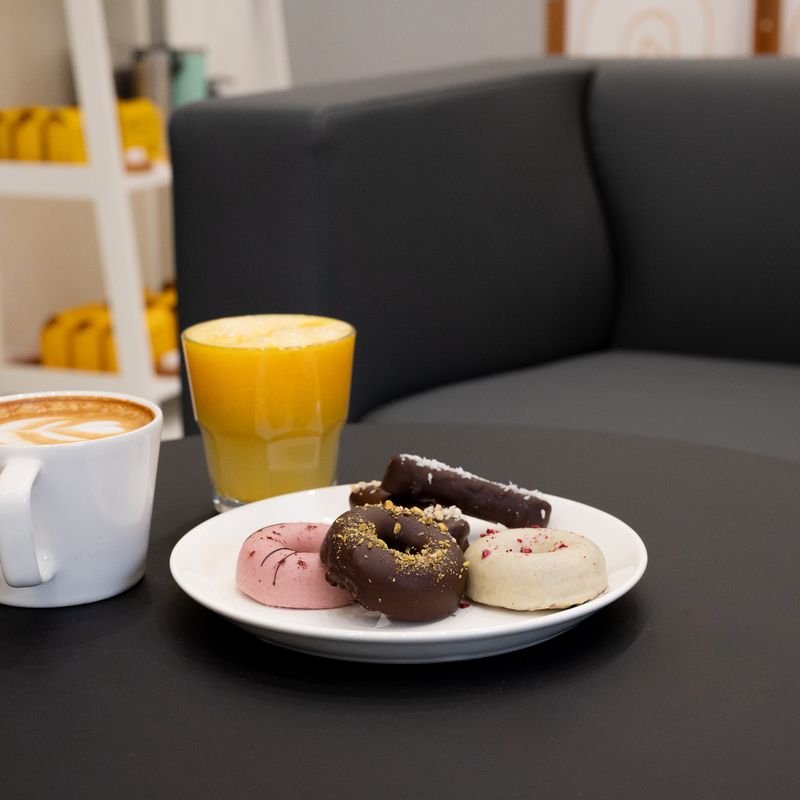
Spiced Chickpea Flour Donuts with Orange Glaze
Golden-fried donuts made from chickpea flour, infused with warm spices and topped with a bright orange glaze. These tender, naturally gluten-free pastries have a tender crumb and a delicate citrus finish, inspired by Mediterranean flavors. They're best eaten the day they're made, while still slightly warm.
Steps
Before you start
- Have all ingredients at room temperature before you start
- Heat oil to exactly 350°F (175°C) in your fryer or thermometer-equipped pan at least 30 minutes before frying
- Line a baking sheet with paper towels for cooling
- Zest your oranges before juicing them
Mix dry ingredients
- In a medium bowl, whisk together chickpea flour, all-purpose flour, sugar, baking powder, salt, cinnamon, cardamom, and nutmeg.
- Make sure the spices are evenly distributed and there are no lumps.
- Set aside.
+ Show details− Hide details
Ready when: Spices evenly distributed throughout dry mixture
Tip: Sift the powdered sugar into the glaze mixture later—don't skip this step or you'll have lumps.
Combine wet ingredients
- In another bowl, whisk together eggs, Greek yogurt, orange zest, and olive oil until smooth.
- The mixture should be pale and well combined, about 1 minute of whisking.
+ Show details− Hide details
Ready when: Mixture is smooth and homogeneous with no streaks
Tip: Cold eggs or yogurt will make the batter lumpy; ensure they're truly at room temperature.
Form the batter
- Pour the wet ingredients into the dry ingredients and fold together gently with a rubber spatula until just combined.
- The batter should be thick but spoonable, similar to thick cake batter.
- Don't overmix—some small lumps are fine and will result in a more tender crumb.
+ Show details− Hide details
Ready when: No dry flour visible; batter is thick and slightly lumpy
Tip: Overmixing develops gluten and creates tough, dense donuts. Stop as soon as the flour disappears.
Fill the donut mold
- Transfer the batter to your donut mold or piping bag fitted with a large round tip.
- If using a mold, fill each cavity about three-quarters full.
- If using a piping bag, pipe batter directly into the hot oil in circles.
- Work quickly and systematically.
- You'll have enough batter for 12 donuts.
+ Show details− Hide details
Ready when: All cavities filled evenly; batter ready to fry
Tip: If using a mold, lightly oil it first so the raw donuts don't stick. Fill carefully to avoid overflow.
Prepare frying stationOven 350°F / 175°C
- Heat your frying oil to exactly 350°F (175°C) in a heavy-bottomed pot or Dutch oven.
- Use a candy thermometer to monitor the temperature continuously.
- Heat for at least 30 minutes before frying, checking that the oil maintains 350°F.
- Arrange a paper towel-lined baking sheet near the stove for cooling.
+ Show details− Hide details
Ready when: Oil thermometer reads 350°F (175°C) and holds steady
Tip: Oil that's too cool will absorb into the donuts; too hot will burn the outside before the inside cooks. Use a thermometer, not guesswork.
Fry first batch of donutsOven 180°F / 80°C
- If using a mold, carefully lower it into the hot oil for 2 minutes, then gently tap and rotate the mold to release the donuts.
- Fry for another 90 seconds until the bottoms are golden brown.
- Use a slotted spoon to flip and fry the other side for another 90 seconds until deeply golden.
- Total fry time is about 4 minutes per batch.
- If piping directly, carefully pipe 3–4 donuts into the oil, spacing them well, fry for 2 minutes on the first side, flip, and fry for 1.5–2 minutes on the second side until golden all over.
- The internal temperature should reach 180°F (82°C).
+ Show details− Hide details
Ready when: Donuts are deep golden brown on both sides and feel hollow when tapped
Tip: Don't crowd the pan—fry only 3–4 donuts at a time. Overcrowding drops oil temperature and leads to greasy donuts.
Transfer and cool first batch
- Use a slotted spoon or spider strainer to carefully lift the fried donuts from the oil and place them on the paper towel-lined baking sheet.
- Let them cool for 2–3 minutes while you fry the remaining batches.
- They should still be warm when glazed.
+ Show details− Hide details
Ready when: Oil drains from donuts; they are warm but cool enough to handle
Tip: Don't let them cool completely before glazing, or the glaze won't adhere as nicely.
Fry remaining batchesOven 350°F / 175°C
- Repeat Step 6 with remaining batter, frying 3–4 donuts at a time.
- Check the oil temperature between batches and adjust heat as needed to maintain 350°F (175°C).
- You'll have about 3 batches total.
+ Show details− Hide details
Ready when: All donuts are golden brown and hollow-sounding when tapped
Tip: Oil temperature will drop between batches; give it 30–60 seconds to come back up to 350°F before frying the next batch.
Make orange glaze
- While the donuts fry and cool, sift the powdered sugar into a shallow bowl.
- Whisk in the fresh orange juice and optional orange extract until the mixture is smooth and pourable.
- It should coat the back of a spoon but still run slowly off a spoon.
- If too thick, add a few more drops of orange juice; if too thin, add a pinch more powdered sugar.
+ Show details− Hide details
Ready when: Glaze is smooth, lump-free, and pourable
Tip: Sifting the powdered sugar is essential—lumps will ruin the glaze. Don't skip this.
Glaze the donuts
- Once all donuts are fried and still warm, dip the top half of each donut into the orange glaze, letting excess drip back into the bowl.
- Return the glazed donut to the baking sheet, glazed-side up.
- For a thicker glaze, dip twice, waiting 30 seconds between dips.
- Finish with a tiny drizzle of melted butter on top if desired for extra shine.
+ Show details− Hide details
Ready when: All donuts are coated with glaze that clings evenly to the surface
Tip: Glaze warm donuts immediately for the best absorption; cold donuts won't accept the glaze as well.
Cool and serve
- Let the glazed donuts rest on the baking sheet for 10 minutes to allow the glaze to set slightly.
- Serve warm or at room temperature.
- These are best eaten within a few hours of frying, while the interior is still tender.
+ Show details− Hide details
Ready when: Glaze has set and no longer runs off the donut when tilted
Tip: Don't stack glazed donuts while the glaze is wet, or they'll stick together.
Good to know
Tips
- For the most tender donuts, resist the urge to overmix the batter. The chickpea flour develops gluten quickly, and even a few extra stirs will make them tough. Fold gently until the flour is just incorporated.
- The oil temperature is non-negotiable. At 350°F (175°C), the donuts cook through in the center while the exterior browns evenly. Too low, and they'll absorb oil; too high, and the outside burns before the inside is done. Use a reliable thermometer.
- If you don't have a donut mold, you can pipe the batter directly into the hot oil using a large piping bag with a round tip, or use a donut dropper tool. This method takes more practice but gives you beautiful results.
- Greek yogurt adds subtle tang and keeps the donuts moist; don't skip it. If you must substitute, choose thick full-fat yogurt and reduce the total liquid slightly to compensate.
Storage & reheating
Room temperature (up to 4 hours): Keep in an airtight container to maintain texture. Reheat briefly in a 300°F (150°C) oven for 5 minutes if desired. Refrigerator (up to 2 days): Store in an airtight container. Reheat in a 300°F (150°C) oven for 8–10 minutes. Freezer (up to 3 weeks): Freeze unglazed donuts in an airtight container. To serve, thaw at room temperature for 1 hour, then glaze fresh.
Substitutions
- plain Greek yogurt → Plain full-fat yogurt or sour cream (use the same amount). Greek yogurt provides structure and richness; regular yogurt or sour cream will work but may produce a slightly less dense crumb.
- chickpea flour (garbanzo flour) → All-purpose flour (use 2.25 cups / 270 g instead of the 1.5 cups chickpea flour plus 0.75 cup all-purpose flour). The donuts will lose their chickpea nuttiness and Mediterranean character, but will still work. Reduce the total batter slightly as all-purpose flour absorbs more liquid.
- fresh orange juice → Lemon juice or another citrus juice (same amount). Lemon glaze will be slightly more tart; lime or grapefruit also work well. Adjust sweetness to taste.
- ground cardamom → Additional ground cinnamon or ground ginger (use 0.5 teaspoon total). Cardamom is warm and floral; cinnamon will make the spice profile earthier, while ginger adds a subtle bite. Both are Mediterranean-friendly alternatives.
More no-bake desserts
See all →




Find more like this
- Meal
- Dessert
- Cuisine
- Mediterranean
- Main ingredient
- Chickpeas
- Diet
- VegetarianHalal
- Method
- Oven