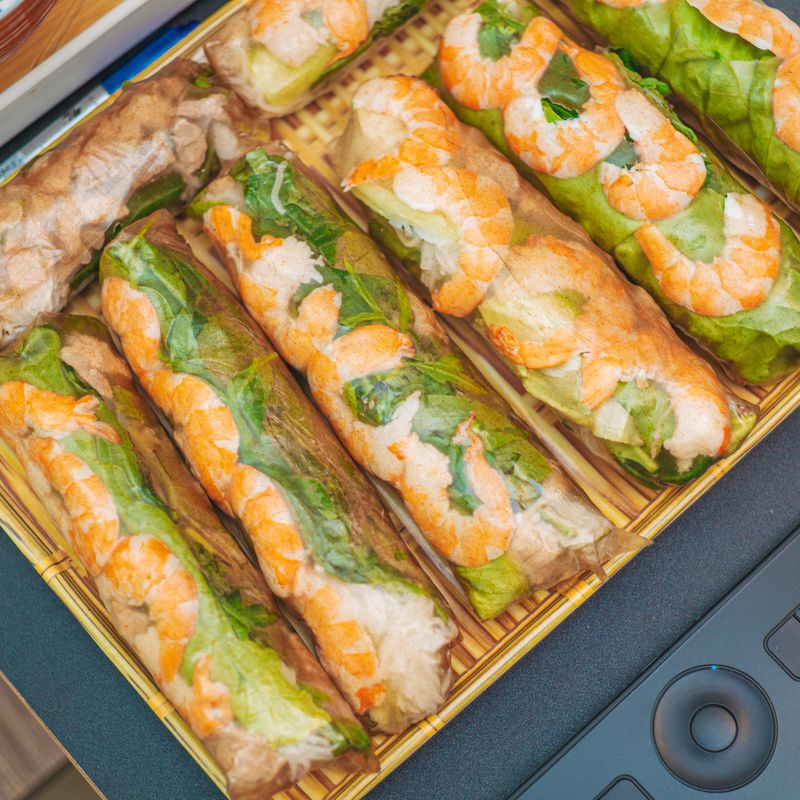
Sourdough Vietnamese Shrimp Paste and Herb Flatbread
A crispy-edged, tender flatbread built on active sourdough starter, brushed with fragrant shrimp paste mixed with lime and garlic, then scattered with fresh cilantro, mint, and scallions. Griddled until golden and charred, it's as good torn apart with a cold beer as it is stuffed with grilled fish or chicken.
- Prep
- 25 min
- Cook
- 20 min
- Wait
- 1 hr 30 min
- Total
- 2 hr 15 min
- Makes
- 4 flatbreads
Steps
Before you start
- Have your sourdough starter fed and bubbly (at peak or within 2–3 hours of peak)
- Measure and combine all herbs and aromatics in a bowl so you can work quickly at the griddle
- Have a sheet pan lined with parchment ready for the dough after mixing
Mix the dough
- In a large mixing bowl or stand mixer, combine the sourdough starter, warm water, and all-purpose flour.
- Mix on low speed with the dough hook for 2 minutes until a shaggy mass forms.
- Let it rest for 10 minutes.
- Add salt and olive oil, then continue mixing on low speed for 6–8 minutes until the dough becomes smooth, elastic, and slightly sticky.
- It should hold together and feel alive.
+ Show details− Hide details
Ready when: Dough is smooth, elastic, and slightly tacky but pulls cleanly from the bowl
Tip: If the dough feels too wet, add water a teaspoon at a time; too dry, sprinkle water sparingly. Sourdough startersthis one especially—vary in hydration.
Bulk fermentation and shape
- Transfer the dough to a parchment-lined sheet pan.
- Cover loosely with a damp kitchen towel or plastic wrap.
- Let it rise at room temperature (68–72°F / 20–22°C) for 60–75 minutes, or until puffy and about 50% larger.
- Divide the dough into 4 equal pieces using a bench scraper.
- Gently pre-shape each piece into a rough ball, then loosely cover and let rest for 10 minutes.
+ Show details− Hide details
Ready when: Dough is puffy, soft, and springs back slowly when gently poked; bubbles visible under parchment
Tip: This is a short fermentation—sourdough's strength lies in flavor, not bulk rise. If your starter is young or weak, add 15 minutes to this step.
Final shape and rest
- Working with one piece at a time, gently press out each dough ball into a 6–7-inch (15–18 cm) oval or slightly irregular round, about ¼ inch (6 mm) thick.
- Don't compress it too much; you want some air left.
- Arrange them on the parchment, cover again with the damp towel, and let rest for 5 minutes while you prepare the topping.
+ Show details− Hide details
Ready when: Dough is soft and slightly puffy, holds its shape without springing back forcefully
Tip: Don't overwork the dough at this stage or you'll lose the soft, airy crumb. Gentle hands make the best flatbread.
Prepare the shrimp paste spread
- In a small bowl, whisk together the shrimp paste, minced garlic, lime juice, and fish sauce (if using) until smooth and well combined.
- Taste and adjust: add more lime juice for brightness, a splash of fish sauce for deeper umami, or a pinch of salt if needed.
- The spread should smell fragrant and be pourable but not watery.
+ Show details− Hide details
Ready when: Mixture is smooth, aromatic, and evenly combined
Tip: Shrimp paste is pungent—this is where its funky notes transform into umami magic when combined with lime and garlic. Taste before committing all of it.
Combine herbs and aromatics
- In another small bowl, toss together the chopped cilantro, torn mint, and sliced scallions.
- Set aside.
+ Show details− Hide details
Ready when: Herbs are combined and ready to scatter
Tip: Prepping herbs now saves you precious seconds at the griddle when the flatbread is hot and waiting.
Heat the griddleOven 400°F / 205°C
- Place a cast-iron griddle or large skillet (10–12 inches) over medium-high heat (about 375–400°F / 190–200°C if you have a thermometer).
- Let it heat for 3–4 minutes until it's hot enough that a drop of water sizzles and evaporates immediately.
- Have the cooking oil nearby.
+ Show details− Hide details
Ready when: Water droplet evaporates instantly and skitters; griddle surface is uniformly hot
Tip: A preheated cast-iron surface is crucial for crust development. Rushing this step leads to pale, chewy flatbread.
Cook the first flatbread
- Lightly brush both sides of one shaped dough oval with cooking oil.
- Gently lay it onto the hot griddle.
- Cook for 2–3 minutes without moving it.
- The bottom should turn golden with some charred spots.
- Flip and cook the other side for another 2–3 minutes until golden and slightly puffed.
- The flatbread should be cooked through but still tender, not tough.
+ Show details− Hide details
Ready when: Both sides are golden to light brown with some charred spots; flatbread is springy when pressed lightly
Tip: Resist the urge to fidget. Let each side sit undisturbed so it develops a crust and doesn't tear when you flip.
Top the first flatbread
- Transfer the hot flatbread to a cutting board or serving plate.
- Immediately brush the top surface with about ½ tablespoon (7 ml) of the shrimp paste spread using a small spoon or pastry brush.
- Scatter a generous pinch of the herb and scallion mixture over the top.
- Serve warm, or stack on a clean towel to keep warm.
+ Show details− Hide details
Ready when: Flatbread is topped and ready to eat; herbs are scattered and visible
Tip: Apply the shrimp paste while the bread is still hot—it'll soften and meld slightly. Don't overload or it becomes one-note; let the bread shine through.
Repeat for remaining flatbreads
- Repeat steps 7 and 8 with the remaining three shaped dough pieces, cooking them one at a time.
- If the griddle heat seems to be dropping (dough cooks too slowly), increase to medium-high; if it's too fierce and charring faster than cooking (4–5 minutes becomes overly dark), reduce to medium.
- Stack finished flatbreads on a clean towel to keep warm while you finish the batch.
+ Show details− Hide details
Ready when: All four flatbreads are cooked, topped, and warm
Tip: The griddle's temperature will stabilize after the first flatbread. If you're making this for a crowd, a second griddle or a warm oven (200°F / 93°C) can keep cooked flatbreads warm without drying them out.
Good to know
Tips
- Shrimp paste is aggressively pungent raw; don't be alarmed. The lime juice and garlic tame it into an addictive condiment. Start with less if you're unsure, and gradually add more as you gain confidence.
- Sourdough's rise is slower than commercial yeast. If your kitchen is cool (under 68°F / 20°C), add 15–20 minutes to bulk and rest times. Cold fermentation also deepens flavor, so slight delays are not a problem.
- Cast iron is ideal for this recipe because it holds heat evenly and creates a beautiful crust. A stainless steel or nonstick skillet works but may not char as effectively; avoid nonstick over high heat.
- Serve these flatbreads with grilled fish, chicken, or just cold beer and a squeeze of lime. They're also excellent vehicles for leftover roasted vegetables or a simple herb-dressed salad tucked inside.
Make ahead
You can prepare the dough up to 24 hours ahead: after bulk fermentation, gently shape and transfer to a parchment-lined sheet pan, cover tightly with plastic wrap, and refrigerate. The next day, let the dough come to room temperature on the counter for 30–45 minutes before shaping and griddle-cooking. The slow cold fermentation deepens the sourdough's tang.
Storage & reheating
Best served warm immediately after cooking. Leftover flatbreads keep at room temperature in an airtight container for 1 day; reheat by wrapping loosely in foil and warming in a 350°F (175°C) oven for 5–8 minutes to revive them. Unfrosted cooked flatbreads freeze well for up to 1 month; thaw at room temperature and reheat as above. Do not freeze topped flatbreads; top only just before eating.
Substitutions
- Vietnamese shrimp paste (mắm tôm) → anchovy paste (1½ tablespoons / 20 g) mixed with 1 teaspoon (5 ml) of soy sauce. Anchovy will be slightly less aromatic but delivers comparable umami and brininess. Add a pinch of fish sauce if you have it.
- fresh cilantro, coarsely chopped → fresh parsley or Thai basil. Cilantro is traditional but basil adds a different anise note, and parsley is milder. Use the same quantity.
- active sourdough starter, unfed and at room temperature → instant yeast (¼ teaspoon / 0.8 g) with 2 tablespoons (30 ml) additional water, omitting the water-reduction. You'll lose sourdough's tangy complexity, but the flatbread will still be tender and flavorful. Reduce bulk fermentation to 30–40 minutes.
- fresh lime juice → rice vinegar (2 tablespoons / 30 ml) or white vinegar (1½ tablespoons / 22 ml, as it's sharper). Vinegar won't be as fragrant, but it adds the necessary acidity. Start with less vinegar—you can always add more.
More flatbread doughs
See all →


Find more like this
- Meal
- Dinner
- Cuisine
- Vietnamese
- Main ingredient
- Shrimp
- Method
- Stovetop