Sourdough Thai Roasted Coconut and Lime Leaf Bread Bowl
A savory sourdough bread bowl infused with the bright, aromatic flavors of Thai cuisine. Shredded coconut is toasted until golden, then folded into a tangy sourdough dough along with fragrant kaffir lime leaves and fresh lime zest. The result is a crusty exterior with a tender, aromatic crumb that's perfect for holding curries, soups, or serving alongside bold Southeast Asian dishes. The subtle coconut sweetness and citrus notes complement rather than overpower the sourdough's signature depth.
- Prep
- 25 min
- Cook
- 35 min
- Wait
- 2 hr
- Total
- 3 hr
- Makes
- 2 bread bowls (about 1 lb / 450 g each)
Steps
Before you start
- Have active, bubbly sourdough starter at room temperature (fed 4-6 hours prior)
- Pull kaffir lime leaves from freezer in advance so they thaw slightly (easier to slice)
- Preheat Dutch oven in oven at 500°F (260°C) for at least 45 minutes
- Line a banneton or small bowl with parchment for shaping
Toast the coconut
- Heat an 8-inch (20 cm) skillet over medium heat.
- Add the unsweetened shredded coconut and toast, stirring constantly, for 4-5 minutes until it reaches a light golden-brown color and releases a toasted, nutty aroma.
- Watch carefully—coconut burns quickly.
- Transfer to a plate to cool to room temperature.
+ Show details− Hide details
Ready when: Coconut is light golden and fragrant, not darkened
Tip: Stir constantly to prevent scorching. Do not over-toast or the bread will taste burnt.
Mix dough
- In a stand mixer bowl, combine the active sourdough starter, room temperature water, and bread flour.
- Mix on low speed with the dough hook for 2 minutes until all flour is incorporated.
- Let rest for 10 minutes (autolyse).
- Add sea salt and mix on low speed for 8 minutes until the dough is smooth and slightly tacky, with the thermometer reading 75-78°F (24-26°C).
+ Show details− Hide details
Ready when: Dough is smooth, slightly tacky, springs back slowly when poked
Tip: Dough temperature is key to correct fermentation. If it reads above 78°F, let it rest before adding salt.
Add lime and coconut
- Add the cooled toasted coconut, sliced kaffir lime leaves, and lime zest to the dough.
- Mix on medium-low speed for 3 minutes until distributed evenly throughout.
- The dough should be cohesive but still slightly tacky.
+ Show details− Hide details
Ready when: Coconut and lime are evenly distributed, no streaks visible
Tip: Don't overmix or the dough becomes dense. Mix just until ingredients disappear into the dough.
First rise with folds
- Transfer the dough to a lightly oiled container.
- Perform stretch-and-fold movements every 15 minutes for the first hour: wet your hand, grab one side of the dough, stretch it up and fold it over itself, rotate the bowl 90 degrees, and repeat 4 times per fold.
- After 1 hour, let the dough rest undisturbed for another 30 minutes at room temperature (65-72°F / 18-22°C).
- The dough should increase by about 50% in volume and feel airy.
+ Show details− Hide details
Ready when: Dough is visibly puffy, with visible bubbles at the surface, jiggles when the container is moved
Tip: Keep the dough between 75-78°F for consistent fermentation. If your kitchen is cold, place the container in an oven with the light on.
Preshape
- Turn the bulk-fermented dough onto a lightly floured work surface.
- Using a bench scraper, divide the dough in half (each piece should be about 450 g).
- Gently preshape each half into a round by pulling the edges toward the center and rotating.
- Let rest for 20 minutes on the work surface, uncovered.
+ Show details− Hide details
Ready when: Dough rounds are relaxed and slightly flattened
Tip: Don't compress the dough during preshaping—you want to retain the gas from bulk fermentation.
Final shaping
- Place a preshape round seam-side up on your work surface.
- Fold the top third toward the center, press gently, then fold the left and right sides over.
- Finally, roll the dough toward you, sealing the seams with the heel of your hand.
- Flip seam-side down and place in the lined banneton or parchment-lined bowl with seam facing away from you.
- Repeat with the second round.
+ Show details− Hide details
Ready when: Shaped dough is tight and evenly round, seams are sealed
Tip: A tight final shape helps the bread rise up rather than outward, creating a more uniform bowl.
Cold proof
- Cover the banneton with a plastic bag or bowl cover.
- Place in the refrigerator at 38-40°F (3-4°C) for at least 12 hours and up to 48 hours.
- The dough will develop flavor and the cold makes scoring easier.
+ Show details− Hide details
Ready when: Dough is cold and holds its shape, surface may show slight dimpling
Tip: A longer cold proof (24-48 hours) creates more complex sour flavor and better oven spring.
Preheat oven and Dutch ovenOven 500°F / 260°C
- Remove the dough from the refrigerator.
- Preheat the oven to 500°F (260°C) with the Dutch oven inside for 45 minutes.
- The Dutch oven must be very hot to create steam for crust development.
+ Show details− Hide details
Ready when: Oven and Dutch oven are fully preheated
Tip: Use an oven thermometer to confirm the oven reaches 500°F. Do not skip this step.
Score and bakeOven 500°F / 260°C
- Carefully remove the hot Dutch oven from the oven.
- Invert one shaped dough round onto parchment in the Dutch oven (it should slide out of the banneton easily).
- Using a bread lame or sharp knife held at a 45-degree angle, make a ½-inch (1.3 cm) deep slash across the top of the dough.
- Sprinkle the salt flakes over the top.
- Cover with the Dutch oven lid and return to the 500°F (260°C) oven.
- Bake for 25 minutes covered.
+ Show details− Hide details
Ready when: Oven spring is complete, dough has risen noticeably in the Dutch oven
Tip: Work quickly when placing dough in the hot Dutch oven. Use the parchment as a sling for safety.
Finish bakingOven 450°F / 230°C
- Remove the Dutch oven lid and reduce oven temperature to 450°F (232°C).
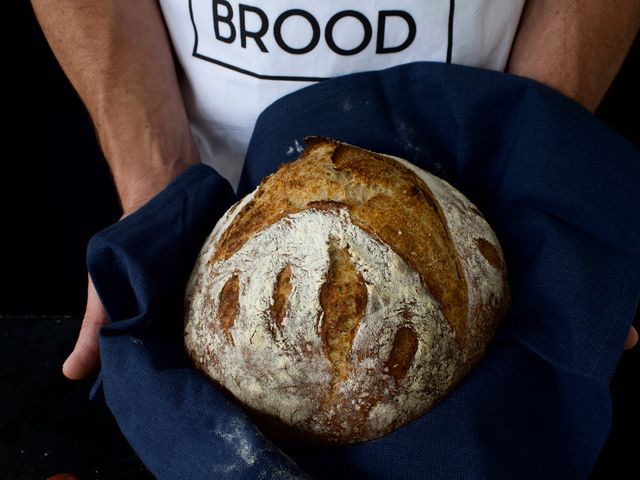
- Bake the uncovered bread for 10 minutes until the crust is deep golden brown with darker caramelization on the score.
- Use an instant-read thermometer to check the internal temperature—it should read 210°F (99°C) at the center.
+ Show details− Hide details
Ready when: Crust is deep golden brown, internal temperature is 210°F (99°C), bread sounds hollow when tapped
Tip: If the crust is not dark enough at 10 minutes, bake 2-3 minutes longer, but watch carefully so it doesn't burn.
Cool and hollow
- Transfer the baked bread to a wire rack and cool for 10 minutes.
- While still warm, carefully slice off a quarter of the top to create the bowl opening.
- Using a spoon or melon baller, gently scoop out about two-thirds of the interior crumb, leaving a ½-inch (1.3 cm) thick wall and base.
- Return the hollow bowl to the cooling rack for at least 1 hour before serving.
+ Show details− Hide details
Ready when: Interior crumb is steamy but the bread is firm enough to hollow without collapsing
Tip: Work quickly while the bread is still warm—it's easier to hollow and less likely to crack. Don't remove the bottom or walls will collapse.
Repeat and serveOven 500°F / 260°C
- Repeat steps 9-11 with the second bread round.
- Once fully cooled, the bread bowls can be filled with Thai curry, coconut soup, or any compatible soup or braise.
- Serve warm or at room temperature.
+ Show details− Hide details
Ready when: Bread is completely cool and structure is stable
Tip: Bake one at a time if your Dutch oven only holds one large round, or use a second Dutch oven if you have one.
Good to know
Tips
- Kaffir lime leaves (also called Thai lime leaves) are a key flavor—don't substitute with regular lime. They're available frozen in most Asian markets or online and keep well for months.
- Toast the coconut to dry it out; fresh or damp coconut will create a gummy texture and won't distribute evenly in the dough.
- Keep accurate track of dough temperature throughout fermentation. Warmer dough (78-80°F) ferments faster; cooler dough (72-74°F) is slower. Adjust room temperature or proof time accordingly.
- The hollowing step is easiest while bread is still warm and slightly steamy. The crumb will be tender, not crumbly, making it easier to scoop without tearing the walls.
Make ahead
Cold fermentation in the refrigerator for 12-48 hours before baking actually improves flavor and makes scoring easier. You can also prepare the dough through step 6, then cover and refrigerate up to 3 days before the cold proof in step 7.
Storage & reheating
Bread bowls keep at room temperature in a paper bag for up to 2 days. Refresh in a 375°F (190°C) oven for 8-10 minutes if they become stale. Store in the freezer in an airtight container for up to 1 month; thaw at room temperature and refresh in the oven before filling. Once filled with hot soup or curry, eat immediately.
Substitutions
- fresh or frozen kaffir lime leaves → 1 tbsp finely grated lemongrass (fresh or frozen) plus 1 tsp lime zest. Lemongrass provides similar citral aromatics if kaffir lime leaves are unavailable, though the flavor is slightly different.
- unsweetened shredded coconut → 80 g toasted coconut flakes or desiccated coconut. Coconut flakes give larger texture. Adjust toasting time to 3-4 minutes as they brown faster than shredded.
- bread flour → all-purpose flour or a mix of all-purpose and whole wheat flour (up to 10% whole wheat). Bread flour produces the highest rise; all-purpose flour works but may yield slightly less oven spring.
- active sourdough starter → If you don't have sourdough starter, use 1/4 tsp instant yeast dissolved in the water, though the bread will lack tang and character.. This is a significant compromise. A stronger starter culture is strongly recommended.