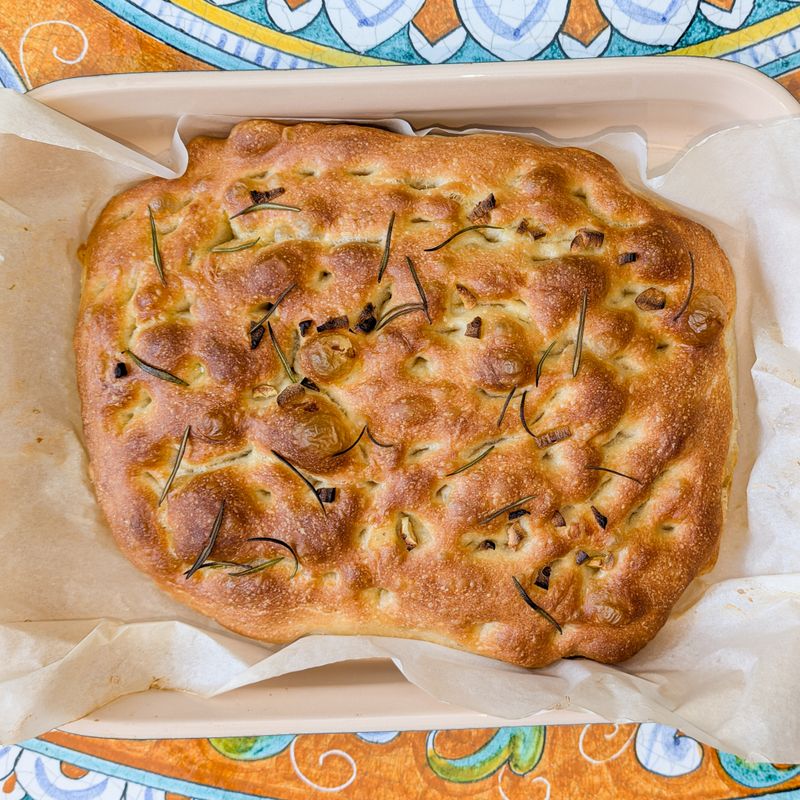
Sourdough Italian Focaccia al Olio with Fleur de Sel and Rosemary
A traditional Italian focaccia made with active sourdough starter, enriched with olive oil and topped with fleur de sel and fresh rosemary. The dough ferments long and slow, developing a tender crumb and subtle tangy flavor. After a final rise, dimple the surface, drizzle with extra virgin olive oil, and scatter with coarse sea salt and fragrant rosemary sprigs. The result is a golden, slightly crispy exterior with a soft, airy interior—perfect for serving alongside soup, salad, or cheese.
- Prep
- 20 min
- Cook
- 25 min
- Wait
- 7 hr
- Total
- 7 hr 45 min
- Makes
- 1 focaccia (9×13 inches / 23×33 cm), 8 pieces
Steps
Before you start
- Have your sourdough starter at room temperature and active (bubbly, at peak or slightly past), fed 4–8 hours before mixing
- Preheat your oven to 475°F (246°C) 30 minutes before baking
- Use a 9×13-inch (23×33 cm) sheet pan; no greasing needed
Mix the dough
- In a large bowl, combine the active sourdough starter, cool water, and bread flour.
- Stir with a wooden spoon or your hand until a shaggy dough forms with no dry flour visible.
- Cover the bowl loosely with a damp cloth and let rest 30 minutes (autolyse) to allow the flour to fully hydrate.
+ Show details− Hide details
Ready when: Flour fully incorporated, shaggy texture
Tip: A longer autolyse—even 1 hour—improves flavor and extensibility; don't skip it.
Add salt and oil, develop dough
- Sprinkle kosher salt and the 2 tablespoons of olive oil over the rested dough.
- Using wet fingers or a dough whisk, pinch and fold the dough over itself about 10–12 times, rotating the bowl slightly with each fold, until the salt and oil are fully incorporated.
- The dough will be wet, loose, and sticky—this is correct.
+ Show details− Hide details
Ready when: Salt and oil fully integrated; dough is shiny and slack
Tip: Wet your fingers with water between folds to prevent sticking. Don't overwork—focaccia dough should remain loose and oily.
Bulk fermentation: first stretch and fold
- Cover the dough and let it rest at room temperature (68–72°F / 20–22°C) for 40 minutes.
- Then perform one set of stretch-and-folds: wet your hand, grab the edge of the dough, stretch it up and over itself toward the center, rotate the bowl a quarter turn, and repeat 4 times.
- Cover again.
+ Show details− Hide details
Ready when: Dough is slightly puffier; surface looks smoother
Tip: Stretch-and-folds strengthen the dough without aggressive kneading; they work best on a wet, slack dough.
Bulk fermentation: second and third folds
- After another 40 minutes, repeat the stretch-and-fold sequence one more time.
- Let rest again, then perform a third set of stretches after 40 more minutes.
- Total bulk time will be about 2 hours.
- The dough should increase in volume by 50–75%, feel airy and puffy, and jiggle slightly when the bowl is nudged.
+ Show details− Hide details
Ready when: Dough is visibly risen; surface shows bubbles; dough jiggles
Tip: Consistent room temperature ensures even fermentation. If your kitchen is cool, bulk fermentation may take 2.5–3 hours.
Shape onto sheet pan
- Gently pour or scrape the dough onto your sheet pan (it will be very wet—no kneading needed).
- Using a wet bench scraper or your wet fingers, coax and stretch the dough to fill the pan evenly, starting from the center and working toward the edges.
- Don't deflate it too much; let it puff up slightly as you work.
- Cover loosely with a damp cloth.
+ Show details− Hide details
Ready when: Dough fills the pan; surface is smooth and lightly dimpled
Tip: Keep your hands or scraper wet so the dough doesn't stick. Gentle handling preserves the gas pockets you've built up.
Final proof
- Let the dough rest on the sheet pan at room temperature for 45–60 minutes, until it is puffy, springs back slowly when poked with a wet finger, and the surface shows small, irregular bubbles beneath the surface.
- The dough should have increased noticeably in volume but should not be flat or damp-looking.
+ Show details− Hide details
Ready when: Dough is puffy and pillowy; poke test yields slow spring-back
Tip: Proofing time depends on room temperature. Cold kitchens need longer; warm ones may finish in 40 minutes. Use the poke test as your guide.
Dimple and oil the surfaceOven 475°F / 245°C
- About 10 minutes before the dough finishes proofing, preheat your oven to 475°F (246°C).
- When ready to bake, wet your fingers and gently press dimples across the entire surface of the dough, creating deep wells about ½ inch (1.25 cm) apart, going halfway down into the dough but not touching the bottom.
- Drizzle the 3 tablespoons of best-quality olive oil all over, letting it pool in the dimples.
- Scatter the fleur de sel evenly across the surface, then sprinkle the fresh rosemary leaves over the top.
+ Show details− Hide details
Ready when: Surface is evenly dimpled; olive oil pools in wells; herbs visible
Tip: Don't press so hard that you deflate the dough completely. Wet fingers help you glide across without tearing. Reserve the best oil for topping—it's what guests taste.
Bake until goldenOven 475°F / 245°C
- Place the sheet pan in the preheated 475°F (246°C) oven.
- Bake for 22–26 minutes, until the top is deep golden brown—almost amber in spots—and the edges are crispy and slightly darker.
- The focaccia should smell nutty and fragrant.
- If the bottom is not yet deep golden, slide the pan onto the oven rack (no sheet) and bake another 2–3 minutes.
+ Show details− Hide details
Ready when: Top is deep golden brown; edges are crispy and fragrant
Tip: Oven temperatures vary; start checking at 20 minutes. A dark, glossy top indicates proper caramelization and a crispy crust.
Cool and serve
- Transfer the hot focaccia to a wire rack or clean cutting board and let cool for 10–15 minutes.
- This brief rest allows the structure to set and makes it easier to slice cleanly.
- Cut into 8 pieces (2 lengthwise, 4 crosswise) and serve warm or at room temperature, drizzling with a tiny bit more olive oil if desired.
+ Show details− Hide details
Ready when: Focaccia is warm and structurally set; cuts cleanly
Tip: Warm focaccia is soft and may tear if sliced too soon; cooled focaccia holds its shape better. It's delicious either way.
Good to know
Tips
- Active sourdough starter is crucial. It should be bubbly, roughly doubled in size, and smell pleasantly sour—fed 4–8 hours before mixing. A sluggish or fed-too-long starter will result in dense, flat focaccia.
- Room temperature matters. Aim for 68–72°F (20–22°C). Warmer rooms shorten bulk fermentation; cooler rooms extend it. Use the visual cues (dough volume, poke test) rather than strict timing.
- Don't skip the stretch-and-folds. They strengthen a wet dough without kneading, build structure, and create those beautiful irregular crumbs that make focaccia special.
- Save your best olive oil for topping, not the dough. The quality of the topping oil is what your guests will taste and remember. Spanish, Italian, or Greek extra virgin oils all excel here.
Make ahead
You can prepare the dough through the end of bulk fermentation (after the third stretch-and-fold), then shape it onto the sheet pan, cover, and refrigerate overnight (8–12 hours). Remove from the fridge 1–2 hours before baking so it can come to room temperature and finish its proof. Cold fermentation deepens flavor and makes the dough easier to handle.
Storage & reheating
Store cooled focaccia in an airtight container or wrapped tightly in foil at room temperature for up to 2 days. To reheat, wrap in foil and warm in a 325°F (163°C) oven for 10–12 minutes. Focaccia keeps in the freezer (wrapped well) for up to 1 month; thaw at room temperature, then reheat as above.
Substitutions
- fresh rosemary sprigs → fresh thyme leaves or a mix of thyme and oregano. Use the same amount (1.5 tablespoons / 5 g). Thyme is more delicate; oregano adds peppery notes. Both work beautifully on focaccia.
- fleur de sel or Maldon sea salt → Maldon sea salt or other large-flake coarse sea salt. Fleur de sel and Maldon are nearly identical; use whichever you have. Avoid fine table salt—the dimples won't hold it evenly.
- extra virgin olive oil, best quality → garlic-infused olive oil or truffle oil. Drizzle the same amount. Garlic oil adds savory depth; truffle oil adds earthy luxury. Use only high-quality versions.
- bread flour → all-purpose flour. Use the same weight (325 g). Bread flour yields a slightly chewier crust; all-purpose produces a softer, more tender crumb. Both are delicious.