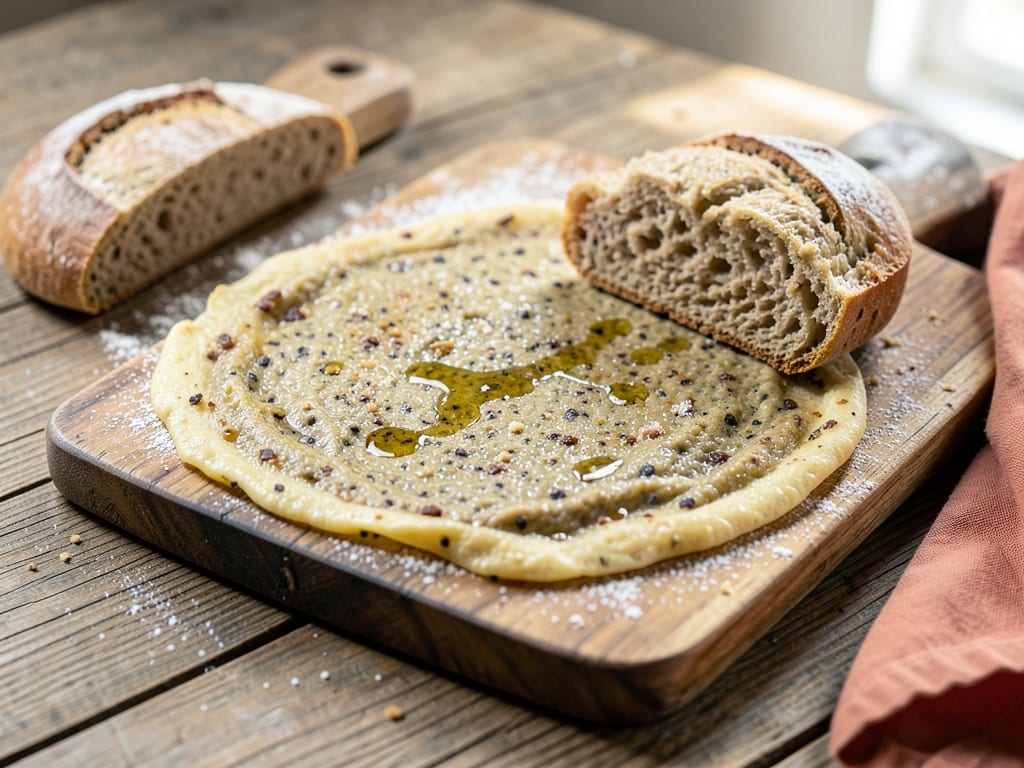
Sourdough Indian Uttapam: Spiced Lentil and Vegetable Griddle Cake
A savory Indian-inspired griddle cake that transforms sourdough discard into tender, tangy uttapam studded with roasted lentils, caramelized onions, and fresh tomatoes. Cumin seeds and green chili create warmth and gentle heat, while the sourdough gives a complex fermented flavor that complements the earthy lentil flour. These are best served warm with coconut chutney or yogurt, making them perfect for breakfast, brunch, or a light lunch.
- Prep
- 20 min
- Cook
- 20 min
- Wait
- 30 min
- Total
- 1 hr 10 min
- Makes
- 4 uttapam (serves 2–3 as a main, 4 as a light meal)
Steps
Before you start
- Have sourdough discard at room temperature and ready to use (fed 4–8 hours prior is ideal, or unfed discard works fine)
- Prep all vegetables (onion, tomato, green chili, cilantro) and measure spices before you begin—the batter comes together quickly
- Have a non-stick or cast-iron skillet or griddle ready; a 10-inch (25 cm) skillet works best for 5–6 inch (12–15 cm) cakes
Mix dry ingredients
- In a medium bowl, whisk together the lentil flour, rice flour, salt, cumin seeds, black pepper, and fenugreek seeds (if using).
- This distributes the spices and leavens the flour evenly.
+ Show details− Hide details
Ready when: Spices evenly distributed throughout flour mixture
Tip: Whisk thoroughly so cumin seeds and seasoning are not clumped together
Combine batter base
- Pour the sourdough discard into the dry mixture, add water, and whisk until you have a thick, pourable batter with no lumps.
- The consistency should be thicker than pancake batter but thinner than dough—it should spread gently on the skillet without running.
+ Show details− Hide details
Ready when: Smooth, lump-free batter that flows slowly
Tip: If too thick, add water 1 tablespoon at a time; if too thin, whisk in a bit more lentil flour. The batter should coat the back of a spoon
Prepare and sauté toppings
- Heat 1 tablespoon (15 ml) of ghee in the skillet over medium-high heat (about 6/10).
- Add the sliced onions and cook for 5–6 minutes, stirring occasionally, until golden and slightly caramelized at the edges.
- The onions should be soft and sweet.
- Add the minced ginger, cook for 30 seconds, then add the minced green chili and stir for another 30 seconds until fragrant.
- Transfer the cooked onion mixture to a small bowl and set aside.
- Wipe the skillet clean with a damp cloth or paper towel.
+ Show details− Hide details
Ready when: Onions are golden and soft; ginger and chili are fragrant
Tip: Caramelizing the onions brings out their natural sweetness, which balances the tartness of the sourdough. Don't rush this step
Rest batter and finish filling
- While the onions cook, fold the diced tomato, cooked onion mixture, and chopped cilantro into the batter.
- Stir gently to distribute evenly.
- Let the batter rest for 5–10 minutes at room temperature.
- This resting allows the lentil flour to fully hydrate and the sourdough's fermentation to add subtle lift.
+ Show details− Hide details
Ready when: Batter looks slightly puffier and vegetables are distributed throughout
Tip: Do not overmix once vegetables are added or the tomato juices will make the batter too wet
Heat skillet and cook uttapam
- Heat the skillet over medium-high heat (6–7/10) and lightly coat with about 1.5 teaspoons (7 ml) of ghee.
- When the ghee shimmers and just begins to smoke slightly, pour about ¼ cup (60 ml) of batter into the center of the skillet.
- Using the back of a spoon or a small offset spatula, gently spread it into a 5–6 inch (12–15 cm) round about ¼ inch (0.6 cm) thick.
- Do not make it paper-thin; uttapam should be substantial.
+ Show details− Hide details
Ready when: Ghee shimmers and begins to smoke
Tip: Have all your batter ready before you start cooking; each uttapam cooks quickly and you'll want to work steadily
Cook first side until golden
- Cook undisturbed for 3–4 minutes.
- You will hear a gentle sizzle and smell the toasted lentil flour aroma.
- The bottom should turn golden-brown and crispy while the top begins to set.
- Peek under the edge with a spatula to check color—it should be a deep golden brown with some darker speckled bits from the toasted cumin seeds.
+ Show details− Hide details
Ready when: Bottom is deep golden brown and crispy; top surface has set and begun to lose shine
Tip: Resist the urge to move or press the uttapam. If the heat is right, it will release naturally from the pan
Flip and cook second side
- Using a spatula, carefully slide it under the uttapam and flip it in one confident motion.
- Cook the second side for 2–3 minutes until it is also golden and crispy, and the center is set when pressed gently with your finger.
- The uttapam will feel slightly springy and firm, not wet or doughy in the center.
+ Show details− Hide details
Ready when: Second side is golden; cake feels firm and springy when gently pressed in the center
Tip: If the second side is browning too quickly, lower the heat slightly to medium (5.5/10) to give the interior time to cook through
Transfer and repeatOven 200°F / 95°C
- Transfer the cooked uttapam to a warm plate.
- Repeat the process with the remaining batter, coating the skillet with about 1.5 teaspoons (7 ml) ghee for each cake.
- You should be able to make 3–4 uttapam depending on how thick you spread them.
- Stack them on the plate, or keep them warm in a 200°F (93°C) oven if you are not serving immediately.
+ Show details− Hide details
Ready when: All uttapam are cooked through and golden on both sides
Tip: Each uttapam cooks quickly once you get the skillet temperature right; don't walk away from the stove during cooking
Serve warm
- Serve the uttapam warm, within 10 minutes of cooking.
- They are best enjoyed fresh and still slightly steaming.
+ Show details− Hide details
Tip: Uttapam can be eaten on its own, with a dollop of plain yogurt, fresh chutney (mint-cilantro or coconut), or a squeeze of lemon
Good to know
Tips
- Sourdough discard adds tang and depth: unfed discard (straight from the jar) works fine, but recently fed discard (within 4–8 hours of feeding) may give slightly more lift and a mellower flavor.
- The ratio of lentil flour to rice flour is important: lentil flour brings the earthy, protein-rich flavor and structure, while rice flour keeps the cake tender and prevents it from being too dense or gritty.
- Temperature control is key to crispy, evenly cooked uttapam: medium-high heat with a properly seasoned or non-stick pan ensures even browning without burning. If your skillet is old or uneven, lower the heat slightly to medium and give each side an extra 30 seconds.
- Uttapam are best enjoyed immediately while the exterior is crispy and the interior is still warm. If serving a group, cook them in batches and keep the finished ones on a warm plate in a low oven.
Make ahead
The batter can be made up to 2 hours ahead and refrigerated; bring it back to room temperature before cooking. This may even improve flavor as the sourdough continues to ferment. However, it is best to cook the uttapam and serve within 10 minutes of cooking, as they soften and lose crispness as they cool.
Storage & reheating
Store leftover uttapam in an airtight container at room temperature for up to 4 hours, or refrigerate for up to 3 days. Reheat in a dry skillet over medium heat for 1–2 minutes per side until warmed through and the exterior re-crisps. Do not microwave, as they will become rubbery. Uttapam do not freeze well due to their delicate texture.
Substitutions
- roasted red lentil flour (or roasted chana dal flour) → chickpea flour (besan) or a 1:1 blend of chickpea and roasted gram flour. Chickpea flour is slightly nuttier but works well; use the same amount. The texture will be slightly denser.
- rice flour or all-purpose flour → all-purpose flour, millet flour, or buckwheat flour. All-purpose flour creates a more tender cake. Millet or buckwheat adds earthiness but may require slightly less water.
- ghee or neutral oil (vegetable, coconut, or sesame) → coconut oil, sesame oil, or butter. Ghee is traditional and adds rich flavor; coconut oil adds subtle sweetness; sesame oil (use only ½ amount) adds nuttiness.
- cumin seeds → fennel seeds, mustard seeds, or a blend of cumin and coriander seeds. Fennel adds licorice notes; mustard seeds add sharp pungency. Adjust to taste.