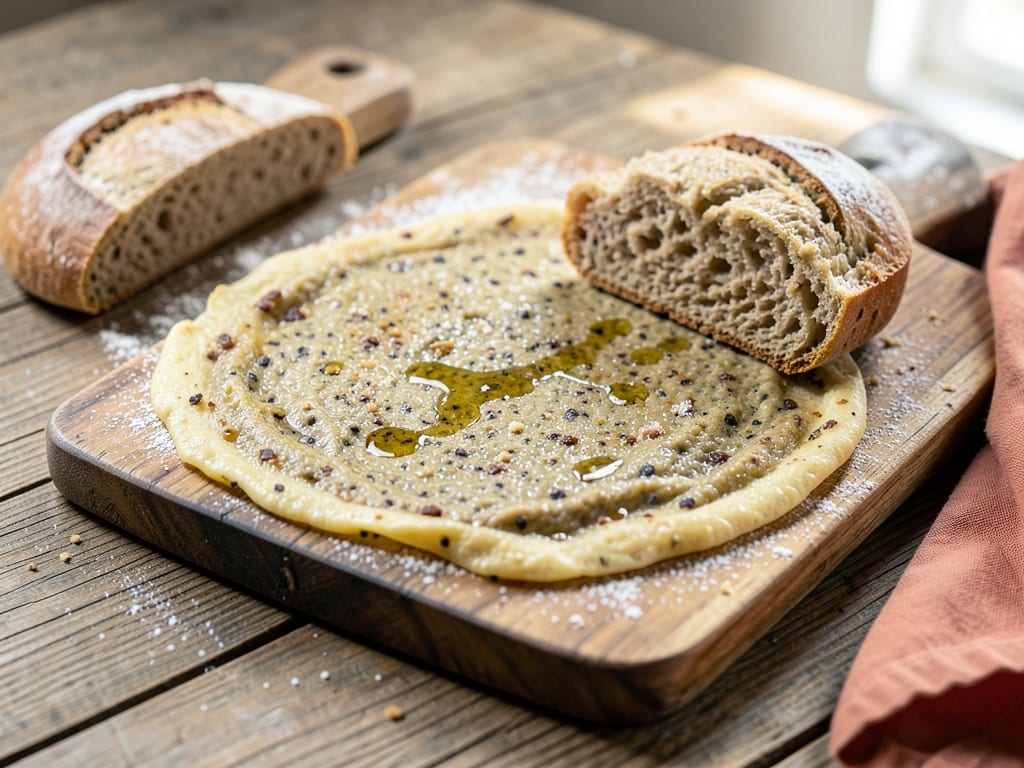
Sourdough Dosa
Crisp, golden South Indian crepes made with a fermented urad dal and rice flour batter boosted by sourdough discard. The discard adds gentle tang and speeds up fermentation, so you get lacy, crackly dosas with very little fuss.
- Prep
- 30 min
- Cook
- 30 min
- Wait
- 14 hr 10 min
- Total
- 15 hr 10 min
- Makes
- About 12 dosas (7–8 inches / 18–20 cm each)
Steps
Before you start
- Plan ahead: the dal soaks 4 hours and the batter ferments 8–12 hours, so start the day before (for example, soak mid-afternoon, grind in the evening, cook the next morning).
- Use unfed sourdough discard at 100% hydration (equal weights flour and water). Stiffer or wetter discard will change the batter thickness, so adjust the thinning water.
- You need a blender or wet grinder that can make a very smooth paste. A high-speed blender works if you grind in two batches with cold water.
- Find a warm spot (78–85°F / 25–29°C) for fermenting, such as an oven with only the light on. Cooler kitchens need the full 12 hours or more.
Soak dal and fenugreek
- Rinse the urad dal in a bowl, swirling and draining 3 times.
- Return it to the 2-quart bowl with the fenugreek seeds and 2 cups (480 ml) room-temperature soak water.
- Let stand uncovered on the counter for 4 hours.
+ Show details− Hide details
Ready when: Dal is plump and a grain crushes easily between your fingers with no hard center
Tip: Do not soak longer than 6 hours in a hot kitchen, or the dal may start to smell sour before grinding.
Grind to fluffy paste
- Drain the dal and fenugreek well, discarding the soak water.
- Add to a blender with ½ cup (120 ml) cold water.
- Blend on high for 3–4 minutes, stopping to scrape down the sides, until completely smooth.
- If your blender struggles, grind in two batches and divide the water.
+ Show details− Hide details
Ready when: Paste is silky with no grit, pale, and noticeably fluffy and thick like soft whipped cream
Tip: Use cold water and pause if the blender gets hot. Heat damages the wild yeast and makes the batter ferment poorly.
Combine batter base
- Scrape the paste into the 4-quart fermenting bowl.
- Add the rice flour and sourdough discard.
- Mix with clean hands or a spatula for 2 minutes until no dry flour remains.
- The batter will be thick, like a dense pancake batter.
- Mixing by hand adds warmth and helpful microbes.
+ Show details− Hide details
Ready when: Batter is uniform, thick, and slowly falls off a spoon in a ribbon
Tip: Choose a bowl at least twice the batter volume since it will rise significantly.
Ferment the batter
- Cover the bowl loosely with a plate or towel (not airtight).
- Leave in a warm spot, 78–85°F (25–29°C), for 8–12 hours.
- Do not stir during this time.
+ Show details− Hide details
Ready when: Batter has risen by about double, is domed and covered with small bubbles, and smells pleasantly tangy and yeasty
Tip: In a cool kitchen, expect closer to 12–14 hours. If it has not risen after 12 hours, give it more time rather than cooking it.
Season and thin batter
- Sprinkle the salt and optional sugar over the batter.
- Stir gently in one direction for about 1 minute to keep some air.
- Add ¾ cup (180 ml) cool water in 2–3 additions, stirring.
- The batter should flow like heavy cream and coat the back of a spoon thinly.
- Let it rest 10 minutes.
- Add up to ¼ cup (60 ml) more water if it still seems thick.
+ Show details− Hide details
Ready when: Batter pours in a smooth, steady stream and ripples back together within a couple of seconds
Tip: Too-thick batter makes soft, uneven dosas that tear. Too-thin batter makes holes. Test with one dosa and adjust.
Heat the skillet
- Set the 10-inch (25 cm) skillet or tawa over medium-high heat for 3–4 minutes.
- Flick a few drops of water on the surface.
- They should sizzle and evaporate within 1–2 seconds.
- Wipe the surface once with a folded paper towel dipped in a little oil.
+ Show details− Hide details
Ready when: Water droplets dance and vanish within 1–2 seconds
Tip: If the pan is too hot, batter sets before you can spread it. Lower the heat slightly or wipe with a damp towel to cool the surface.
Pour and spread
- Stir the batter gently.
- Pour a scant ¼ cup (60 ml) onto the center of the pan.
- Using the bottom of the ladle, spread in quick light spirals from the center outward to make a thin 7–8 inch (18–20 cm) round.
- Drizzle ½ teaspoon oil around the edge and over the top.
+ Show details− Hide details
Ready when: Batter sets with a lacy, matte surface in about 20 seconds
Tip: Spread with a light touch and do not press down, which tears the surface.
Cook until crisp
- Cook for 2–3 minutes without flipping.
- The underside will turn deep golden, the edges will curl away from the pan, and the top will look dry.
- Fold in half or roll and slide onto a plate.
+ Show details− Hide details
Ready when: Underside is golden brown and crisp, edges lift easily, top is dry with no wet batter
Tip: If the first dosa sticks or tears, the pan is too cool or too hot. Treat it as a test and adjust.
Repeat with remaining batter
- Return the heat to medium-high.
- Wipe the pan with a damp folded towel for 2–3 seconds to cool and clean it, then pour, spread, and cook the remaining batter the same way, restirring the batter every few dosas.
- Stack finished dosas loosely, or serve straight from the pan with chutney, sambar, or potato masala.
+ Show details− Hide details
Ready when: Each dosa is evenly golden and crisp, about 2–3 minutes per dosa
Tip: Stir the batter gently each time you scoop since it settles. Do not whisk hard, which deflates the bubbles.
Good to know
Tips
- For a crisper dosa, spread the batter thinner and cook it an extra 30 seconds; for a softer, thicker one, use a little more batter and cover the pan for 1 minute.
- A well-seasoned cast-iron pan or tawa gives the best crispness. Nonstick works but may brown less.
- If the dosas stick, wipe the pan with half an onion dipped in oil between rounds.
- Taste the batter before cooking. It should be mildly tangy, not sharply sour. If it is too sour, it fermented too long; thin it a little more and add a pinch more sugar.
Make ahead
Ferment the batter, then refrigerate it before adding salt and thinning water, for up to 4 days. Bring it to room temperature for 30–45 minutes, then season and thin as in step 5. The flavor becomes more sour each day.
Storage & reheating
Cooked dosas keep at room temperature for up to 2 hours. Refrigerate in an airtight container for up to 2 days and reheat on a hot dry skillet for 30–60 seconds per side to re-crisp. Fermented, seasoned batter keeps in the fridge for up to 4 days. Batter can be frozen up to 1 month; thaw overnight in the fridge and stir gently. Cooked dosas do not freeze well.
Substitutions
- neutral oil or melted ghee → Clarified butter (ghee) or coconut oil. Ghee gives the best flavor and browning; coconut oil adds a slight sweetness.
- granulated sugar → Omit. Sugar only helps browning, so the dosas will be a little paler without it.
- white rice flour → Idli rice or parboiled rice, soaked and ground (about 1 cup / 200 g dry). Soak for 4 hours and grind with the dal for a more traditional texture; the batter will need a slightly longer ferment.
- fine sea salt → Kosher salt, 2 tsp (Diamond Crystal) or 1½ tsp (Morton). Measure by weight (9 g) if possible, since crystal sizes differ.
More breakfast dishes
See all →
Find more like this
- Meal
- Breakfast
- Cuisine
- South Indian
- Method
- Stovetop
- Quick & Easy
- Make Ahead