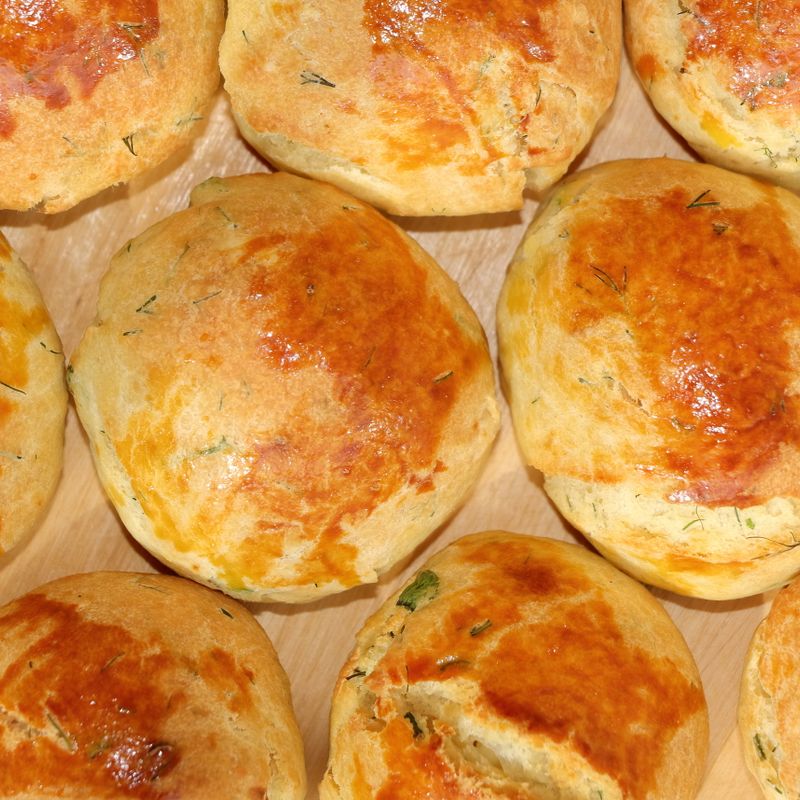
Sourdough Garlic Parmesan Dinner Rolls
Soft, tangy sourdough dinner rolls infused with butter and topped with a savory crust of garlic and Parmesan cheese. These rolls have a tender, open crumb from the slow sourdough fermentation and a beautiful golden exterior with an herbaceous, umami finish. Perfect alongside soups, stews, or any meal where you want something more interesting than standard rolls.
- Prep
- 20 min
- Cook
- 20 min
- Wait
- 7 hr 30 min
- Total
- 8 hr 10 min
- Makes
- 12 rolls
Steps
Before you start
- Feed your sourdough starter 4–6 hours before mixing; it should be bubbly, active, and roughly doubled
- Use bread flour if available; it produces chewier, more structured rolls than all-purpose flour
- Have a 9×13-inch (23×33 cm) baking pan ready on your counter
- Read through the bulk fermentation steps (Steps 2–4) so you understand the stretch-and-fold technique
Mix dough with autolyse
- In a large bowl, combine 100g active sourdough starter, 120ml lukewarm water (75–80°F / 24–27°C), and 300g bread flour.
- Stir with your hand or a wooden spoon until all the flour is moistened and no dry bits remain; the mixture should look shaggy.
- Let rest uncovered at room temperature for 30 minutes (this is called the autolyse and allows the flour to fully hydrate).
- After 30 minutes, add 5g salt and 25g softened butter.
- Mix by hand or use a stand mixer on low speed for 5–7 minutes until the dough comes together smoothly and the butter is fully incorporated.
- The finished dough should be soft and slightly sticky—resist the urge to add extra flour.
+ Show details− Hide details
Ready when: Dough is smooth and elastic; butter is fully incorporated; dough holds together when gathered
Tip: Slightly sticky dough is correct for sourdough rolls and yields a tender crumb. Higher hydration (wet dough) = more open holes and softer rolls.
Perform first stretch and fold
- At 30 minutes after Step 1, perform a stretch and fold: wet your hand with cool water (this prevents sticking), grab one side of the dough, stretch it upward, and fold it over the center of the mass.
- Rotate the bowl 90 degrees and repeat 4 times total.
- The dough will become smoother and firmer.
- Return it to the bowl, cover loosely with a damp kitchen towel, and let rest for 30 minutes.
+ Show details− Hide details
Ready when: Dough is noticeably smoother and holds its shape better than before the folds
Tip: Wet your hands rather than flouring them—it prevents sticking and avoids adding extra flour to the dough. Each stretch-and-fold is gentle; you're building structure, not kneading aggressively.
Perform second stretch and fold
- Repeat the stretch and fold process described in Step 2: wet your hand, perform 4 stretches and folds around the perimeter of the dough, rotating 90 degrees between each fold.
- Cover the bowl with the damp towel and rest for 30 minutes.
+ Show details− Hide details
Ready when: Dough is considerably puffier and feels airy when you gently squeeze it
Final fold and bulk fermentation
- Perform one final round of stretch and folds (4 stretches and folds as before).
- Cover the bowl with the damp towel and let the dough rise at room temperature (68–72°F / 20–22°C) until it has roughly doubled in volume and shows visible bubbles and air pockets on the surface.
- Gently shake the bowl—the dough should jiggle and feel airy, not dense.
- Total bulk fermentation time from Step 1 is typically 6–8 hours, depending on your kitchen temperature.
- Cooler rooms (65°F / 18°C) may take 8+ hours; warmer rooms (75°F / 24°C) may finish in 4–5 hours.
+ Show details− Hide details
Ready when: Dough has roughly doubled; surface shows bubbles; dough jiggles when you gently shake the bowl; a poke leaves a slow-springing indent
Tip: Watch the dough, not the clock—fermentation speed depends entirely on room temperature. Underfermentation yields dense rolls; overfermentation yields gummy, collapsed rolls. Aim for roughly doubled volume.
Shape rolls and arrange in pan
- Turn the dough out onto a lightly oiled surface (use about 15ml olive oil on the work surface).
- Gently stretch the dough into a rough 12×8-inch (30×20 cm) rectangle, trying not to deflate the bubbles you've developed.
- Using a sharp bench knife or pizza cutter, divide the dough into 12 equal squares (3 rows × 4 columns).
- Working with one square at a time, roll it into a tight ball by pulling the corners toward the bottom and pinching them together to seal.
- Place the rolls seam-side down in a 9×13-inch (23×33 cm) baking pan, arranging them in 3 rows of 4.
- The rolls should be snug but not compressed—they'll have room to expand during the final proof.
- Cover loosely with a damp towel.
+ Show details− Hide details
Ready when: 12 evenly shaped, round rolls are arranged snugly in the baking pan
Tip: Handle the dough gently and work quickly—you want to preserve the air bubbles. Do not compress or aggressively knead the rolls.
Final proofing
- Let the shaped rolls rise in the pan at room temperature (68–72°F / 20–22°C) for 60–90 minutes until they are puffy and have risen about halfway up the side of the pan.
- Gently poke one roll with your finger—if the dough springs back slowly (leaving a slight indent that doesn't immediately disappear), the rolls are ready to bake.
- If they spring back immediately, they need more time; if they don't spring back at all, they are likely overproofed.
+ Show details− Hide details
Ready when: Rolls are puffy, have roughly doubled in height, and poke-indent springs back slowly
Tip: If your kitchen is cold (below 65°F / 18°C), this step may take up to 2 hours. Watch for the slow-spring-back indicator, not the timer. Overproofed rolls will collapse in the oven and become gummy inside.
Preheat oven and prepare garlic-Parmesan toppingOven 400°F / 205°C
- While the rolls are proofing, preheat your oven to 400°F (200°C).
- In a small bowl, melt 25g butter in the microwave (30–45 seconds) or in a small saucepan over low heat.
- Stir in 3 minced garlic cloves, 50g finely grated Parmesan cheese, and optionally 3g finely chopped fresh parsley.
- Season very lightly with salt and pepper to taste (the Parmesan is already salty, so be restrained).
- Stir until well combined and fragrant.
+ Show details− Hide details
Ready when: Oven is fully preheated to 400°F (200°C); topping is warm, well mixed, and fragrant
Tip: Mince the garlic finely so it distributes evenly and doesn't burn. If using fresh parsley, add it at the last moment before brushing onto the rolls to preserve its color and flavor. Do not add salt aggressively—Parmesan is salty.
Brush topping and bakeOven 400°F / 205°C
- Just before baking, brush the garlic-Parmesan mixture generously over the top of each roll, using all of the topping and working it into any crevices between the rolls.
- Place the pan in the preheated 400°F (200°C) oven.
- Bake for 18–22 minutes until the rolls are deep golden brown on top and the edges are golden and crispy.
- The topping should be fragrant and slightly caramelized.
- If the tops are browning too quickly before the rolls are fully baked (around 15 minutes), loosely tent the pan with a piece of foil for the remaining time.
+ Show details− Hide details
Ready when: Rolls are deep golden brown on top; edges are crispy and golden; topping is fragrant and caramelized; internal temperature of a roll center reads 195–200°F (90–93°C)
Tip: Do not open the oven door during the first 15 minutes, or steam will escape and rolls may not rise properly. Watch the tops closely in the final minutes—Parmesan can go from caramelized to burnt quickly.
Cool and serve
- Remove the pan from the oven and let the rolls cool in the pan for 5 minutes (they will firm up and be easier to remove).
- Turn them out onto a wire rack to cool slightly, or serve them directly from the pan while warm.
- The rolls are best eaten warm but remain delicious at room temperature.
+ Show details− Hide details
Ready when: Rolls are golden brown, still warm, and pull apart easily without tearing
Good to know
Tips
- Room temperature controls everything: Sourdough fermentation is temperature-dependent. A cool kitchen (65°F / 18°C) extends bulk fermentation to 8+ hours; a warm kitchen (75°F / 24°C) may finish in 4–5 hours. Watch the dough, not the clock—look for roughly doubled volume and a slow spring-back when poked.
- These rolls reheat beautifully: Brush lightly with olive oil and warm in a 300°F (150°C) oven for 5 minutes. They regain their softness without drying out. You can also wrap a roll in a damp paper towel and microwave for 20–30 seconds.
- For even more flavor, make a compound butter the night before: mix softened butter with minced garlic, finely grated Parmesan, fresh chopped parsley, and a pinch of black pepper. Spread it on the warm rolls just before serving for an extra-decadent experience.
- A mature, active sourdough starter (at least 4–5 days old and regularly fed) is essential. If your starter is sluggish or new, it won't provide enough lift. A mature starter roughly doubles within 4–6 hours of feeding and smells pleasantly sour and yeasty.
Make ahead
Prepare the dough through Step 3 (first two rounds of stretch and folds), then cover and refrigerate overnight in the same bowl or transfer to an airtight container. In the morning, remove from the fridge, perform one final stretch and fold (Step 4), and let it rise at room temperature until doubled (usually 4–6 hours due to the cold start). Then proceed with shaping and final proofing. Cold fermentation deepens the sourdough tang significantly.
Storage & reheating
Room temperature: Store cooled rolls in an airtight container or resealable bag for up to 2 days. Reheat gently in a 300°F (150°C) oven for 5 minutes before serving. Freezer: Wrap cooled rolls individually in plastic wrap and place in a freezer bag; freeze for up to 1 month. Thaw at room temperature for 1–2 hours, then warm in a 300°F (150°C) oven for 8–10 minutes until heated through.
Substitutions
- garlic cloves → 1 tsp garlic powder (use only 1/2 tsp for a milder flavor). Garlic powder delivers a sharper, less fresh flavor than minced garlic and can taste slightly bitter if overused. Mix it into the melted butter in Step 7. Fresh garlic is preferred for a brighter, more herbaceous result.
- bread flour → all-purpose flour (use same weight, 300g). All-purpose flour yields slightly softer, less chewy rolls because it has less gluten. The rolls will still be delicious but may rise slightly faster and have a more tender crumb. Bulk fermentation time may be 30 minutes shorter.
- Parmesan cheese (Parmigiano-Reggiano preferred) → Pecorino Romano cheese or aged sharp Cheddar. Pecorino Romano is sharper and saltier; reduce the amount to 40g. Aged Cheddar adds a tangier, nuttier flavor and works at the same 50g amount. Both are excellent alternatives.
- active sourdough starter (fed and bubbly, at room temperature) → 1 tsp instant (rapid-rise) yeast mixed with 60g whole wheat flour and 60ml lukewarm water, rested 30 minutes to activate. This creates a quick sourdough-like base (though it lacks sourdough tang) and allows faster fermentation. Reduce bulk fermentation to 3–4 hours and follow the same visual cues. The rolls will be lighter in color and slightly less complex in flavor, but still delicious and much faster.
More rolls & buns
See all →




Find more like this
- Meal
- Dinner
- Cuisine
- French
- Main ingredient
- Parmesan
- Method
- Oven
- Quick & Easy
- Make Ahead