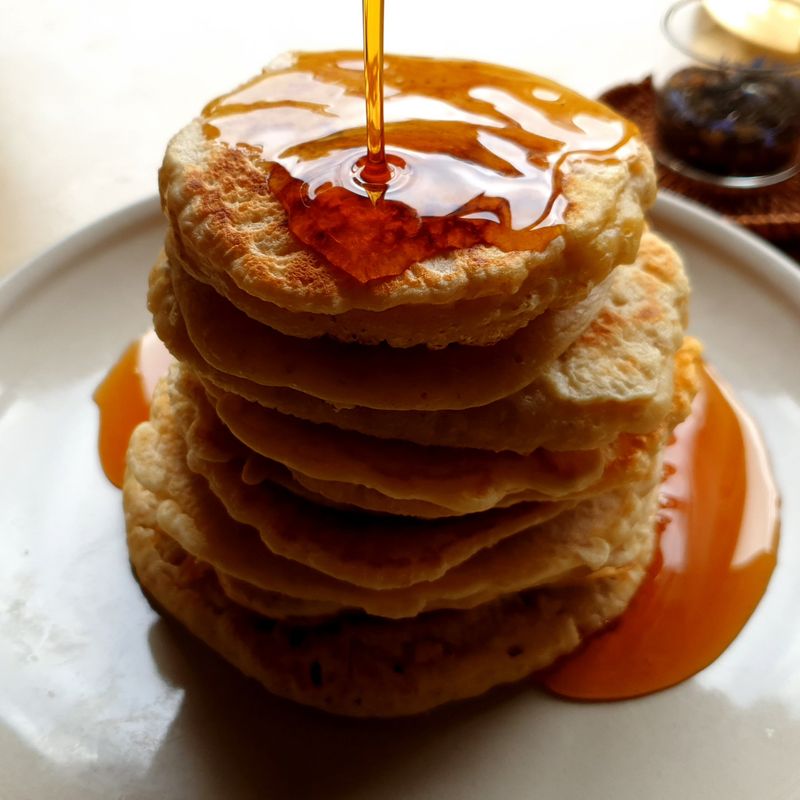
Sourdough Discard Pancakes
Fluffy, golden griddle pancakes with a gentle tang from unfed sourdough discard. They come together in one bowl in about 10 minutes, with no overnight wait and no extra rising agent beyond baking soda.
- Prep
- 10 min
- Cook
- 20 min
- Wait
- 5 min
- Total
- 35 min
- Makes
- 12 pancakes (4 inches / 10 cm each)
Steps
Before you start
- Use discard that is 100% hydration (fed with equal weights flour and water), stirred well and measured by weight. It can be straight from the fridge, but let it sit out 15 minutes if you can, because cold discard slows cooking.
- Take the milk and eggs out of the fridge 20 to 30 minutes ahead so the melted butter does not clump when it hits them.
- Plan for 3 batches on a standard griddle or 12-inch skillet. Warming the oven first keeps early batches hot while you finish.
- Do not stir the batter more than the instructions say. A few small lumps are what keep the pancakes tender.
Warm the ovenOven 200°F / 95°C
- Heat the oven to 200°F (95°C).
- Set a wire rack inside a baking sheet and place it on the middle rack so finished pancakes can stay warm without steaming.
+ Show details− Hide details
Ready when: Oven reads 200°F (95°C).
Tip: Keep the pancakes in a single layer on the rack. Stacking them makes them soggy.
Melt the butter
- Melt the 3 tablespoons (42 g) butter in a small saucepan or in the microwave in 15-second bursts.
- Set it aside for 2 minutes to cool slightly.
+ Show details− Hide details
Ready when: Butter is fully liquid and warm, not hot to the touch.
Tip: Hot butter can scramble the eggs when you whisk it in.
Whisk the wet ingredients
- In the medium bowl, whisk the sourdough discard, milk, eggs and vanilla for about 30 seconds.
- Slowly whisk in the melted butter.
+ Show details− Hide details
Ready when: The mixture is smooth and pale, with no streaks of egg or clumps of butter.
Tip: If the discard is very thick, loosen it with the milk first before adding the eggs.
Mix the dry ingredients
- In the large bowl, whisk together the flour, sugar, salt and baking soda for 20 seconds.
- Make sure the baking soda is evenly spread, with no pockets.
+ Show details− Hide details
Ready when: The mixture looks uniform in color.
Tip: Pockets of baking soda taste soapy and leave dark spots on the pancakes.
Combine the batter
- Pour the wet mixture into the dry ingredients.
- Fold with a whisk or spatula for about 15 strokes, only until no dry flour remains.
- The batter will be thick, with some small lumps.
+ Show details− Hide details
Ready when: The batter is thick and pourable, and it starts to bubble lightly as the soda reacts with the discard.
Tip: Overmixing makes pancakes tough and flat. Stop while you can still see a few lumps.
Rest and preheat
- Let the batter rest for 5 minutes.
- While it rests, set the griddle or skillet over medium heat (about 350°F / 175°C) and let it heat for 5 minutes.
- The rest lets the flour hydrate and gives the baking soda time to start working.
+ Show details− Hide details
Ready when: A few drops of water flicked onto the surface dance and evaporate in about 2 seconds. The batter looks slightly puffed.
Tip: If the water vanishes instantly the pan is too hot. Lower the heat for 1 minute.
Cook the first side
- Rub the griddle lightly with a little of the softened butter.
- Pour the batter in ¼-cup (60 ml) portions, leaving 2 inches (5 cm) between pancakes.
- Cook 2 to 3 minutes, until bubbles form across the top and the edges look dry and matte.
+ Show details− Hide details
Ready when: Bubbles on top pop and leave small holes, and the edges look set.
Tip: Pancakes that brown in under 90 seconds mean the pan is too hot, so turn the heat down a little.
Flip and finish
- Slide a wide spatula under each pancake and flip it in one motion.
- Do not press down on it.
- Cook 1½ to 2 minutes more, until the second side is golden and the pancake springs back when touched lightly in the center.
+ Show details− Hide details
Ready when: Both sides are golden brown, and the center feels springy and no batter oozes out when pressed gently at the side. Internal temperature is 160°F (71°C).
Tip: Pressing with the spatula squeezes out the air and makes dense pancakes.
Keep warm and repeatOven 200°F / 95°C
- Move the finished pancakes to the rack in the oven.
- Wipe the griddle if it has dark crumbs, re-grease lightly, and cook the remaining batter in 2 more batches (about 4 pancakes each).
- Stir the batter once gently between batches only if it has separated.
+ Show details− Hide details
Ready when: All 12 pancakes are golden and cooked through.
Tip: The batter thickens as it sits. If it gets stiff, whisk in 1 to 2 tablespoons of milk.
Serve
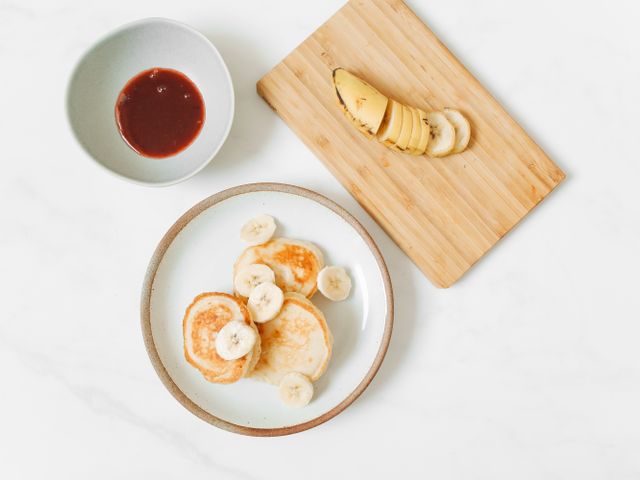
- Stack 3 pancakes per plate and serve straight away with warmed maple syrup and extra butter if you like.
+ Show details− Hide details
Ready when: Pancakes are hot and steaming.
Good to know
Tips
- Weigh the discard. A cup of discard can vary by 40 g or more depending on how thick it is, which changes the batter.
- Test with one small pancake first. If it is flat, the baking soda may be old. If it is bitter, check that the soda was mixed evenly.
- Keep the heat at medium and adjust slightly. Discard pancakes have natural sugars and brown quicker than regular ones.
- Add blueberries, chocolate chips or sliced banana to each pancake right after pouring the batter, not into the bowl, so the batter stays light.
Make ahead
"Stir together the dry ingredients and the wet ingredients (without the butter) in separate containers up to 12 hours ahead and keep the wet mixture refrigerated. Combine with the melted butter just before cooking. Do not mix them in advance, because the baking soda loses its lift once it meets the acidic discard."
Storage & reheating
"Room temperature: up to 2 hours. Fridge: layer cooled pancakes with parchment in an airtight container for up to 4 days. Freezer: freeze in a single layer on a baking sheet, then bag for up to 2 months. Reheat from frozen in a toaster or on a baking sheet at 350°F (175°C) for 8 to 10 minutes, or microwave for 30 to 45 seconds per 2 pancakes."
Substitutions
- whole milk → buttermilk or unsweetened oat milk. Buttermilk adds more tang and fluffiness. Oat milk works for dairy-free, using an equal amount.
- all-purpose flour → half whole wheat flour. Replace up to 60 g of the flour with whole wheat. The pancakes will be denser and nuttier, so add 1 to 2 tablespoons more milk if the batter is stiff.
- unsalted butter → neutral oil such as avocado or canola oil. Use 3 tablespoons (45 ml). There is no need to cool it.
- large eggs → 1 large egg plus 2 tablespoons (30 ml) extra milk. This gives a slightly softer, less rich pancake and makes a smaller batch of batter.
More pancakes & waffles
See all →

Find more like this
- Meal
- Breakfast
- Cuisine
- American
- Diet
- VegetarianHalal
- Quick & Easy
- Easy