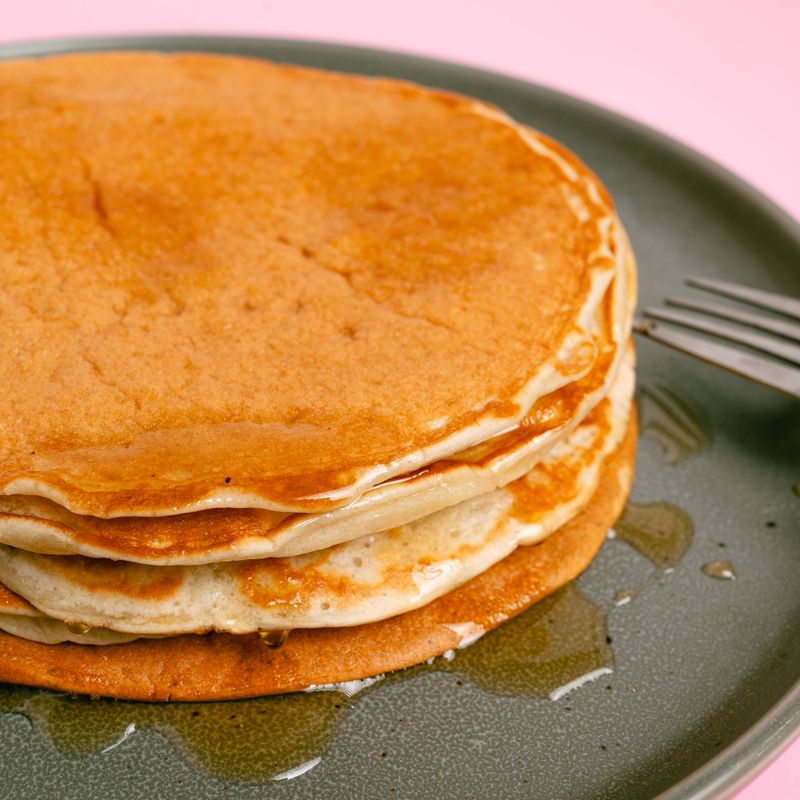
Fluffy Buttermilk Oatmeal Pancakes
Tender, golden griddle pancakes with a hearty, nutty chew from rolled oats softened in buttermilk. They're fluffy in the middle, crisp at the edges, and ready in about 40 minutes.
- Prep
- 15 min
- Cook
- 15 min
- Wait
- 10 min
- Total
- 40 min
- Makes
- 12 pancakes (about 4-inch/10 cm each)
Steps
Before you start
- Take the eggs and buttermilk out of the fridge 20–30 minutes ahead. Cold buttermilk can make the melted butter clump.
- Use old-fashioned rolled oats, not instant or steel-cut. Instant oats turn gluey and steel-cut oats stay hard.
- The 10-minute oat soak is when you mix the dry ingredients and start heating the griddle, so read steps 2–4 before you begin.
- Melt the batter butter now so it can cool for 5 minutes before it goes into the eggs.
- Cook in 3 batches of 4 pancakes. Keep finished pancakes warm in a low oven so everyone eats them hot.
Warm the ovenOven 200°F / 95°C
- Heat the oven to 200°F (95°C).
- Set a wire rack inside a baking sheet and put it in the oven.
- This keeps finished pancakes warm and crisp-edged without steaming them.
+ Show details− Hide details
Ready when: Oven reads 200°F (95°C).
Soak the oats
- In a large bowl, stir the rolled oats into the buttermilk.
- Let the mixture stand at room temperature for 10 minutes.
- Start the timer, then use this time for steps 3 and 4: mix the dry ingredients right away, and start heating the griddle when about 5 minutes of soaking remain.
+ Show details− Hide details
Ready when: Oats look plump and the mixture is thick like loose porridge.
Tip: Don't skip the soak. Unsoaked oats stay hard and the pancakes turn out dense.
Mix the dry ingredients
- While the oats soak, whisk together the flour, brown sugar, baking powder, baking soda, salt and cinnamon (if using) in a medium bowl.
- Whisk for 20 seconds so the leaveners are evenly spread and no brown sugar lumps remain.
+ Show details− Hide details
Ready when: Mixture is uniform in color with no visible clumps.
Heat the griddle
- When about 5 minutes of soaking remain, set the griddle or skillet over medium heat (350–375°F/175–190°C on an electric griddle) for 4–5 minutes.
- Leave it dry for now.
- Test with a few drops of water: they should dance and evaporate within a couple of seconds.
- Keep the griddle on medium while you finish the batter.
+ Show details− Hide details
Ready when: Water drops sizzle and skitter across the surface before evaporating.
Tip: If the surface smokes, the heat is too high. Lower it for 1 minute before cooking.
Add the wet ingredients
- When the 10-minute soak ends, whisk the eggs, cooled melted butter and vanilla into the soaked oat mixture until smooth and combined, about 30 seconds.
+ Show details− Hide details
Ready when: No streaks of egg remain and no butter pieces are visible.
Tip: If the butter is hot, it can scramble the eggs. Let it cool for 5 minutes first.
Combine the batter
- Pour the dry ingredients into the wet mixture.
- Fold with a spatula or whisk just until the flour disappears, about 12–15 strokes.
- The batter will be thick and slightly lumpy.
- Rest it for 2 minutes while the already-hot griddle stays on medium.
+ Show details− Hide details
Ready when: Batter is thick, scoopable and slowly spreads when dropped from a spoon, with a few small lumps.
Tip: Overmixing develops gluten and makes tough pancakes. Small lumps are fine. If the batter is too thick to spread, stir in 1–2 tbsp (15–30 ml) of milk.
Cook the first side
- Brush the hot griddle lightly with some of the softened griddle butter.
- Scoop ¼ cup (60 ml) of batter per pancake onto the griddle, leaving 2 inches (5 cm) between them (4 pancakes per batch).
- Gently spread each into a 4-inch (10 cm) round.
- Cook for 2–3 minutes, without pressing, until bubbles form across the surface and the edges look dry and set.
+ Show details− Hide details
Ready when: Bubbles on top pop and leave holes that stay open; the edges look matte and the underside is golden brown when you peek.
Tip: Flip only once. Pressing down squeezes out air and makes pancakes flat. If the butter browns in seconds, the pan is too hot.
Flip and finish
- Slide the spatula fully under each pancake and flip it.
- Cook for 1½–2 minutes more, until the second side is golden and the pancake springs back when pressed gently in the center.
+ Show details− Hide details
Ready when: Both sides are golden brown, the center springs back, and no wet batter oozes from the sides.
Tip: The second side browns faster. If it darkens quickly, lower the heat slightly.
Cook the remaining batchesOven 200°F / 95°C
- Move the finished pancakes to the rack in the warm oven in a single layer.
- Wipe the griddle with a paper towel, rebrush it with a little more softened butter, and repeat with the remaining batter for 3 batches total.
- Stir the batter gently before each batch, and add a splash of buttermilk if it has thickened as the oats absorb more liquid.
+ Show details− Hide details
Ready when: All 12 pancakes are golden, set in the center and warm on the rack.
Tip: Stacking pancakes in the oven makes them soggy. Keep them in a single layer on the rack.
Serve
- Serve the pancakes hot, about 3 per person, with butter, warm maple syrup, sliced fruit or yogurt.
Good to know
Tips
- Make a test pancake first. If it browns before the center sets, lower the heat; if it's pale after 3 minutes, raise it slightly.
- Use a scoop or ¼-cup measure so pancakes are the same size and cook evenly.
- For a chewier, more rustic texture, keep the oats whole. For a smoother pancake, pulse ½ cup (45 g) of the oats in a blender for a few seconds before soaking.
- For add-ins, scatter ½ cup (about 75 g) blueberries or chopped walnuts onto each pancake right after pouring the batter, rather than stirring them in, to avoid streaks.
Make ahead
Mix the dry ingredients (flour, sugar, baking powder, baking soda, salt, cinnamon) up to 1 week ahead and store airtight. You can soak the oats in the buttermilk overnight in the fridge. Bring the mixture to room temperature for 20 minutes, then whisk in the eggs, butter and vanilla, and fold in the dry mix. The batter itself is best used right away because the leaveners lose power.
Storage & reheating
Room temperature: up to 2 hours. Fridge: cool completely, then store airtight for up to 3 days. Freezer: freeze in a single layer on a tray until solid, then bag for up to 2 months. Reheat from fridge or frozen in a toaster or in a 350°F (175°C) oven on a baking sheet for 5–8 minutes (10 minutes if frozen), until hot in the center.
Substitutions
- buttermilk → 1½ cups (360 ml) whole milk mixed with 1½ tbsp lemon juice or white vinegar, rested 5 minutes. Gives a similar tang and tenderness. Plain yogurt thinned with milk (¾ cup each) also works.
- all-purpose flour → Whole wheat flour (125 g). Makes a nuttier, denser pancake. Add 1–2 tbsp more buttermilk if the batter is too thick.
- light brown sugar → Maple syrup (2 tbsp / 30 ml). Slightly softer batter. The pancakes brown a little faster.
- unsalted butter, for the batter → Neutral oil such as canola (3 tbsp / 45 ml). Makes a dairy-free fat swap with a slightly less rich flavor.
More pancakes & waffles
See all →
Find more like this
- Meal
- Breakfast
- Cuisine
- American
- Diet
- VegetarianHalal
- Quick & Easy
- Easy