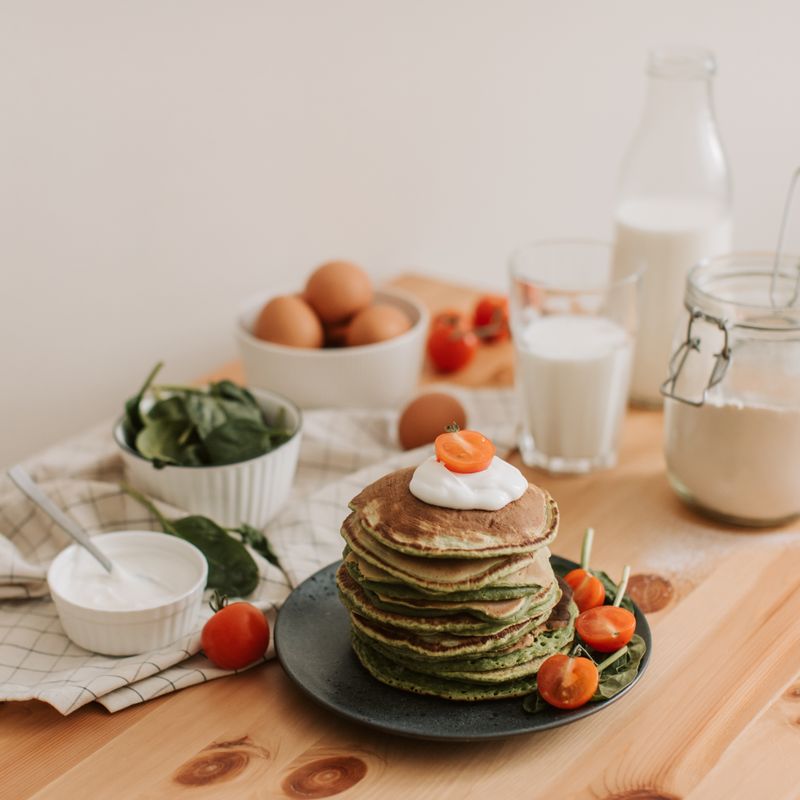
Greek Yogurt Pancakes
Fluffy, tender pancakes with a golden crust and a subtle tang from Greek yogurt. The batter comes together in one bowl and cooks in about 15 minutes.
- Prep
- 10 min
- Cook
- 16 min
- Wait
- 10 min
- Total
- 36 min
- Makes
- About 12 pancakes (3½–4 inches / 9–10 cm each)
Steps
Before you start
- Take the yogurt, milk and eggs out of the fridge 20 minutes ahead. Cold dairy makes the melted butter clump.
- Use plain, full-fat or 2% Greek yogurt. Nonfat works but gives a slightly drier pancake. Do not use flavored or thin, drinkable yogurt.
- Melt the butter and let it cool for a few minutes so it won't scramble the eggs.
- The batter rests for 10 minutes, so heat the pan and oven during that time.
Warm the ovenOven 200°F / 95°C
- Heat the oven to 200°F (95°C).
- Set a wire rack inside a baking sheet and place it in the oven to keep finished pancakes warm and crisp-edged.
+ Show details− Hide details
Ready when: Oven reads 200°F (95°C).
Tip: Keep pancakes in a single layer on the rack. Stacking them steams them and makes them soggy.
Whisk dry ingredients
- In a large bowl, whisk together the flour, sugar, baking powder, baking soda and salt for 20–30 seconds until evenly mixed, with no streaks of baking powder or soda.
+ Show details− Hide details
Ready when: The mixture looks uniform in color and has no lumps.
Whisk wet ingredients
- In a medium bowl, whisk the Greek yogurt and milk until completely smooth and pourable, with no yogurt lumps.
- Whisk in the eggs and vanilla, then slowly drizzle in the cooled melted butter while whisking.
+ Show details− Hide details
Ready when: The mixture is smooth and uniform, with no streaks of egg or pockets of butter.
Tip: Whisk the yogurt and milk first. Adding the eggs to thick yogurt leaves lumps that are hard to remove.
Combine gently
- Pour the wet mixture into the dry ingredients.
- Fold with a rubber spatula for about 15 strokes, just until no dry flour remains.
- The batter will be thick, with a few small lumps.
- Do not try to smooth it out.
+ Show details− Hide details
Ready when: No dry flour is visible. The batter is thick and falls from the spatula in a slow ribbon.
Tip: Overmixing develops gluten and makes the pancakes tough and rubbery.
Rest the batter
- Let the batter rest at room temperature for 10 minutes.
- During this time the flour hydrates and the leaveners start working, so the batter puffs slightly and becomes bubbly.
- Meanwhile, set a 12-inch (30 cm) nonstick skillet or griddle over medium-low heat.
+ Show details− Hide details
Ready when: The surface of the batter shows a few small bubbles and looks slightly puffed.
Heat and grease pan
- Heat the pan for about 3 minutes.
- Test it by flicking a few drops of water onto it.
- They should sizzle and skitter, not vanish instantly.
- Add about 1 teaspoon of the cooking butter and swirl it to coat the pan.
+ Show details− Hide details
Ready when: Water drops sizzle and dance. The butter foams but does not brown.
Tip: If the butter browns right away, lower the heat. A hot pan burns the outside before the thick batter cooks through.
Cook first side
- Scoop ¼ cup (60 ml) of batter per pancake onto the pan, spacing them about 2 inches (5 cm) apart.
- Use the back of the measuring cup to spread each one slightly into a 3½-inch (9 cm) round.
- If using berries, scatter 5–6 blueberries or a few strawberry slices on each pancake now.
- Cook for 2½–3 minutes.
+ Show details− Hide details
Ready when: The edges look dry and set, small bubbles on top pop and leave holes that stay open, and the underside is golden brown when you peek.
Tip: Add the berries on the batter, not stirred into it. This keeps the batter from turning purple and the fruit from bursting.
Flip and finish
- Slide a thin spatula under each pancake and flip it in one confident motion.
- Cook the second side for 1½–2 minutes without pressing down.
- Press the center lightly.
- It should spring back.
+ Show details− Hide details
Ready when: The second side is golden and the center springs back when pressed. The cooked center reaches 160°F (71°C).
Tip: Pressing with the spatula squashes out the air and makes dense pancakes.
Keep warm, repeatOven 200°F / 95°C
- Move the finished pancakes to the rack in the 200°F (95°C) oven.
- Wipe the pan with a paper towel if any bits are browning, add another ½ teaspoon of cooking butter, and cook the remaining batter in 2 more batches (about 4 pancakes per batch).
- Adjust the heat down slightly if the pancakes brown in under 2 minutes per side.
+ Show details− Hide details
Ready when: All batter is used, giving about 12 evenly golden pancakes.
Tip: The first batch is often a test. Adjust the heat after it, and don't worry if it's paler or darker than the rest.
Serve warm
- Stack 3 pancakes on each of 4 plates.
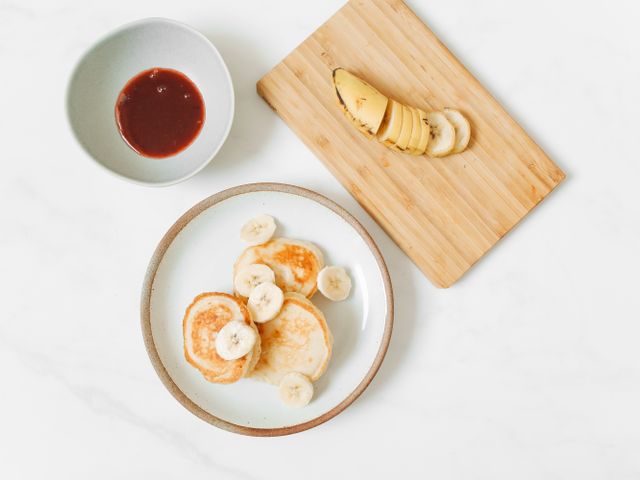
- Top with the remaining fresh berries and drizzle with warm maple syrup.
- Serve immediately.
+ Show details− Hide details
Ready when: Pancakes are hot and fluffy.
Good to know
Tips
- Keep the heat at medium-low. Yogurt batter is thick, so a hotter pan browns the outside before the middle is set.
- Lumps are fine. A few small lumps cook out and mean you haven't overmixed.
- If the batter thickens after resting, stir in 1–2 tablespoons of milk to get a thick but scoopable consistency.
- Use a scale for the flour if you can. Too much flour is the most common reason for dry, dense pancakes.
Make ahead
"Whisk the dry ingredients and the wet ingredients separately, cover, and refrigerate the wet mixture up to 12 hours (keep the dry mix at room temperature). Combine just before cooking, rest 5 minutes, and cook as directed. Don't mix the full batter ahead, because the baking powder loses lift."
Storage & reheating
"Room temperature: up to 2 hours. Refrigerator: cool completely, then store in an airtight container for up to 3 days. Freezer: freeze in a single layer on a tray until firm, then bag for up to 2 months. Reheat from the fridge in a toaster or a 350°F (175°C) oven for 5–6 minutes. Reheat from frozen in a toaster or the oven for 8–10 minutes until hot in the center."
Substitutions
- plain Greek yogurt → plain full-fat skyr or thick strained yogurt. Use the same weight. Regular unstrained yogurt is too thin, so reduce the milk to ½ cup (120 ml).
- whole milk → unsweetened oat or soy milk. Use the same amount. Almond milk works but gives a slightly paler pancake.
- all-purpose flour → half whole wheat flour (95 g) and half all-purpose flour (95 g). Makes a nuttier, heartier pancake. Add 1–2 tablespoons more milk if the batter seems stiff.
- unsalted butter → neutral oil such as canola. Use 3 tablespoons (45 ml). The flavor will be less rich.
More pancakes & waffles
See all →

Find more like this
- Meal
- Breakfast
- Cuisine
- American
- Diet
- VegetarianHalal
- Quick & Easy
- Easy