Sourdough Discard Oatmeal Pancakes
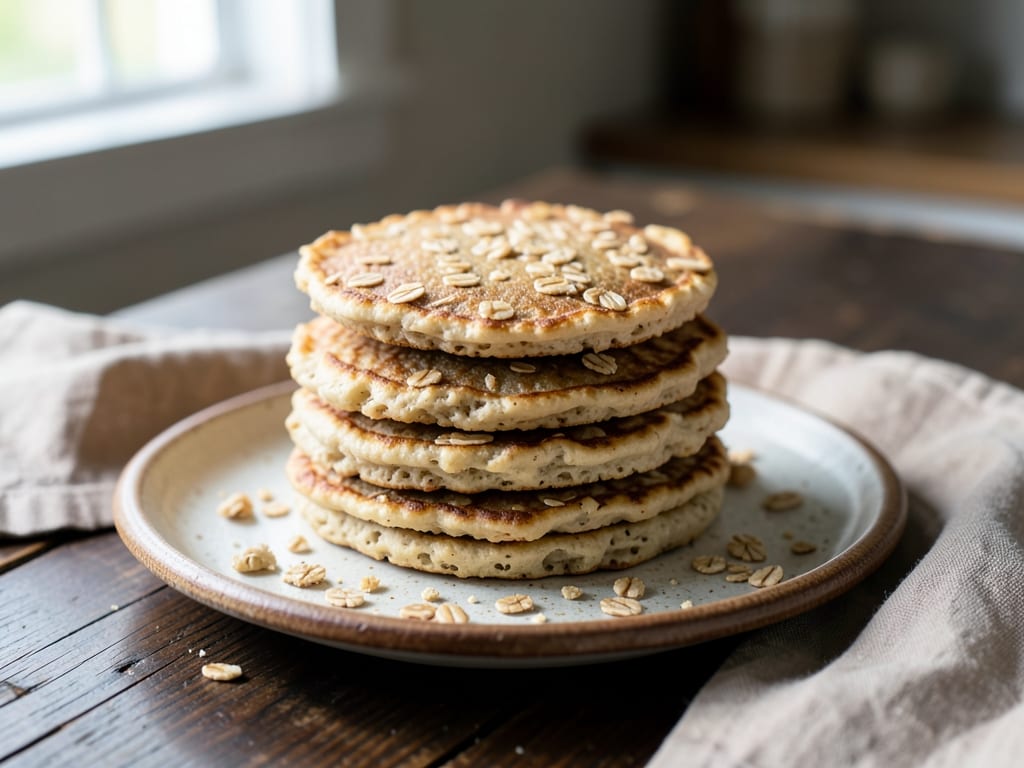
Hearty, tender pancakes that put unfed sourdough discard to work. Rolled oats soak in milk for a soft, chewy crumb, and the discard adds a gentle tang that reacts with baking soda for plenty of lift. No overnight planning needed.
- Prep
- 13 min
- Cook
- 16 min
- Wait
- 20 min
- Total
- 49 min
- Makes
- About 12 pancakes (4-inch / 10 cm), serving 4
Steps
Before you start
- Use unfed sourdough discard straight from the fridge or at room temperature. Stir it well before measuring. Any age works, but very sharp, old discard gives a tangier pancake.
- Melt the butter and let it cool for a few minutes so it won't scramble the eggs.
- Use old-fashioned rolled oats, not instant or steel-cut. Instant oats turn gummy, and steel-cut oats stay hard.
- The batter needs 15 minutes to soak plus 5 minutes to rest, so start the soak before you gather everything else.
Soak the oats
- In the large mixing bowl, stir together the rolled oats and milk.
- Let the mixture sit at room temperature for 15 minutes so the oats absorb the milk and soften.
+ Show details− Hide details
Ready when: The oats look plump and the milk is mostly absorbed, with a thick, porridge-like texture
Tip: Skipping the soak gives chewy, dry-tasting oats and a thinner pancake.
Whisk the dry ingredients
- In the medium bowl, whisk together the all-purpose flour, brown sugar, baking powder, baking soda, salt and cinnamon (if using).
- Press out any lumps of brown sugar with your fingers.
+ Show details− Hide details
Ready when: No visible clumps, and the mixture is an even color
Add the wet ingredients
- Add the eggs, sourdough discard, cooled melted butter and vanilla to the soaked oats.
- Whisk until smooth and evenly combined, about 30 seconds.
- The mixture will be thick and slightly bubbly.
+ Show details− Hide details
Ready when: No streaks of egg or pockets of discard remain
Tip: If the butter is hot, it can partly cook the eggs. Let it cool until just warm to the touch.
Fold and rest batter
- Pour the dry ingredients over the wet mixture.
- Fold with a rubber spatula just until no dry flour remains, about 15 strokes.
- A few small lumps are fine.
- Let the batter rest for 5 minutes.
- The discard's acidity will react with the baking soda and the batter will puff and look bubbly.
+ Show details− Hide details
Ready when: The batter is thick but scoopable, with small bubbles on the surface
Tip: Overmixing makes the pancakes tough. If the batter is too thick to spoon, stir in 1–2 tablespoons of milk.
Heat pan and ovenOven 200°F / 95°C
- While the batter rests, heat the oven to 200°F (93°C) and set a wire rack on a baking sheet on the middle rack.
- Place the skillet over medium heat for 3 minutes.
- Add about ½ teaspoon of the pan butter and swirl it to coat the surface.
- Wipe off any excess with a paper towel if it pools.
+ Show details− Hide details
Ready when: A drop of water flicked onto the pan sizzles and evaporates within 2 seconds
Tip: If the pan is too hot, the outsides brown before the center cooks. Medium-low is better if your pan runs hot.
Cook the first side
- Scoop ¼ cup (60 ml) of batter per pancake into the hot skillet, spacing them about 2 inches (5 cm) apart.
- Cook 4 pancakes at a time.
- Cook for 2½ to 3 minutes, until bubbles form across the surface and pop, and the edges look dry and set.
+ Show details− Hide details
Ready when: Bubbles cover the top and stay open after popping, edges look matte, and the underside is deep golden brown
Tip: Do not flip early. If the pancake feels loose and wet, give it another 30 seconds.
Flip and finish
- Slide a thin spatula under each pancake and flip it in one motion.
- Cook the second side for 1½ to 2 minutes, until golden brown.
- Don't press down on the pancakes, as that squeezes out the air.
+ Show details− Hide details
Ready when: Pancakes spring back when gently pressed in the center, and a toothpick in the thickest part comes out clean (about 160°F / 71°C)
Tip: The second side browns faster than the first, so watch it closely.
Repeat and keep warmOven 200°F / 95°C
- Move the finished pancakes to the rack in the 200°F (93°C) oven.
- Wipe the skillet, add another ½ teaspoon of pan butter, and cook the remaining batter in 2 more batches the same way.
- Lower the heat to medium-low if the pancakes brown in under 2 minutes.
- You should have about 12 pancakes.
+ Show details− Hide details
Ready when: Each batch is evenly golden brown on both sides and cooked through
Tip: Keep pancakes in a single layer on the rack. Stacking them traps steam and makes them soggy.
Serve
- Stack 3 pancakes per plate and serve right away with butter, pure maple syrup, fresh fruit or yogurt.
Good to know
Tips
- Keep the heat at medium or medium-low. Oat batter is thick, and high heat browns the outside before the center is cooked.
- Make a test pancake first. If it spreads too thin, let the batter sit 2 more minutes. If it's too thick to pour, loosen it with a splash of milk.
- Fold in ½ cup (about 70 g) of blueberries or chopped toasted walnuts at the end for variety. Add them after the last fold, and don't overmix.
- Don't push the discard past about 1 cup (245 g). More makes the pancakes gummy and noticeably sour.
Make ahead
"Soak the oats in the milk, cover and refrigerate overnight (up to 12 hours). In the morning, stir in the wet ingredients, then the dry mix, and rest 5 minutes before cooking. Keep the dry ingredients whisked together in a separate bowl or jar. Cooked pancakes can also be frozen (see storage)."
Storage & reheating
"Room temperature: up to 1 hour on a rack. Fridge: cool completely, then store in an airtight container for up to 4 days. Freezer: freeze in a single layer on a tray until firm, then bag with parchment between pancakes for up to 2 months. Reheat from fridge or frozen in a toaster or in a 350°F (175°C) oven for 8–10 minutes until hot in the center."
Substitutions
- whole milk → Unsweetened oat, soy or almond milk. Works at a 1:1 ratio. Pancakes will be slightly less rich.
- all-purpose flour → Whole wheat flour or white whole wheat flour. Use the same weight (90 g). The batter may need 1–2 tablespoons more milk, and the pancakes will be denser and nuttier.
- light brown sugar → Pure maple syrup. Use 2 tablespoons (30 ml). The batter will be slightly looser, so reduce the milk by 1 tablespoon if needed.
- unfed sourdough discard (100% hydration) → Active (fed) sourdough starter. Use the same amount. Pancakes will be slightly puffier and the tang is milder.