Sourdough Brazilian Pão de Queijo Cheese Balls
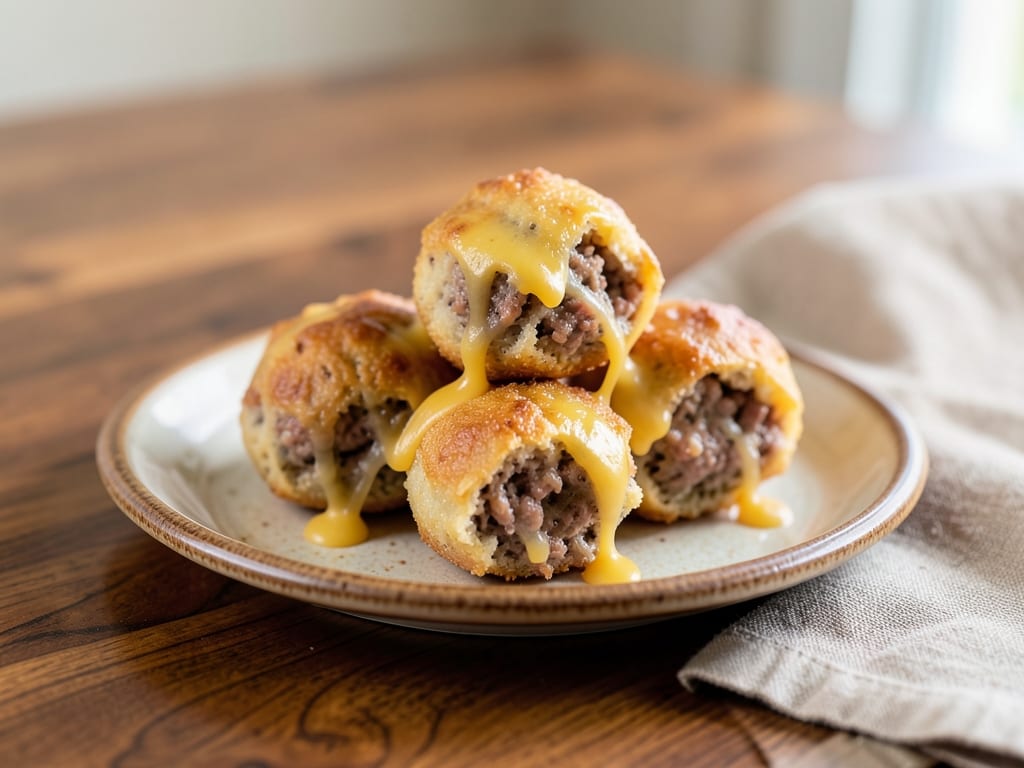
Crispy-edged, chewy Brazilian cheese balls made with sourdough discard instead of traditional yeast. Tapioca flour and polvilho create the signature stretchy crumb, while sharp cheddar and Parmesan add depth. These ferment briefly for extra flavor complexity and bake until golden with a light, airy interior.
- Prep
- 15 min
- Cook
- 20 min
- Wait
- 1 hr
- Total
- 1 hr 35 min
- Makes
- 16 cheese balls (about 1.5 oz / 45g each)
Steps
Before you start
- Preheat oven to 400 °F (200 °C)
- Line two baking sheets with parchment paper
- Bring milk to room temperature if using from refrigerator
- Have sourdough discard at room temperature
Warm milk and butter
- Heat milk and butter in a medium saucepan over medium heat until the butter is melted and milk is warm (about 120 °F / 50 °C).
- Remove from heat and let cool to just warm to the touch (about 105–110 °F / 40–43 °C).
- This temperature supports mild fermentation without killing the sourdough culture.
+ Show details− Hide details
Ready when: Butter is melted, milk steams lightly
Tip: Too-hot milk will kill the sourdough's yeast and bacteria; too cool won't activate fermentation.
Combine wet ingredients
- In a large mixing bowl, whisk together sourdough discard and the warm milk-butter mixture until smooth.
- Beat in the egg until fully incorporated.
- The mixture should be pale and slightly frothy.
+ Show details− Hide details
Ready when: Mixture is smooth and uniform
Mix dry ingredients
- In a separate bowl, whisk together tapioca flour, polvilho doce, sea salt, and black pepper until evenly distributed.
- This prevents the starches from lumping when added to the wet mixture.
+ Show details− Hide details
Ready when: Salt and pepper are evenly dispersed throughout
Combine and fold in cheese
- Add the dry mixture to the wet ingredients and fold gently with a spatula until just combined—the dough will be thick and sticky, more like a thick batter.
- Add shredded cheddar and grated Parmesan, folding gently until the cheeses are evenly distributed throughout.
- The dough should hold together but still feel moist.
+ Show details− Hide details
Ready when: Cheese is evenly distributed, no dry pockets remain
Tip: Overmixing develops gluten-like networks in the tapioca; fold gently to keep the crumb tender.
First fermentation
- Cover the bowl with a damp kitchen towel and let the dough rest at room temperature for 60 minutes.
- During this time, the sourdough culture will produce gentle fermentation, developing flavor and creating subtle gas bubbles.
- The dough will rise slightly and become slightly puffy.
+ Show details− Hide details
Ready when: Dough is puffy and has a slight tang on the nose
Tip: In a warm kitchen (above 75 °F / 24 °C), fermentation may complete in 45 minutes; in a cool one, it may need 75 minutes.
Preheat ovenOven 400°F / 205°C
- While the dough ferments, preheat the oven to 400 °F (200 °C).
- Arrange two racks in the upper and middle thirds of the oven so you can bake two sheets simultaneously.
+ Show details− Hide details
Ready when: Oven reaches 400 °F (200 °C)
Portion the dough
- Line two baking sheets with parchment paper.
- Using an ice cream scoop or spoon, portion the dough into 16 equal mounds (about 1.5 oz / 45 g each), spacing them 2 inches (5 cm) apart on the prepared baking sheets.
- Lightly wet your hands so the sticky dough doesn't cling to your fingers as you shape each ball.
- The balls don't need to be perfectly round—rustic, slightly irregular shapes are traditional.
+ Show details− Hide details
Ready when: 16 portioned mounds on parchment paper
Tip: Wet hands make handling the sticky dough much easier; keep a bowl of water nearby for quick dips.
Bake the cheese ballsOven 400°F / 205°C
- Place both baking sheets in the preheated 400 °F (200 °C) oven, one on the upper rack and one on the middle rack.
- Bake for 18–22 minutes, rotating the sheets halfway through (swap top and bottom racks) for even browning.
- The cheese balls should be deep golden brown on the outside, slightly darker at the very bottom, with puffed-up, light interiors.
- When done, the exterior should feel crisp and slightly rigid, while the interior remains soft and stretchy.
+ Show details− Hide details
Ready when: Deep golden-brown exterior, puffed interior, crispy on outside
Tip: Rotate sheets halfway through to prevent the bottom rack's batch from browning too fast. If they're browning too quickly, lower the oven temp to 375 °F (190 °C).
Cool and serve
- Remove the baking sheets from the oven and let the cheese balls cool on the parchment for 5 minutes.
- They will firm up slightly as they cool but remain soft inside.
- Serve warm or at room temperature.
- They are best eaten within 2 hours of baking when the exterior is still crispy, though they remain pleasant for up to 8 hours.
+ Show details− Hide details
Ready when: Exterior has firmed; interior is still tender
Tip: Eating them within the first few hours preserves the contrast between crispy outside and creamy inside.
Good to know
Tips
- Sourdough discard works best if it is 'unfed' (a few days old in the refrigerator) rather than freshly fed, as it has more flavor compounds. If using fresh discard, increase the fermentation time by 15 minutes.
- The dough is sticky by design—this is what creates the light, airy interior. Resist the urge to add extra flour; wet hands are your friend.
- These cheese balls are best eaten the same day they are baked. Reheating restores the crispy exterior but the crumb gradually loses its tender quality after 24 hours.
- For a tangier, more complex flavor, extend the fermentation to 90 minutes at room temperature or do an overnight cold fermentation in the refrigerator (then bring to room temperature before portioning and baking).
Make ahead
Prepare the dough through step 4 (after adding cheese), cover, and refrigerate up to 12 hours. Before baking, let the dough come to room temperature and ferment for 30 minutes at room temperature, then portion and bake as directed. Alternatively, freeze portioned, unbaked balls on a tray, then transfer to a freezer bag and store up to 2 months; bake from frozen at 400 °F (200 °C) for 25–28 minutes.
Storage & reheating
Store cooled cheese balls in an airtight container at room temperature for up to 8 hours. Refrigerate for up to 3 days; reheat in a 350 °F (175 °C) oven for 6–8 minutes to restore crispness. Freeze in a single layer, then transfer to a freezer bag for up to 3 months; reheat from frozen at 375 °F (190 °C) for 12–15 minutes.
Substitutions
- polvilho doce (sweet cassava starch) → additional tapioca flour (use 1¾ cups / 230 g total tapioca flour instead). Polvilho gives the signature chewy, slightly stretchy texture; tapioca alone will produce a less elastic crumb but remains delicious.
- sharp cheddar cheese, finely shredded → sharp white cheddar, aged Gouda, or Gruyère. Each cheese brings different depth; aged cheeses intensify the savory flavor. Keep the total cheese weight the same.
- Parmigiano-Reggiano cheese, finely grated → Pecorino Romano or Asiago. Use the same weight. Pecorino is saltier and more assertive; Asiago is milder. Adjust salt down slightly if using Pecorino.
- sourdough discard, unfed and at room temperature → ½ cup (120 ml) active fed sourdough starter or 1 teaspoon instant yeast mixed with 1 tablespoon warm water. Active starter produces more lift but less tang; instant yeast is faster but omits the sourdough flavor entirely. If using yeast, reduce fermentation time to 30 minutes.