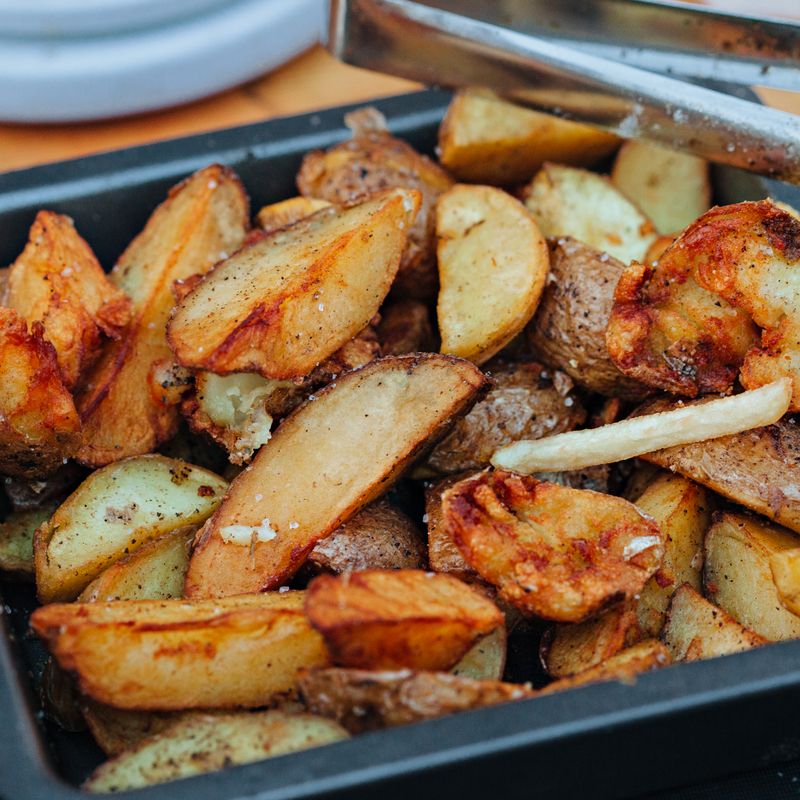
Crispy Baked Potato Skins
Twice-cooked russet shells brushed with bacon fat, baked until shatteringly crisp, then loaded with sharp cheddar and bacon and broiled until bubbly. Serve with chive sour cream for dipping.
- Prep
- 28 min
- Cook
- 19 min
- Wait
- 1 hr 27 min
- Total
- 2 hr 14 min
- Makes
- 12 potato skins
Steps
Before you start
- Choose russets of similar size (about 8 oz / 225 g each) so they bake evenly.
- Shred the cheddar from a block yourself; pre-shredded cheese is coated with starch and melts less smoothly.
- Arrange one oven rack in the center and have a second position ready about 6 inches (15 cm) below the broiler.
- Plan for about 2¼ hours total, most of it hands-off baking and cooling.
- The scooped potato flesh isn't used here. Save it for mashed potatoes, potato pancakes or soup.
Bake the potatoesOven 425°F / 220°C
- Position a rack in the center of the oven and heat to 425°F (220°C).
- Pierce each dry potato 4–5 times with a fork.
- Rub with the olive oil and sprinkle with ½ tsp of the kosher salt.
- Set the potatoes directly on the oven rack with the baking sheet on the rack below to catch drips.
- Bake 55–65 minutes.
+ Show details− Hide details
Ready when: Skins feel taut and crisp, a knife slides into the center with no resistance, and the internal temperature reaches about 205°F (96°C).
Tip: Baking directly on the rack, not in foil, keeps the skins dry and sturdy.
Cook the bacon
- While the potatoes finish, put the bacon pieces in a cold 12-inch skillet over medium heat.
- Cook, stirring occasionally, 8–10 minutes.
- Transfer with a slotted spoon to a paper-towel-lined plate.
- Pour the fat into a small bowl and keep it; you need about 2 tbsp (30 ml).
+ Show details− Hide details
Ready when: Bacon pieces are deep golden brown and crisp, with the fat fully rendered and no pale, soft spots.
Tip: Starting in a cold pan renders the fat slowly so the bacon crisps instead of burning. If you have less than 2 tbsp fat, top up with olive oil.
Cool the potatoes
- Remove the baked potatoes from the oven and leave the oven on.
- Let them rest on the rack 15 minutes, just until cool enough to handle.
+ Show details− Hide details
Ready when: Potatoes are warm, not hot, to the touch.
Tip: Don't let them go fully cold; warm flesh scoops out more cleanly.
Halve and scoop
- Cut each potato in half lengthwise.
- With a metal spoon, scoop out the flesh, leaving a ¼-inch (6 mm) layer attached to the skin.
- Save the scooped flesh for another use.
- Set the 12 shells on a wire rack set inside the baking sheet.
+ Show details− Hide details
Ready when: Shells hold their shape and have an even ¼-inch wall with no holes.
Tip: Scooping too thin makes floppy skins; too thick makes them heavy and less crisp.
Season and brushOven 450°F / 230°C
- Raise the oven temperature to 450°F (230°C).
- In a small bowl, stir the reserved bacon fat with the smoked paprika, garlic powder, black pepper and remaining ½ tsp kosher salt.
- Brush generously over the inside and outside of every shell.
+ Show details− Hide details
Ready when: Every surface looks evenly glossy and speckled with spices.
Tip: Rewarm the fat briefly if it solidifies so it brushes smoothly.
Crisp the shellsOven 450°F / 230°C
- Arrange the shells cut side down on the rack.
- Bake 8 minutes, flip so the cut sides face up, then bake another 8 minutes (16 minutes total) at 450°F (230°C).
+ Show details− Hide details
Ready when: Edges are deep golden and the shells feel dry and rigid when tapped.
Tip: Elevating the shells on a rack lets hot air reach the bottoms so they stay crisp.
Fill the skins
- Turn the shells cut side up.
- Divide the cheddar evenly among them (about 2½ tbsp each), then scatter about three-quarters of the bacon over the cheese.
- Reserve the rest for garnish.
+ Show details− Hide details
Ready when: Each shell is evenly filled, with cheese mounded in the center.
Tip: Put the cheese down first so it melts around the bacon and holds it in place.
Broil until bubblyOven 500°F / 260°C
- Move the rack about 6 inches (15 cm) below the broiler and heat the broiler to high (about 500°F / 260°C).
- Broil the filled skins 2–3 minutes, watching constantly.
+ Show details− Hide details
Ready when: Cheese is fully melted, bubbling and flecked with golden-brown spots.
Tip: Broilers vary widely and cheese can burn in seconds, so don't walk away.
Garnish and serve
- Stir 1 tbsp of the chives into the sour cream.
- Sprinkle the remaining bacon and chives over the hot skins.
- Serve right away with the chive sour cream.
+ Show details− Hide details
Tip: Serve within 10 minutes, while the shells are at their crispiest.
Good to know
Tips
- Dry potatoes bake into crisper skins, so towel them completely dry after scrubbing and never wrap them in foil.
- Leave a full ¼-inch layer of potato in each shell; it gives the skins structure to hold the filling.
- Use a rack for both baking steps so air circulates under the shells and the bottoms don't turn soggy.
- Make a smaller batch by halving everything; the times stay the same.
Make ahead
"Bake, halve and scoop the potatoes up to 2 days ahead; cover and refrigerate the shells. Cook the bacon up to 2 days ahead and refrigerate. When ready, brush with the seasoned fat and continue from the crisping step, adding 3–4 minutes to each side.
Storage & reheating
"Best eaten immediately. Leftovers keep at room temperature up to 2 hours, or refrigerated in an airtight container up to 3 days. Freeze assembled, unbroiled skins on a tray, then bag, for up to 2 months. Reheat on a rack at 400°F (200°C) for 8–12 minutes (15–18 from frozen) until hot and crisp; avoid the microwave.
Substitutions
- sharp cheddar cheese → Monterey Jack, pepper jack or a cheddar-Jack blend. Pepper jack adds heat; the melt will be slightly creamier.
- sour cream → Plain full-fat Greek yogurt. Tangier and a bit thicker; add a splash of milk if too stiff.
- fresh chives → Thinly sliced scallion greens. Slightly sharper onion flavor; use the same amount.
- thick-cut bacon → Turkey bacon with 2 tbsp extra olive oil for brushing. Turkey bacon renders little fat, so the oil replaces the brushing fat.