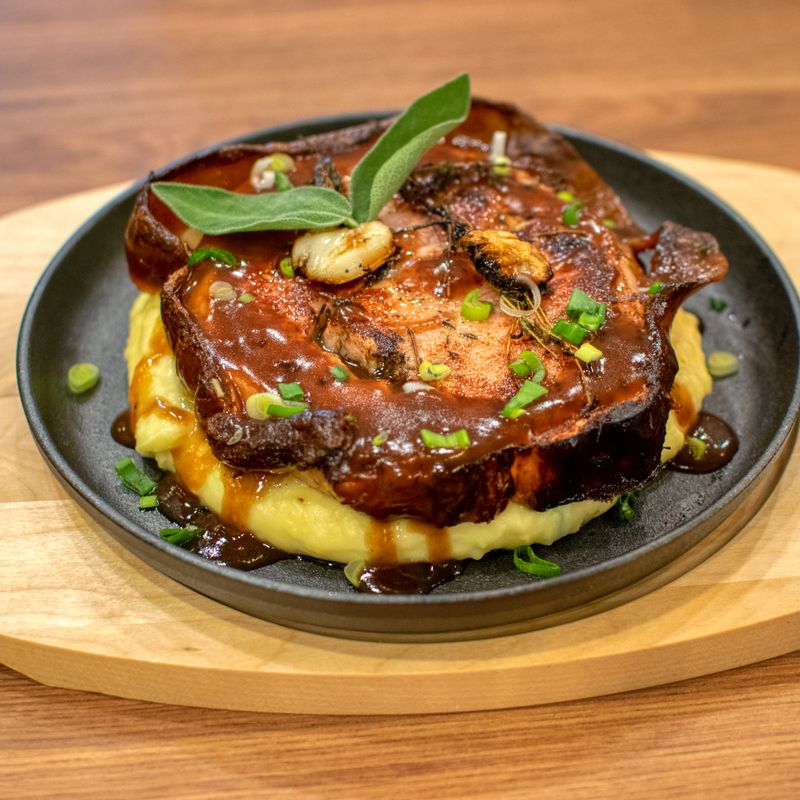
Slow Roasted Pork Shoulder with Brown Sugar, Paprika and Garlic
A bone-in pork shoulder rubbed with a sweet-smoky paprika and brown sugar crust, then roasted low and slow over onions and garlic until it pulls apart with a fork. The pan juices become an easy sauce.
- Prep
- 52 min
- Cook
- 6 hr
- Wait
- 9 hr 5 min
- Total
- 15 hr 57 min
- Makes
- 1 roast (about 10 servings, 6–7 cups pulled pork)
Steps
Before you start
- Plan ahead: the rub needs at least 4 hours (ideally overnight, up to 24 hours) on the pork. Total time is about 16 hours, but only about 50 minutes is hands-on.
- Use a bone-in shoulder (also sold as Boston butt or picnic shoulder) of 7–8 lb (3.2–3.6 kg) with a fat cap. A smaller roast will finish sooner, so start checking the temperature early.
- Measure the salt carefully. This recipe uses Diamond Crystal kosher salt. If you only have Morton kosher salt, use 2½ tablespoons (30 g). If you use fine table salt, use 2 tablespoons (35 g).
- Check that your roasting pan or Dutch oven holds the pork with at least 1 inch (2.5 cm) of space around it, and that you have heavy-duty foil or a tight lid.
Dry and score pork
- Unwrap the pork shoulder and pat it very dry on all sides with paper towels.
- Set it fat-side up on a cutting board.
- With a sharp knife, score the fat cap in a diamond pattern with cuts about 1 inch (2.5 cm) apart and ¼ inch (6 mm) deep.
- Cut through the fat only, not into the meat.
- Use the tip of the knife to cut 12 small, deep slits (about 1 inch / 2.5 cm deep) all over the meat, spaced evenly.
+ Show details− Hide details
Ready when: The fat cap shows a clean grid of shallow cuts and the surface feels dry to the touch.
Tip: A dry surface browns better. If the pork is wet, pat it again before scoring.
Rub and marinate
- In a small bowl, stir together the kosher salt, brown sugar, paprika, black pepper, garlic powder and cumin (if using).
- Stir in the olive oil to make a thick, damp paste.
- Push a sliver of garlic (use 6 slivers total, 1 per slit) into half of the slits.
- Rub the paste over every surface of the pork, pressing it into the scoring and slits.
- Set the pork on a plate or tray, fat-side up, and refrigerate uncovered for at least 4 hours or up to 24 hours (8 hours is ideal).
+ Show details− Hide details
Ready when: The surface looks dry and tacky, and the rub has darkened and turned into a paste-like coating.
Tip: If you have leftover slivers, push them into the remaining slits. Use all 6 slivers here; the 4 smashed cloves go in the pan later.
Preheat and set up panOven 300°F / 150°C
- About 1 hour before roasting, take the pork out of the refrigerator.
- Place an oven rack in the lower third of the oven and heat to 300°F (150°C).
- Scatter the onion wedges and the 4 smashed garlic cloves across the bottom of the roasting pan.
- Pour in the cider vinegar and broth.
- Set the pork on top of the onions, fat-side up, so the meat sits about 1 inch above the liquid.
+ Show details− Hide details
Ready when: The oven reads 300°F (150°C) and the pork is no longer ice-cold at the center of the surface.
Tip: Pour the liquid around the meat, not over it, so you don't wash off the rub.
Roast coveredOven 300°F / 150°C
- Cover the pan tightly with a double layer of heavy-duty foil (or the lid), crimping the edges so no steam escapes.
- Roast at 300°F (150°C) for 4½ hours without opening the oven.
- The onions will soften and the juices will build in the pan.
+ Show details− Hide details
Ready when: After 4½ hours, the foil is puffed slightly and the pork is soft when pressed with tongs, with an internal temperature of about 180–185°F (82–85°C).
Tip: Opening the oven repeatedly lets heat and steam out and lengthens the cooking time.
Uncover and brownOven 300°F / 150°C
- Carefully remove the foil, tilting it away from you to avoid the steam.
- Check the liquid in the pan; if it has dropped below ½ inch (1.25 cm), add ½ cup (120 ml) hot water.
- Return the pan, uncovered, to the oven and roast at 300°F (150°C) for another 1½ hours (up to 2 hours if needed), until the crust is deep mahogany and the pork reaches 195–205°F (90–96°C) in the thickest part, away from the bone.
- A thermometer or a skewer should slide in with almost no resistance.
+ Show details− Hide details
Ready when: Internal temperature is 195–205°F (90–96°C), the crust is dark brown and the bone wiggles freely when twisted.
Tip: The sugar in the rub can darken quickly. If the crust looks nearly black before the pork is tender, tent it loosely with foil and keep roasting.
Rest the roast
- Remove the pan from the oven.
- Transfer the pork to a large cutting board or rimmed baking sheet, tent loosely with foil, and let it rest for 30 minutes.
- Leave the onions and juices in the pan.
+ Show details− Hide details
Ready when: The pork is cool enough to handle with a kitchen towel or gloves, and steam has slowed.
Tip: Do not skip the rest; shredding right away lets juices run out onto the board.
Make the pan sauce
- While the pork rests, pour the contents of the pan, onions, garlic and juices, through a fine strainer into a fat separator or a large measuring jug, pressing on the onions.
- Let the fat rise for 5 minutes, then skim it off with a spoon (or pour off the juices from underneath).
- You should have about 2 cups (480 ml) of juices.
- Discard the fat, or save a little to moisten the meat.
- Taste the juices and add a pinch of salt only if needed.
+ Show details− Hide details
Ready when: The juices are dark amber and the fat is cleanly separated on top.
Tip: The juices are already seasoned from the rub, so taste before adding more salt.
Pull and serve
- Remove and discard the bone (it should slide out clean) and any large pockets of un-rendered fat.
- Using two forks or meat claws, shred the pork into bite-sized pieces, mixing the crust in with the tender meat.
- Drizzle about 1 cup (240 ml) of the skimmed juices over the pork and toss lightly.
- Serve warm with the remaining juices on the side.
+ Show details− Hide details
Ready when: The meat is moist, glistening and pulls apart easily with no tough, rubbery pieces.
Tip: Shred while the pork is still warm; cold pork is harder to pull and soaks up less juice.
Good to know
Tips
- Go by temperature and feel, not the clock. Shoulders vary, and the pork is ready when a probe slides in with almost no resistance at 195–205°F (90–96°C).
- If the pork stalls around 160–170°F (71–77°C) for an hour or more, that is normal as collagen melts. Keep the oven at 300°F and be patient.
- For a crisper, more bark-like crust, after resting, shred the outer crust pieces and broil them on a baking sheet 2–3 minutes until the edges crisp, watching closely.
- A smaller 4–5 lb (1.8–2.3 kg) shoulder will take about 4–5 hours total; start checking for tenderness after 3½ hours.
Make ahead
"Rub the pork up to 24 hours ahead and refrigerate uncovered. You can also roast the pork completely a day ahead: shred it, toss with the juices, cool, and refrigerate in an airtight container. Reheat gently, covered, at 300°F (150°C) for 25–30 minutes."
Storage & reheating
"Cool within 2 hours. Refrigerate shredded pork with its juices in an airtight container for up to 4 days. Freeze in portions with juices for up to 3 months and thaw overnight in the refrigerator. Reheat covered in a 300°F (150°C) oven for 20–30 minutes, or in a covered skillet over low heat with a splash of juices or water, until steaming hot (165°F / 74°C). Do not leave at room temperature more than 2 hours."
Substitutions
- sweet paprika → smoked paprika. Gives a barbecue-style, smoky flavor. Use the same amount, or replace half the sweet paprika for a milder smoke.
- light or dark brown sugar → coconut sugar or maple sugar. Use the same amount; the crust will be slightly less sticky but still caramelized.
- apple cider vinegar → white wine vinegar or apple juice. Use the same amount. Apple juice gives a sweeter sauce, so reduce the brown sugar slightly if you prefer.
- low-sodium chicken broth or water → water or light beer. Water gives a cleaner pork flavor; beer adds a malty depth. Use the same amount.
More roasts
See all →
Find more like this
- Meal
- Dinner
- Cuisine
- American
- Main ingredient
- Pork Shoulder
- Method
- Oven
- Quick & Easy
- EasyMake Ahead