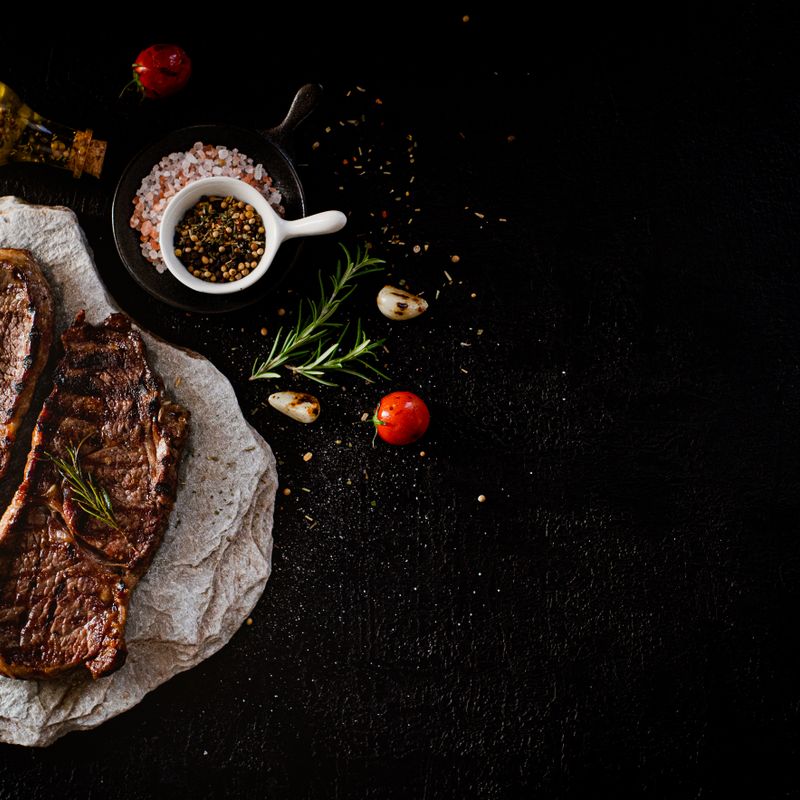
Garlic-Rosemary Prime Rib Roast
A dry-brined, bone-in rib roast cooked low and slow for edge-to-edge rosy beef, then blasted in a hot oven for a deeply browned, garlicky rosemary crust. A quick pan jus from the drippings finishes it.
- Prep
- 55 min
- Cook
- 3 hr 5 min
- Wait
- 1.1 days
- Total
- 1.3 days
- Makes
- 1 roast (3 bones, about 6 generous servings)
Steps
Before you start
- Order a 3-bone (about 7 lb / 3.2 kg) bone-in rib roast, also called a standing rib roast, from the butcher. Ask for the chine bone to be removed so carving is easier.
- Start the day before: the roast needs at least 24 hours of uncovered dry-brining in the fridge (up to 48 hours is even better).
- You need an instant-read or leave-in probe thermometer. Judging doneness by time alone is the most common way to ruin a prime rib.
- Clear a shelf in the fridge for the roast on its rack and pan, and set the oven rack in the lower third.
- The recipe uses Diamond Crystal kosher salt. If you only have Morton kosher salt, use about half the volume (1¼ tbsp).
Dry-brine the roast
- Pat the roast very dry with paper towels.
- Mix the kosher salt and half of the black pepper (1½ tsp), then rub evenly over the top, sides, ends, and between the meat and bones.
- Set the roast bone-side down on a wire rack set in the roasting pan.
- Refrigerate, uncovered, for 24 to 48 hours.
+ Show details− Hide details
Ready when: The surface looks dry, darker red, and slightly tacky to the touch
Tip: Do not cover the roast. Plastic wrap traps moisture and prevents the dry surface that gives you a good crust.
Make the herb paste
- In a small bowl, stir together the minced garlic, chopped rosemary, olive oil, and the remaining 1½ tsp black pepper to form a loose paste.
- Do not add more salt.
+ Show details− Hide details
Ready when: The mixture looks like a thick, spoonable, fragrant paste
Tip: The roast is already seasoned from the dry brine, so extra salt here would make the crust too salty.
Season and temperOven 250°F / 120°C
- Take the roast out of the refrigerator.
- Rub the herb paste over the fat cap and sides, avoiding the bones where it would just burn.
- Leave the roast on its rack at room temperature for 1½ hours.
- Insert the probe thermometer horizontally into the center of the thickest part of the meat, not touching a bone.
- Move the oven rack to the lower third and preheat the oven to 250°F (120°C) for the last 20 minutes of resting.
+ Show details− Hide details
Ready when: The roast no longer feels icy cold at the surface, and the oven has reached 250°F (120°C)
Tip: A cold roast straight from the fridge cooks unevenly, leaving a gray overcooked ring around a cool center.
Roast low and slowOven 250°F / 120°C
- Place the pan in the oven with the roast bone-side down.
- Roast at 250°F (120°C) for about 2½ to 3 hours, checking the temperature after 2 hours.
- Remove the roast when the center reads 120°F (49°C) for medium-rare.
- Do not open the oven door more than necessary.
+ Show details− Hide details
Ready when: The thermometer reads 120°F (49°C) in the center of the thickest part (125°F / 52°C for medium, which finishes near 140°F / 60°C)
Tip: Ovens vary and roasts differ in shape, so trust the thermometer, not the clock. Start checking early; a few degrees past your target cannot be undone.
Rest the roastOven 500°F / 260°C
- Transfer the roast on its rack to a cutting board or tray, reserving all the drippings in the pan.
- Tent loosely with foil.
- Rest for 45 minutes.
- About 20 minutes before the rest ends, raise the oven temperature to 500°F (260°C), or as high as your oven will go, and let it fully preheat.
+ Show details− Hide details
Ready when: The temperature rises a few degrees to about 125°F (52°C), and the oven reads 500°F (260°C)
Tip: Tent loosely. Wrapping tightly traps steam and softens the crust you worked to dry out.
Make the pan jus
- While the roast rests, pour the drippings from the roasting pan through a strainer into a bowl, then spoon 2 tbsp of the clear fat into a saucepan (discard the rest).
- Heat over medium heat, add the minced shallot, and cook for 2 minutes, stirring, until soft.
- Raise the heat to medium-high, add the red wine if using, and simmer for 2 to 3 minutes until reduced by about half.
- Add the beef stock and any meat juices that have collected under the roast.
- Simmer for 8 to 10 minutes until reduced to about 1 cup (240 ml).
- Remove from the heat and swirl in the cold butter until melted.
+ Show details− Hide details
Ready when: The jus lightly coats the back of a spoon and tastes rich and savory
Tip: Taste before adding salt. The drippings and dry brine are usually salty enough, especially after reduction.
Blast for the crustOven 500°F / 260°C
- Return the roast on its rack to the 500°F (260°C) oven.
- Roast for 7 to 10 minutes, watching closely, until the fat cap is deeply browned and sizzling.
- Remove from the oven and let stand 5 minutes.
- A final thermometer reading should be about 130°F (54°C) for medium-rare.
+ Show details− Hide details
Ready when: The surface is deep mahogany brown and crackling, with the garlic and rosemary toasted but not black
Tip: Open the oven to check at 7 minutes; the garlic can scorch quickly. If your oven smokes heavily, crack a window or run the vent fan.
Carve and serve
- Stand the roast on a cutting board.
- Use a sharp carving knife to cut along the curve of the rib bones to remove the whole rack of bones in one piece (save them for gnawing).
- Slice the meat across the grain into ¾-inch (2 cm) thick slices.
- Serve right away with warm pan jus on the side.
+ Show details− Hide details
Ready when: Slices are rosy pink from edge to edge with a dark browned crust, and juices stay in the meat rather than flooding the board
Tip: Cut the bones off first. Slicing the meat while it is still attached to the bones is awkward and leads to ragged slices.
Good to know
Tips
- Always use a thermometer: the roast is expensive, and a few degrees decide whether it's medium-rare or overdone.
- Don't skip the long rest before the sear. It keeps the juices in the meat and gives you time to make the jus.
- Save the bones: you can roast the carved bones for 10 minutes at 450°F (230°C) and serve them as a cook's treat.
- For a larger roast, keep the 250°F (120°C) temperature and add roughly 25 to 30 minutes per additional pound, relying on the thermometer to confirm.
Make ahead
"Dry-brine the roast up to 48 hours ahead. The herb paste can be made 1 day ahead and refrigerated in a covered container. The pan jus can be made up to 2 days ahead with stock and fat from a previous roast, then reheated gently."
Storage & reheating
"Room temperature: no more than 2 hours. Refrigerator: store sliced or whole leftover beef in an airtight container for up to 4 days. Freezer: wrap slices tightly and freeze for up to 2 months. Reheat slices gently in a covered skillet or 275°F (135°C) oven with a splash of jus or stock until just warm, so the beef stays pink."
Substitutions
- bone-in beef rib roast (3 ribs) → boneless rib-eye roast. Use a 5 lb (2.3 kg) boneless roast, tie it with kitchen twine, and start checking the temperature after about 1½ hours.
- fresh rosemary leaves → fresh thyme leaves. Use the same amount for a more delicate, earthy flavor.
- dry red wine → additional beef stock. Add an extra ½ cup (120 ml) and a teaspoon of balsamic vinegar for acidity.
- unsalted butter → extra-virgin olive oil. Use 1 tsp to finish the jus if you want to avoid dairy.
More roasts
See all →
Find more like this
- Meal
- Dinner
- Cuisine
- American
- Main ingredient
- Beef Roast
- Method
- Oven
- Occasion
- ChristmasFamily Gatherings