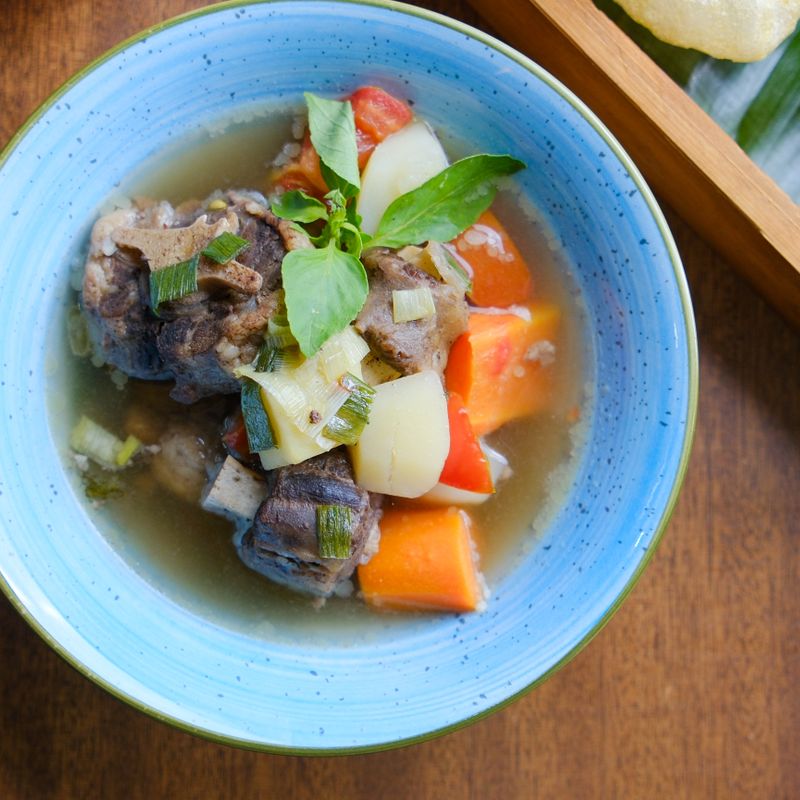
Slow Cooker Oxtail and Root Vegetable Broth
A deeply flavored, collagen-rich broth made from oxtail and root vegetables simmered low and slow for 10–12 hours in a slow cooker. The extended cooking time extracts maximum flavor from the bones and meat, creating a silky, gelatinous broth perfect as a foundation for soups or served simply on its own with fresh herbs.
- Prep
- 20 min
- Cook
- 10 hr
- Wait
- 2 hr
- Total
- 12 hr 20 min
- Makes
- 2 to 3 quarts (8 to 12 cups)
Steps
Before you start
- Pat the oxtail dry with paper towels to help remove excess blood for a clearer broth
- Have a 6-quart or larger slow cooker ready and positioned on a stable surface
- Gather all vegetables, seasonings, and a fine mesh strainer before beginning
- Plan your time: the broth will need 10–12 unattended hours in the slow cooker
Prepare vegetables and oxtail
- Pat the oxtail pieces dry with paper towels.
- If the oxtail isn't already cut into pieces, trim any large excess fat and cut into 2-inch chunks.
- Roughly chop carrots and parsnips into 2- to 3-inch pieces—do not peel them, as the skins add color and nutrients.
- Roughly chop celery stalks into similar-sized pieces.
- Peel the outer layers from the onion and cut it in half, leaving the papery skin on the cut sides for color.
+ Show details− Hide details
Ready when: All vegetables are roughly chopped into 2- to 3-inch chunks; oxtail is cut into manageable pieces
Tip: Don't worry about even sizing—the vegetables will break down completely and be discarded. Leaving skins on saves time and adds flavor.
Add ingredients to slow cooker
- Place all the oxtail pieces into the bottom of the slow cooker.
- Arrange the chopped carrots, parsnips, celery, and onion halves around the oxtail.
- Scatter the 2 bay leaves and fresh thyme sprigs on top.
- Sprinkle the whole black peppercorns over everything.
- Pour the 3 quarts of water over all the ingredients until they are submerged by at least 1 inch.
- Stir gently with a wooden spoon to distribute the seasonings evenly.
+ Show details− Hide details
Ready when: All ingredients are in the slow cooker and covered with water, aromatics distributed
Tip: The slow cooker should be no more than three-quarters full. If ingredients aren't covered by at least 1 inch of water, add more. Leave 2 inches of headspace at the top.
Cook on low heat
- Cover the slow cooker and set it to LOW.
- Cook for 10 to 12 hours.
- During cooking, the broth will gradually deepen in color to a rich golden-brown, and the meat on the oxtail bones will become very tender and pull away easily.
- If foam or gray scum rises to the surface during the first 1–2 hours, skim it off with a spoon for a clearer final broth (optional but recommended).
- Check that liquid still covers the solids; if it has reduced significantly and bones are exposed, add a bit more water.
- After 10 hours, begin checking for doneness: the oxtail meat should shred easily between your fingers.
+ Show details− Hide details
Ready when: Broth is rich golden-brown; oxtail meat is very tender and pulls from bones easily when tested with a fork
Tip: Set a timer on your phone—different slow cookers cook at different rates. Start checking at 10 hours. If your cooker runs hot, broth may be done closer to 9–10 hours.
Strain broth from solids
- Carefully ladle or slowly pour the hot broth through a fine mesh strainer (optionally lined with a double layer of cheesecloth) into a large heatproof pot or heat-safe container, discarding all the solids: bones, cooked vegetables, and aromatics.
- Gently press on the solids with the back of a ladle or slotted spoon to extract a little additional liquid, but do not squeeze hard—this can cloud the broth.
- If you strained through cheesecloth, allow the broth to drip through naturally.
- Set the strained broth aside in a cool place (or at room temperature) to cool slowly, about 90 minutes to 2 hours.
- If extra-clear broth is desired, strain once more through fresh cheesecloth.
+ Show details− Hide details
Ready when: Broth is clear and has cooled to room temperature or close to it
Tip: Save the tender oxtail meat for another use—it's delicious shredded into soups, over rice, or on toast with a spoonful of broth and a pinch of salt.
Remove fat from surface
- Once the broth has cooled, use a large flat spoon or ladle to skim excess fat from the surface and discard it.
- Alternatively, transfer the cooled broth to a covered container, refrigerate it overnight, and lift off the fat when it has solidified into a solid layer on top.
- This step is optional: fat adds flavor and nutrition and is prized in many cuisines.
- Only remove it if you prefer a lighter broth.
- The broth is now ready to use or store.
+ Show details− Hide details
Ready when: Fat has been skimmed or removed from the surface
Tip: If refrigerating overnight to solidify fat, cover the container tightly to prevent the broth from absorbing odors in the fridge.
Final seasoning
- Place the broth in a pot over medium heat and warm gently until it just begins to steam; do not boil.
- Carefully taste a small spoonful (it will be hot).
- The broth should taste savory and rich.
- Add salt to taste, starting with ½ teaspoon and increasing by ¼ teaspoon at a time until you are satisfied with the seasoning.
- Remember that removing fat may require slightly more salt than leaving it in.
- Stir well to distribute salt evenly.
- The broth is now ready to serve or store.
+ Show details− Hide details
Ready when: Broth is steaming gently and seasoned to your taste
Tip: Taste carefully and add salt gradually—it is much easier to add more salt than to remove it. If you plan to reduce the broth later for a richer flavor, season on the light side now.
Good to know
Tips
- Do not peel the carrot, parsnip, or onion—the skins add color, flavor, and nutrients to the broth. Simply rinse them well under cold water.
- Save the cooked oxtail meat: after straining, pick the tender meat from the bones and use it to enrich soups, stews, or serve it over rice or toast.
- Freeze broth in ice cube trays (each cube is roughly 2 tablespoons) for easy portioning into sauces, soups, and braised dishes.
- For an even richer, more gelatinous broth, do not remove any of the fat. The gelatin and fat create a silky mouthfeel prized in traditional cooking.
Make ahead
Yes. This broth is ideal made 1–2 days ahead, which allows you to refrigerate it overnight and easily remove the solidified fat before using.
Storage & reheating
Room temperature: up to 2 hours (do not leave unrefrigerated longer than 2 hours). Refrigerator: up to 5 days in a covered airtight container (skim and discard fat before storing for longer shelf life). Freezer: up to 3 months in freezer-safe containers, glass jars, or ice cube trays for portioning. To reheat: Thaw in the refrigerator overnight, then warm gently on the stovetop over medium heat, stirring occasionally. Do not boil. Alternatively, add frozen broth directly to simmering soups and stews.
Substitutions
- Oxtail → Beef knuckle bones or beef marrow bones (3 lbs / 1360 g total). These create an equally rich broth, though oxtail provides more meat and gelatin for a silkier texture. Use bones cut into 3-inch pieces and add the same amount of water.
- Parsnip → Turnip or rutabaga. Similar earthy sweetness and texture. Use the same weight and chop into similar-sized pieces.
- Yellow onion → 2 medium leeks (white and light green parts only, cleaned and halved lengthwise). Leeks add a milder, slightly sweet flavor. Avoid dark green parts, which can bitter the broth.
- Fresh thyme → 1 tsp dried thyme or 2 bay leaves. Dried thyme is more concentrated, so use less. Add it directly in step 2. Bay leaves alone are less aromatic but work in a pinch.
More broths
See all →

Find more like this
- Meal
- Lunch
- Main ingredient
- Carrots
- Method
- Slow Cooker