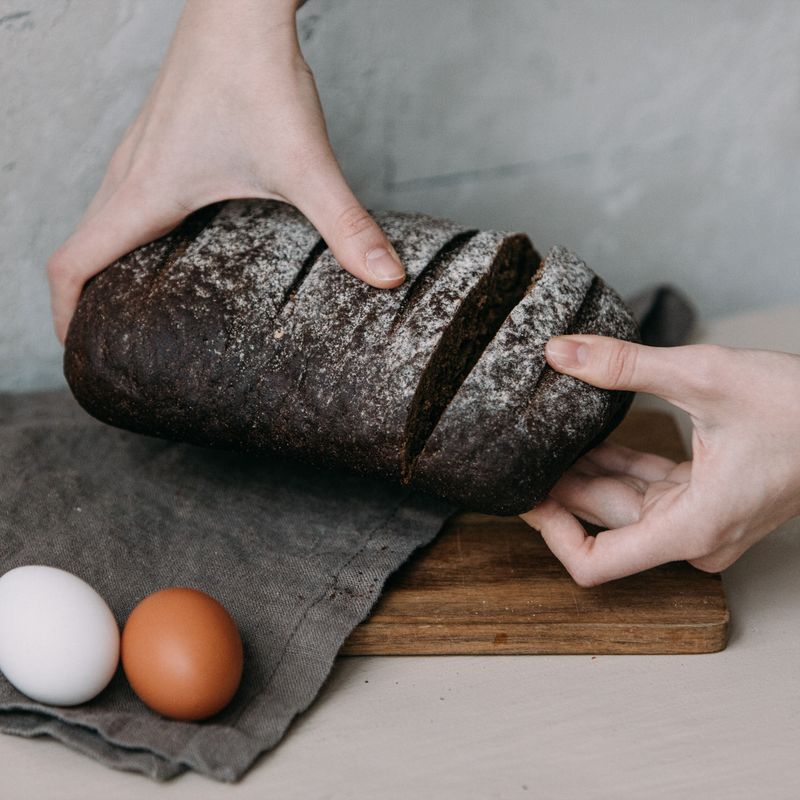
Rye and Molasses Breakfast Loaf with Caraway
A hearty, moist breakfast loaf that combines earthy rye flour with rich molasses and the distinctive anise-like warmth of caraway seeds. This yeasted bread has a tender crumb with a slight tang from the rye, making it perfect for toasting and spreading with butter or cream cheese. The molasses adds subtle sweetness and depth while keeping the loaf moist for days.
- Prep
- 15 min
- Cook
- 40 min
- Wait
- 1 hr 45 min
- Total
- 2 hr 40 min
- Makes
- 1 loaf (10 to 12 slices)
Steps
Before you start
- Check that your yeast is fresh and not expired
- Have your 9×5-inch (23×13 cm) loaf pan ready; grease or line it lightly
- Use warm water between 100°F and 110°F (38°C to 43°C)—too hot kills yeast, too cool slows rising
- Read through the entire recipe first so you understand the two rises
Combine dry ingredients
- In a large mixing bowl (at least 3-quart capacity), whisk together the bread flour, rye flour, instant yeast, salt, and lightly crushed caraway seeds.
- Make sure the yeast is evenly distributed throughout the flour mixture so it activates uniformly.
+ Show details− Hide details
Ready when: Dry ingredients are combined and look uniform
Tip: Sift the flours together if they feel lumpy, especially the rye flour, which can compress during storage.
Mix in wet ingredients
- Pour the warm molasses and warm water into the flour mixture.
- Using a wooden spoon or sturdy spatula, stir and fold until all dry ingredients are hydrated and you have a shaggy, sticky dough.
- There should be no pockets of dry flour visible.
- The dough will be slightly wetter than a typical bread dough—this is normal for rye breads.
+ Show details− Hide details
Ready when: All flour is moistened and the dough is shaggy and sticky with no dry streaks
Tip: Do not knead yet; just mix until the dry ingredients are incorporated. Rye dough develops differently than wheat dough and doesn't need traditional kneading.
Knead briefly and add oil
- Transfer the dough to a lightly oiled surface or, if you prefer, continue in the bowl.
- Knead by folding and pressing for about 8 to 10 minutes until the dough becomes smoother and slightly less sticky, but it will still be wetter than wheat bread dough.
- Add the vegetable oil, folding it in gently until fully incorporated.
- The dough should feel elastic but still slightly tacky.
+ Show details− Hide details
Ready when: Dough is smoother, elastic, and slightly tacky; oil is completely incorporated
Tip: Handle rye dough more gently than wheat dough—overworking can make it dense. Stop kneading as soon as the dough feels elastic and holds together.
First rise
- Shape the dough into a loose ball and return it to the bowl (oil the bowl lightly if needed).
- Cover with plastic wrap or a damp kitchen towel.
- Let it rise in a warm, draft-free spot for 50 to 60 minutes, until it has increased in volume by about 50 percent and pokes gently with a fingertip leave a slight indent that slowly springs back partway.
+ Show details− Hide details
Ready when: Dough increases by about 50 percent and a light poke leaves a slight fingerprint that slowly springs back partway
Tip: The ideal temperature for rising is 75°F to 78°F (24°C to 26°C). If your kitchen is cold, turn on the oven light or place the bowl in a turned-off oven with the door slightly ajar.
Shape and pan the loaf
- Lightly grease or line a 9×5-inch (23×13 cm) loaf pan.
- Turn the risen dough out onto a lightly oiled work surface.
- Gently press and stretch the dough into a rough rectangle that is about 8 inches long and 4 inches wide.
- Fold the rectangle in thirds lengthwise, overlapping the sides, then roll it tightly from one short end toward you, pressing gently as you go to seal the seams.
- Place the loaf, seam-side down, into the prepared pan.
- The dough should just touch the sides of the pan.
+ Show details− Hide details
Ready when: Loaf is shaped and sits snugly in the pan with seams sealed
Tip: For a smoother, more even crumb, seal the seams carefully—gaps or loose seams can cause the bread to split unevenly during baking.
Second rise
- Cover the pan loosely with plastic wrap or a damp towel.
- Let the loaf rise in the same warm, draft-free spot for 45 to 50 minutes, until the dough rises about ½ inch above the rim of the pan and a gentle poke leaves a shallow indent that springs back slowly.
+ Show details− Hide details
Ready when: Dough rises ½ inch above the pan rim; a light poke leaves a shallow indent that springs back slowly
Tip: Rye dough rises more slowly than wheat dough, so don't rush this stage. The slower rise actually improves flavor and texture.
Preheat oven and prepare to bakeOven 375°F / 190°C
- About 15 minutes before the loaf finishes its second rise, preheat your oven to 375°F (190°C).
- Position the rack in the lower-middle part of the oven so the top of the loaf won't get too dark.
- If you like, lightly spray or brush the top of the loaf with water for a slightly more open crumb.
+ Show details− Hide details
Ready when: Oven reaches 375°F (190°C)
Tip: Use the lower-middle rack to ensure the bottom of the loaf bakes through without the top burning. If the top browns too quickly, tent it loosely with foil during the last 10 minutes.
Bake the loafOven 375°F / 190°C
- Place the pan in the preheated 375°F (190°C) oven.
- Bake for 38 to 42 minutes.
- The loaf is done when the internal temperature reaches 205°F to 210°F (96°C to 99°C) on an instant-read thermometer inserted into the center, or when it sounds hollow when you tap the bottom of the pan and the top is a deep golden brown.
- The edges may be slightly darker than the top, which is normal.
+ Show details− Hide details
Ready when: Internal temperature reaches 205°F to 210°F (96°C to 99°C); loaf sounds hollow when tapped; top is deep golden brown
Tip: If the top is browning too quickly, make a loose tent of foil and place it over the loaf after 30 minutes. The internal temperature is the most reliable indicator of doneness.
Cool in pan and turn out
- Remove the loaf from the oven and let it rest in the pan for 8 to 10 minutes.
- During this time, the structure will firm up slightly.
- Then, turn the loaf out onto a wire rack or clean kitchen towel.
- If you've lined the pan with parchment, simply lift the loaf out.
- Let the loaf cool completely on the rack, about 45 to 50 minutes, before slicing.
- This allows the interior to set properly and makes slicing easier.
+ Show details− Hide details
Ready when: Loaf is cooled completely and feels firm when pressed gently
Tip: Slicing warm bread tears the crumb. Wait until it cools completely for clean, neat slices. A serrated bread knife works best.
Good to know
Tips
- Rye dough is naturally stickier and more fragile than wheat dough because rye lacks gluten-forming proteins. Don't panic if it seems wetter—this is correct. Gentle handling and slightly longer rises give the best results.
- The molasses not only sweetens but also adds acidity, which helps the dough develop a subtle tang and keeps the loaf moist for days. Do not skip it or substitute it with only sugar.
- A spray bottle of water on top of the dough before baking can create a more open, rustic crumb. This step is optional but adds character.
- Slice the completely cooled loaf with a sharp serrated bread knife using a gentle sawing motion. Warm bread will compress and tear; cold bread slices cleanly.
Make ahead
The dough can be made and placed in the refrigerator at the end of the first rise (Step 4). Cover well and refrigerate for up to 12 hours. Remove from the fridge, shape, and allow it to come to room temperature (about 1 hour) before the second rise and baking. Alternatively, bake the loaf, cool completely, wrap tightly, and freeze for up to 3 months.
Storage & reheating
Store cooled loaf, wrapped well in plastic wrap or in an airtight container, at room temperature for up to 3 days. The molasses keeps it moist and tender. For longer storage, wrap the cooled loaf in plastic wrap and then foil, and freeze for up to 3 months. To reheat, wrap in foil and warm in a 350°F (175°C) oven for 10 to 15 minutes, or toast slices individually.
Substitutions
- rye flour (medium or dark) → Whole wheat flour or spelt flour. Use the same weight. The loaf will be slightly less earthy and may rise a touch more quickly, but the molasses and caraway flavor will remain strong.
- instant (rapid-rise) yeast → Active dry yeast. Use the same weight or increase slightly (2 grams / about 1.75 teaspoons). Active dry yeast is coarser and less potent; mixing it in with the dry ingredients still works well.
- caraway seeds → Fennel seeds or anise seeds. Use the same amount. Fennel will be slightly sweeter and milder; anise will be more licorice-forward. Omit entirely if you dislike these flavors.
- unsulphured molasses → Honey, brown sugar syrup, or barley malt syrup. Use 0.5 cup (120 ml) honey or 0.5 cup (120 ml) brown sugar mixed with a splash of water. The loaf will be slightly less deep in flavor, but still tender and delicious. Barley malt syrup is closest to molasses in character.
More yeast breads
See all →



Find more like this
- Meal
- Breakfast
- Diet
- VegetarianHalal
- Method
- Oven