Roasted Carrot and Harissa Soup
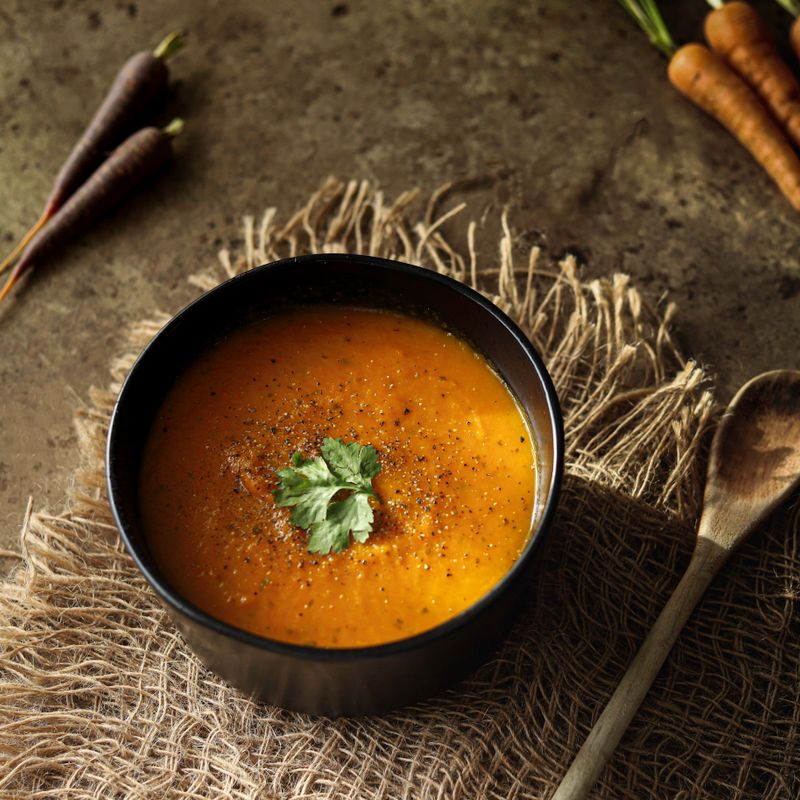
A vibrant North African–inspired soup built on roasted carrots that caramelize and deepen in flavor, balanced with the complex heat of harissa paste and warmth of cumin. Coconut milk adds richness and smoothness, while a final drizzle of olive oil and handful of herbs brighten each spoonful. The roasting step is crucial—it transforms the carrots into something sweet and concentrated, far beyond simple boiling.
- Prep
- 15 min
- Cook
- 45 min
- Wait
- 5 min
- Total
- 1 hr 5 min
- Makes
- 4 servings, about 5 cups (1.2 liters)
Steps
Before you start
- Preheat your oven to 425°F (220°C) so it's ready when you toss the carrots
- Have your vegetable broth measured and nearby
- Read through all steps—the roasting is the only time-sensitive part
Roast the carrotsOven 425°F / 220°C
- On a large rimmed baking sheet, toss the carrot pieces with 3 tablespoons (45 ml) olive oil, 1 teaspoon (6 g) kosher salt, and ½ teaspoon (1 g) black pepper until evenly coated.
- Spread in a single layer, cut-side down where possible.
- Roast in a 425°F (220°C) oven for 30–35 minutes, stirring once halfway through, until deeply golden and tender when pierced with a fork.
- The edges should be caramelized and slightly charred.
+ Show details− Hide details
Ready when: Carrots are golden with caramelized edges and tender throughout
Tip: Spread carrots in a single layer so they roast, not steam. The browning is what gives the soup its depth.
Sauté garlic and harissa
- Transfer the roasted carrots to a large pot.
- Set the pot over medium heat, add the sliced garlic, and cook for 1 minute, stirring constantly, until fragrant.
- Add the harissa paste and cumin, and stir for another 30 seconds to toast the cumin slightly and bloom the harissa's flavors.
+ Show details− Hide details
Ready when: Garlic is fragrant and harissa is warmed through
Tip: Don't let the harissa paste scorch—keep stirring and move to the next step quickly.
Add broth and simmer
- Pour in the 4 cups (950 ml) of vegetable broth, stirring to break up the harissa and distribute it evenly.
- Bring to a gentle simmer over medium-high heat, then reduce to medium-low and let simmer for 10 minutes.
- This allows the flavors to meld and the liquid to reduce slightly.
+ Show details− Hide details
Ready when: Broth is gently simmering with small bubbles breaking the surface
Tip: Keep the heat gentle so the soup doesn't reduce too much—you want a creamy consistency, not a thick stew.
Blend until smooth
- Remove from heat and let cool for 5 minutes.
- Using an immersion blender, blend the soup directly in the pot until completely smooth, 2–3 minutes of blending.
- If using a regular blender, work in batches (about 3 cups per batch), blending on high speed for 1–2 minutes per batch.
- Be careful with hot liquid—leave the blender lid slightly ajar or cover loosely with a kitchen towel to let steam escape.
+ Show details− Hide details
Ready when: Soup is completely smooth with no chunks or visible fibers
Tip: If using a regular blender, never fill it more than halfway with hot liquid—it can splatter. A wet kitchen towel over the lid will catch any splashes.
Stir in coconut milk
- Return the pot to low heat (if using a regular blender).
- Stir in the ¾ cup (175 ml) of coconut milk, stirring constantly for 1–2 minutes until it's fully incorporated and the soup is creamy and uniform in color.
+ Show details− Hide details
Ready when: Soup is creamy and uniform in color throughout
Tip: Stir well—coconut milk can separate if left alone, so folding it in evenly prevents streaks.
Season and finish
- Remove from heat.
- Stir in the 2 tablespoons (30 ml) of fresh lemon juice.
- Taste and adjust salt to your preference, starting with ¼ teaspoon (1.5 g) if needed.
- Ladle into bowls and drizzle each with a little olive oil if desired.
- Scatter cilantro and mint over the top.
+ Show details− Hide details
Ready when: Soup is balanced in flavor—warm, slightly spicy, bright, and creamy
Tip: The lemon juice brightens the soup and cuts through the richness of the coconut milk. Taste first before adding extra salt, as the broth and harissa already contain sodium.
Good to know
Tips
- Roasting the carrots is non-negotiable for this recipe—it develops sugars and creates a caramelized depth that boiling simply cannot achieve. The 30–35 minute window ensures deep browning without drying them out.
- Harissa paste varies in heat level by brand. Start with 2 tablespoons and taste after seasoning; you can always add more, but you cannot remove it. If you prefer a milder soup, use 1½ tablespoons and taste.
- If the soup seems too thick after blending, whisk in additional broth, ¼ cup (60 ml) at a time, until you reach your desired consistency. If too thin, simmer uncovered for 5 minutes to reduce.
- For a creamier texture without coconut milk, reserve ½ cup (120 ml) of the roasted carrots before blending, blend the rest as directed, then fold in the reserved carrots at the end for a rustic, chunkier consistency.
Make ahead
Blend and cool the soup completely, then refrigerate in an airtight container for up to 3 days. Do not add the lemon juice, cilantro, or mint until just before serving. Reheat gently on the stovetop over low heat, stirring often, or in the microwave in 2-minute intervals until warmed through.
Storage & reheating
Room temperature: up to 2 hours in a covered pot. Refrigerator: up to 3 days in an airtight container. Freezer: up to 2 months in freezer-safe containers or bags. Thaw overnight in the refrigerator and reheat on low heat, stirring often, until warmed through. Add fresh lemon juice and herbs only after reheating.
Substitutions
- harissa paste → 3 tablespoons (45 ml) tomato paste mixed with 1 tablespoon (15 ml) hot sauce and ½ teaspoon (1 g) ground coriander. Creates a milder, less fermented heat. Adjust the hot sauce amount to taste.
- unsweetened full-fat coconut milk → heavy cream or crème fraîche. Yields a richer, tangier soup without the coconut flavor. Use the same amount.
- vegetable broth, unsalted → chicken broth or bone broth. Adds savory depth; the soup becomes slightly less vegetarian-friendly but still works beautifully.
- ground cumin → ground coriander or a blend of ½ teaspoon coriander and ½ teaspoon ground ginger. Shifts the flavor profile toward brighter, more citrusy spice notes.