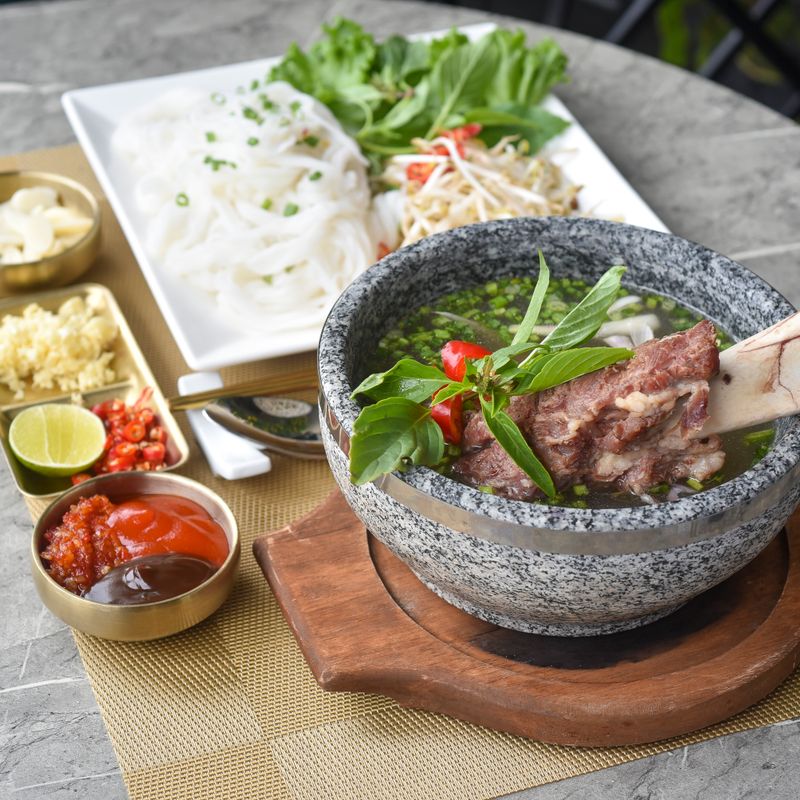
Roasted Beef Bone Broth
A deeply savory, gelatin-rich beef broth made by roasting marrow bones and vegetables until caramelized, then simmering gently for hours with a splash of apple cider vinegar. Sip it from a mug or use it as a base for soups and sauces.
- Prep
- 25 min
- Cook
- 12 hr 30 min
- Wait
- 4 hr
- Total
- 16 hr 55 min
- Makes
- About 3 quarts (2.8 liters), 10 servings of about 1 cup (300 ml)
Steps
Before you start
- Plan for about 17 hours start to finish: 45 minutes roasting, 12 hours simmering, then cooling and chilling. Most of it is unattended.
- Choose a pot of at least 8 quarts (7.5 liters) so the bones are covered with room to spare.
- If the bones are frozen, thaw them in the fridge overnight so they roast evenly.
- Do not salt the broth while it simmers; season each portion when you use it so you can control the final flavor.
Heat the ovenOven 450°F / 230°C
- Position a rack in the center of the oven and heat to 450°F (230°C).
- Line the large rimmed baking sheet with parchment or leave it bare for better browning.
+ Show details− Hide details
Ready when: Oven thermometer or display reads 450°F (230°C).
Roast the bonesOven 450°F / 230°C
- Spread the bones in a single layer on the baking sheet with space between them.
- Roast for 30 minutes at 450°F (230°C), turning them once halfway through.
+ Show details− Hide details
Ready when: Bones are deep golden brown on the surface and the marrow is starting to bubble.
Tip: Dry bones brown better than wet ones, so pat them well before roasting.
Add vegetablesOven 450°F / 230°C
- Remove the sheet.
- Add the onions, carrots, celery and garlic around the bones.
- Smear the tomato paste over the vegetables and a few bones.
- Roast another 20 to 25 minutes at 450°F (230°C), stirring once.
+ Show details− Hide details
Ready when: Vegetable edges are browned and the tomato paste has darkened to brick red, not black.
Tip: Pull the sheet if anything smells burnt; scorched bits make the broth bitter.
Transfer to pot
- Use tongs to move the bones and vegetables into the stockpot.
- Pour off and discard the fat from the baking sheet, leaving any browned bits.
- Add about 1 cup (240 ml) of the water to the hot sheet and scrape the browned bits with a spoon, then pour this into the pot.
+ Show details− Hide details
Ready when: The baking sheet is clean of stuck-on bits.
Tip: Those browned bits hold much of the flavor, so don't skip deglazing.
Add water and vinegar
- Pour in the apple cider vinegar, bay leaves, peppercorns and parsley stems if using.
- Add the remaining cold water so everything is covered by at least 1 inch (2.5 cm).
- Let the pot stand 30 minutes so the vinegar can begin drawing minerals and collagen from the bones.
+ Show details− Hide details
Ready when: All bones are submerged.
Tip: Starting with cold water yields a clearer broth.
Bring to a simmer
- Set the pot over medium-high heat and bring it slowly to a bare simmer, about 40 minutes.
- As gray foam rises to the top, skim it off with a ladle or spoon.
- Reduce the heat to low once the first bubbles break the surface.
+ Show details− Hide details
Ready when: A few small bubbles break the surface every second or two and little foam remains.
Tip: Never let the broth reach a rolling boil; it clouds the broth and emulsifies the fat.
Simmer low and slow
- Keep the pot partially covered on low heat for 12 hours (or 10 hours minimum), maintaining a gentle shimmer.
- Check every few hours and top up with hot water if the bones poke above the liquid.
- If you leave the house or sleep, use a slow cooker on low instead.
+ Show details− Hide details
Ready when: Liquid is dark amber, reduced by about a quarter, and the bones look pale with meat and cartilage falling apart.
Tip: If you cannot supervise a stovetop pot overnight, use a slow cooker or a 200°F (95°C) oven.
Strain the broth
- Turn off the heat and let the pot stand 20 minutes.
- Remove large bones and vegetables with tongs and discard.
- Pour the broth through a fine-mesh strainer into a large heatproof bowl or second pot.
+ Show details− Hide details
Ready when: Broth runs clear to amber with no bone fragments.
Tip: Scoop out the soft marrow before discarding bones if you like to spread it on toast.
Cool quickly
- Set the bowl in a sink filled with ice water, stirring occasionally, until the broth reaches 70°F (21°C) or below, about 45 minutes.
- Then cover and refrigerate for at least 8 hours.
+ Show details− Hide details
Ready when: A layer of white fat has solidified on top and the broth beneath jiggles like soft gelatin.
Tip: Do not leave hot broth at room temperature for more than 2 hours.
Defat and store
- Lift off the solid fat cap with a spoon and save it for cooking if desired.
- Ladle the broth into jars, leaving 1 inch (2.5 cm) of headspace if freezing.
- Season each cup with salt when you heat it to serve.
+ Show details− Hide details
Ready when: Broth is clear and gelled when cold.
Tip: A weak gel is still fine to eat; it simply means a lighter broth, so use fewer cups of water next time.
Good to know
Tips
- Mix marrow bones with collagen-rich knuckle, neck or oxtail bones for a broth that gels well.
- Keep the simmer barely moving; a hard boil makes the broth cloudy and greasy.
- Freeze some broth in ice cube trays for quick pan sauces.
- Reduce the strained broth by half for a concentrated broth that takes less storage space.
Make ahead
"The broth can be made up to 5 days ahead and kept chilled, or frozen for up to 6 months."
Storage & reheating
Refrigerate in covered containers for up to 5 days. Freeze for up to 6 months, leaving 1 inch (2.5 cm) headspace in jars. Thaw overnight in the fridge. Reheat gently in a saucepan over medium heat until steaming, about 165°F (74°C), and season with salt.
Substitutions
- apple cider vinegar → lemon juice or white wine vinegar. Use the same amount; flavor stays neutral.
- beef marrow bones and knuckle bones, mixed → oxtail or beef short rib bones. Replace up to half the bones for a richer meaty flavor.
- tomato paste → 1 whole tomato, halved. Roast it with the vegetables for similar depth.
- fresh parsley stems → fresh thyme sprigs. Use 4 sprigs.
More broths
See all →

Find more like this
- Meal
- Lunch
- Main ingredient
- Beef
- Quick & Easy
- EasyMake AheadFreezer Friendly