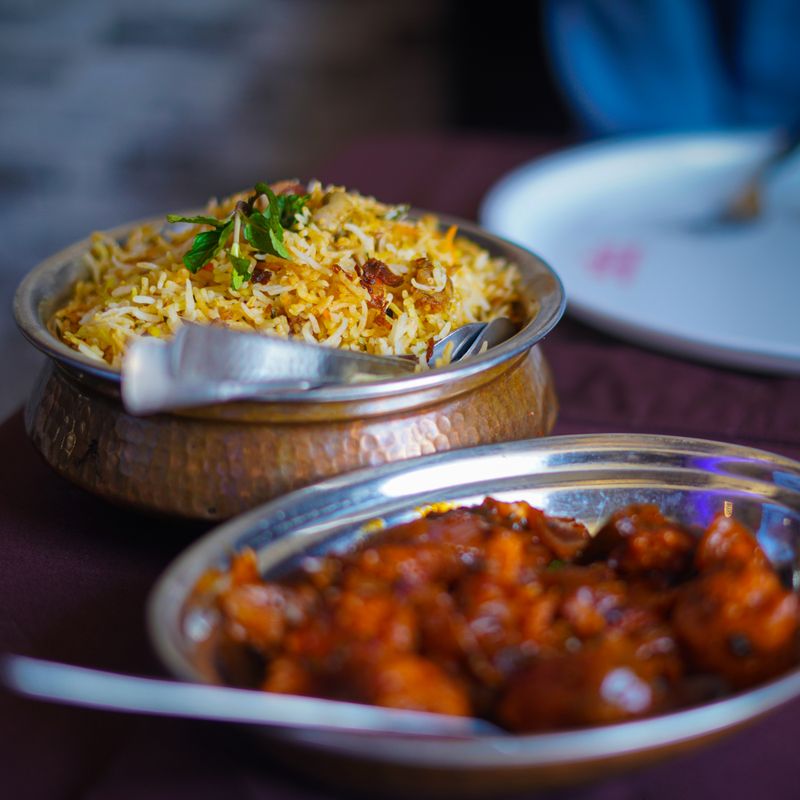
Prawn Biryani with Coconut and Fried Onions
Juicy marinated prawns are simmered briefly in a coconut-tomato masala, then layered with parboiled basmati, crisp fried onions, herbs and saffron milk and steamed (dum) until every grain is fragrant. The prawns finish cooking in the steam, so they stay tender.
- Prep
- 40 min
- Cook
- 50 min
- Wait
- 40 min
- Total
- 2 hr 10 min
- Makes
- 4 generous servings (about 8 cups / 1.8 kg biryani)
Steps
Before you start
- Start the rice soak first (30 minutes). You will prepare the prawns and onions while it soaks.
- Pat the prawns very dry and keep them refrigerated until you marinate them; wet prawns water down the masala.
- Use a heavy-bottomed 5½–6 quart (5–5.5 L) pot with a tight lid. A thin pot will scorch the bottom layer. This recipe is cooked entirely on the stovetop; no oven is needed.
- Have foil and a flat griddle (tawa) or heat diffuser ready for the steaming step.
Soak the rice
- Rinse the basmati in a bowl with cold water, swirling and draining 4–5 times until the water is almost clear.
- Cover with fresh cold water and soak for 30 minutes, then drain well in a sieve.
- Meanwhile, crumble the saffron into the hot milk in a small bowl and leave it to steep until the milk is deep golden.
+ Show details− Hide details
Ready when: Grains turn opaque white and the soaking water is cloudy-clear
Tip: Handle the rice gently; soaked basmati breaks easily.
Marinate the prawns
- While the rice soaks, combine the prawns in a bowl with the yogurt, 1 tablespoon of the ginger-garlic paste, the turmeric, Kashmiri chili powder, 1 tablespoon of the biryani masala, 1 tablespoon of the lemon juice and 1 teaspoon of the salt.
- Toss until every prawn is coated, cover and refrigerate for the remaining soak time, up to 30 minutes.
+ Show details− Hide details
Ready when: Prawns are evenly coated in a thick red-orange marinade
Tip: Do not marinate longer than 30 minutes; the acid in yogurt and lemon turns prawns mushy.
Fry the onions
- Heat the ghee and oil in the 12-inch skillet over medium-high heat.
- Add the sliced onions.
- Fry, stirring every minute or so and lowering to medium once they soften, for 15–18 minutes until deep golden brown.
- Scoop out about half of the onions with a slotted spoon onto a plate lined with paper towel; they will crisp as they cool.
- Leave the rest, with the fat, in the skillet.
+ Show details− Hide details
Ready when: Onions are deep golden brown (not dark brown or bitter) and the reserved half turns crisp as it cools
Tip: Spread the onions out and keep stirring near the end; they go from golden to burnt quickly.
Blend the coconut paste
- Combine the coconut, green chilies and ¼ cup (60 ml) of water from the boiling water amount in a blender.
- Blend to a fairly smooth, thick paste, scraping down the sides once, about 1 minute.
+ Show details− Hide details
Ready when: Paste is pale green and nearly smooth, with only tiny flecks of coconut
Build the prawn masala
- Return the skillet with the remaining onions to medium heat.
- Stir in the remaining tablespoon of ginger-garlic paste and cook 1 minute until the raw smell fades.
- Add the tomatoes and cook 6–8 minutes, mashing with your spoon, until they collapse and the oil begins to separate at the edges.
- Stir in the coconut paste, the remaining tablespoon of biryani masala and ½ teaspoon salt and cook 3 minutes.
- Add the marinated prawns with all the marinade and cook, stirring, for 2–3 minutes just until the prawns turn pink on the outside but are still translucent in the centre.
- Turn off the heat.
+ Show details− Hide details
Ready when: Masala is thick and glossy with oil separating at the edges; prawns are pink outside, still underdone inside
Tip: Resist cooking the prawns fully here. They finish in the steam, and overcooked prawns turn rubbery.
Parboil the rice
- Bring the remaining water (about 11¾ cups / 2.7 L) to a rolling boil in the large pot.
- Add the salt, bay leaves, cinnamon, cardamom, cloves and 1 tablespoon lemon juice.
- Add the drained rice, stir once, and boil briskly for 5–6 minutes.
- Test a grain: it should snap into 2–3 pieces when pressed, with a thin, firm white core.
- Drain immediately in a colander and discard the whole spices if you like.
+ Show details− Hide details
Ready when: Grains are about 70% cooked: they have elongated, are soft outside and still have a firm white core
Tip: Err on the side of undercooked. The rice keeps cooking in the steam and will turn mushy if boiled further.
Layer the biryani
- Spread the prawn masala evenly across the bottom of the 5½–6 quart heavy pot.
- Scatter half of the cilantro and mint over it.
- Spoon half of the drained rice on top in an even layer, without pressing down.
- Scatter over half of the crisp onions and the remaining herbs, then add the remaining rice.
- Drizzle the saffron milk in streaks over the top, then the melted ghee, and finish with the rest of the crisp onions.
+ Show details− Hide details
Ready when: Rice sits in two loose layers with golden saffron streaks across the top
Tip: Keep the layers loose so steam can travel up through the rice.
Seal and steam (dum)
- Cover the pot with a sheet of foil pressed around the rim, then set the lid on tightly.
- Place over high heat for 2 minutes until you see steam escaping at the edges.
- Move the pot onto a hot griddle or heat diffuser, reduce the heat to low and steam for 20 minutes without lifting the lid.
+ Show details− Hide details
Ready when: A fragrant, steady wisp of steam escapes at the rim; the pot smells of saffron, spices and coconut
Tip: If the pot hisses loudly or you smell burning, turn the heat to its lowest setting; the base should only gently sizzle.
Rest the biryani
- Turn off the heat and leave the pot undisturbed and covered for 10 minutes.
- Then remove the lid and check one of the larger prawns with an instant-read thermometer inserted into the thickest part: it should read at least 145°F (63°C) and the flesh should be opaque and firm.
+ Show details− Hide details
Ready when: Prawns are opaque and curled in a loose C shape; rice grains are fully tender and separate
Tip: If the prawns are not yet opaque in the centre, re-cover and steam 3 more minutes over low heat.
Fluff and serve
- Gently fold the biryani from the bottom up with a wide spoon, keeping the layers of white and saffron rice, prawn masala and onions partly marbled and the grains whole.
- Serve hot, straight from the pot, with raita and sliced cucumber and onion.
+ Show details− Hide details
Ready when: Grains are long, separate and lightly coated in masala
Tip: Use a flat spoon and lift rather than stir to avoid breaking the grains.
Good to know
Tips
- Use aged basmati for the best long, separate grains; fresh or short-grain rice turns sticky.
- Buy raw, large prawns (16–20 per lb). Small ones overcook easily; if using frozen, thaw in the fridge and dry thoroughly.
- A tight seal is essential for dum: if your lid is loose, press foil under it or use a strip of flour-and-water dough around the rim.
- Salt the boiling water generously. Rice is only seasoned at this stage and the masala beneath can't flavour all of it.
Make ahead
Fry the onions up to 2 days ahead and store the crisp ones airtight at room temperature and the rest in the fridge. The coconut paste keeps 2 days refrigerated. Marinate prawns no more than 30 minutes before cooking. Assemble and steam just before serving for the best prawn texture.
Storage & reheating
Cool within 1 hour. Refrigerate in an airtight container for up to 1 day; do not leave at room temperature more than 2 hours. Freeze for up to 1 month (the prawns will be a little softer). Reheat single portions covered in the microwave with 1 tablespoon of water for 1½–2 minutes, or in a covered skillet over low heat for 5–8 minutes, until steaming hot throughout (165°F / 74°C).
Substitutions
- freshly grated or thawed frozen coconut → unsweetened desiccated coconut (¼ cup / 25 g) soaked in 3 tablespoons hot water for 10 minutes. Gives a similar flavour; the paste will be slightly less creamy.
- biryani masala powder → 1 tablespoon garam masala plus ½ teaspoon ground coriander and ½ teaspoon ground cumin per tablespoon called for. Close approximation if you can't find biryani masala.
- ghee → unsalted butter plus a little extra oil. Slightly less nutty; brown the onions in the oil first to prevent the butter burning.
- thick plain whole-milk yogurt → full-fat coconut milk (¼ cup / 60 ml) plus 1 teaspoon extra lemon juice. Dairy-free option for the marinade.
More biryani
See all →
Find more like this
- Meal
- Dinner
- Cuisine
- Indian
- Main ingredient
- ShrimpBasmati Rice