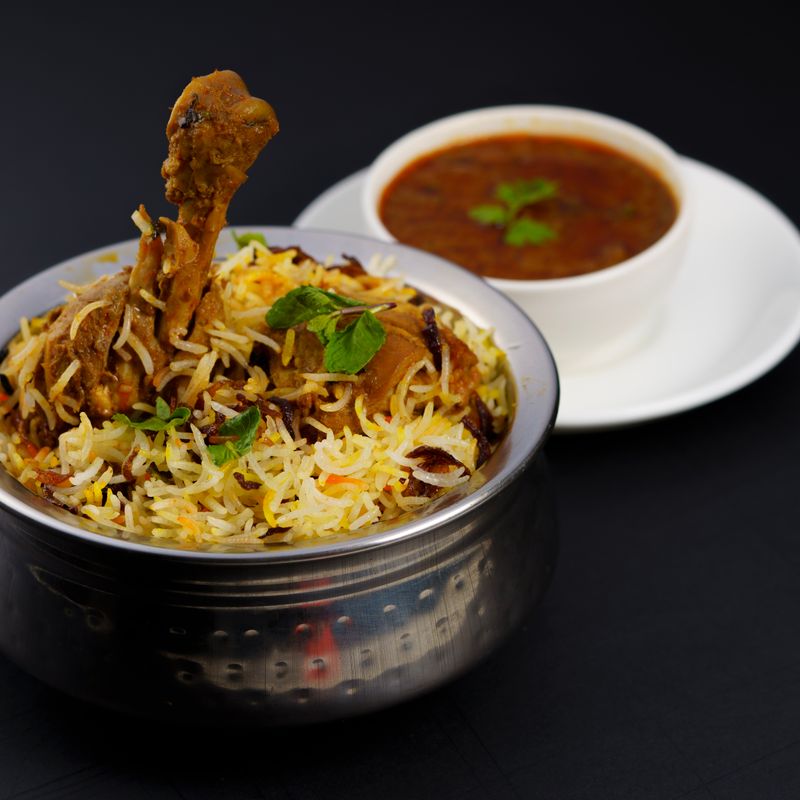
Hyderabadi Mutton Dum Biryani
Tender bone-in mutton in a yogurt, chili and herb masala, layered with 70%-cooked basmati, crisp fried onions, mint and saffron milk, then sealed and steamed on "dum" so every grain takes up the flavor of the meat.
- Prep
- 45 min
- Cook
- 1 hr 58 min
- Wait
- 4 hr 10 min
- Total
- 6 hr 53 min
- Makes
- 6 generous servings (about 9 cups / 2.1 L biryani)
Steps
Before you start
- Plan ahead: the mutton needs at least 4 hours in the marinade (overnight in the fridge is even better). Total time is about 7 hours, most of it hands-off.
- Use bone-in goat or mature lamb (shoulder or leg) cut into 1½–2 inch (4–5 cm) pieces. Pat the pieces dry and let them sit out for 30 minutes before cooking so they cook evenly.
- You need a heavy-bottomed 8-quart (7.5 L) pot or Dutch oven with a tight lid. A thin pot will scorch the bottom layer during dum.
- Use aged basmati if you can find it. Rinse it until the water runs nearly clear so the grains stay separate.
- Whisk the yogurt smooth and use full-fat. Low-fat yogurt splits and makes the gravy watery.
Fry the onions
- Slice the onions as thinly and evenly as you can.
- Heat the frying oil in a large, wide pan over medium-high heat until a slice sizzles immediately.
- Add the onions in one layer (work in two batches if crowded).
- Fry, stirring every minute at first and constantly near the end, for 20–25 minutes total, until deep golden brown and crisp at the edges.
- Lift them out with a slotted spoon onto a paper-towel-lined tray, spreading them out.
- Keep ¼ cup (60 ml) of the frying oil in the pan for step 5 and discard or save the rest.
+ Show details− Hide details
Ready when: Onions are deep golden brown (not dark brown) and snap when cooled; they keep crisping as they sit.
Tip: Pull the onions when they are one shade lighter than you want. They continue to darken in the hot oil, and burnt onions make the whole biryani bitter.
Marinate the mutton
- In a large non-reactive bowl, combine the yogurt, ginger-garlic paste, green chilies, Kashmiri chili powder, turmeric, garam masala, kosher salt, lemon juice, chopped mint and cilantro from the marinade list, and half of the fried onions (crush them between your fingers as you add them).
- Mix into a thick paste.
- Add the dry mutton and massage the marinade into every piece.
- Cover and refrigerate for at least 4 hours, or up to 12 hours.
- Set aside the remaining fried onions for layering, uncovered at room temperature.
+ Show details− Hide details
Ready when: Every piece is evenly coated in a thick, reddish marinade with no dry spots.
Tip: Take the bowl out of the fridge 30 minutes before cooking so the meat is not ice cold.
Soak and drain rice
- During the last 30 minutes of marinating, rinse the basmati in a bowl of cold water, swirling gently and changing the water 4–5 times until it runs almost clear.
- Cover with fresh cold water and soak for 30 minutes.
- Drain well in a strainer just before you boil it.
+ Show details− Hide details
Ready when: Grains look opaque white and are slightly longer than dry grains.
Tip: Handle the rice gently; soaked basmati snaps easily, and broken grains turn mushy.
Steep saffron milk
- Warm the milk until steaming but not boiling.
- Add the crushed saffron and rose water (if using).
- Cover and leave it to steep while you cook the mutton, at least 15 minutes.
+ Show details− Hide details
Ready when: The milk turns a deep orange-gold and smells floral.
Cook the mutton
- Heat the reserved ¼ cup (60 ml) onion oil in the 8-quart pot over medium-high heat for 1 minute.
- Add the marinated mutton with all of its marinade and cook, stirring, for 5–6 minutes until the yogurt stops looking raw.
- Pour in the hot water, bring to a simmer, then cover and reduce to low (medium-low if there is no simmer).
- Cook for 35–40 minutes, stirring every 10 minutes, until the meat is about 85% tender: a knife slides into the thickest piece with some resistance.
- Remove the lid and cook 5 more minutes over medium heat, stirring, until the gravy is thick, clings to the meat, and a layer of reddish oil appears on top.
- You want about 1 cup (240 ml) of thick gravy, not a soupy sauce.
- Turn off the heat and leave the mutton in the pot.
+ Show details− Hide details
Ready when: Meat is almost tender (a knife goes in with slight resistance), gravy is thick with oil separating at the edges, and the meat reads at least 145°F (63°C) in the thickest piece.
Tip: If the gravy is thin, rice will go soggy later. Keep boiling it uncovered until it is thick. If the pot looks dry before the meat is tender, add ¼ cup (60 ml) hot water.
Parboil the rice
- In the 6-quart pot, bring the 3 quarts (3 L) of water to a rolling boil with the kosher salt, bay leaves, crushed cardamom, cloves, cinnamon stick and shahi jeera.
- Boil 2 minutes to infuse.
- Add the drained rice, stir once gently, and boil over high heat for 6–7 minutes.
- Test a grain at 6 minutes: it should break easily when pressed between your fingers but still have a firm white core and snap when bitten.
- Drain immediately in the strainer and spread over the strainer so steam escapes.
- Do not rinse.
+ Show details− Hide details
Ready when: Grains are about 70% cooked: they are longer, bend without snapping, and have a firm, chalky center when bitten.
Tip: Err on the side of undercooked. The rice finishes in the steam, and overcooked rice here means a mushy biryani.
Layer the biryani
- Level the mutton and gravy in the pot (it should still be warm, not scorching).
- Scatter half of the mint and cilantro from the layering list over it.
- Spoon half of the rice on top in an even layer, without pressing down.
- Sprinkle with half of the remaining fried onions, the remaining mint and cilantro, and drizzle with half of the saffron milk and half of the melted ghee.
- Add the remaining rice as a second layer and top with the rest of the fried onions, saffron milk and ghee.
+ Show details− Hide details
Ready when: You can see distinct layers of golden rice, herbs and onions, with patches of saffron color.
Tip: Fish out and discard the whole spices if you notice large clumps of them, so they don't end up in a serving.
Seal the pot
- Knead the whole wheat flour with the water into a soft, pliable dough (add water by the teaspoon if crumbly).
- Roll it into a long rope.
- Press the rope firmly around the rim of the pot, then set the lid on top and press down so the dough forms a complete airtight seal with no gaps.
- (If you prefer, cover the pot tightly with a layer of foil and then the lid.)
+ Show details− Hide details
Ready when: The dough rope is pressed continuously around the rim and lid with no gaps for steam to escape.
Tip: Any gap lets steam escape and leaves the top rice hard. Patch cracks with a little extra dough during cooking.
Cook on dum
- Place the sealed pot over high heat for 3–4 minutes, until you hear a faint sizzle and see steam puffing at the seal.
- Put a tava or heavy skillet under the pot, reduce heat to the lowest setting, and cook for 35 minutes without lifting the lid.
- Turn off the heat.
+ Show details− Hide details
Ready when: A rich aroma of saffron, mint and spices comes from the pot, and the dough seal has dried and hardened.
Tip: If you smell burning, the heat is too high. Use a heavier tava underneath or lower the flame next time.
Rest the biryani
- Leave the pot sealed and undisturbed for 10 minutes so the steam settles and the grains firm up.
+ Show details− Hide details
Ready when: Pot is no longer pushing steam from the seal.
Serve gently
- Break the dough seal and lift the lid away from you so steam escapes.
- Using a wide spoon, fold gently from the bottom up so each portion gets rice, mutton and gravy, keeping the saffron and white rice streaked.
- Check that the meat is fork-tender and the rice is fully cooked, fluffy and separate.
- Serve hot with raita and a simple onion-tomato salad.
+ Show details− Hide details
Ready when: Rice grains are long, fluffy and separate; mutton pulls easily off the bone and reads 190–200°F (88–93°C) for fork-tender meat.
Tip: Fold, don't stir, to avoid breaking the long rice grains.
Good to know
Tips
- Texture is everything: thick gravy plus 70% cooked rice gives separate, fluffy grains rather than a mushy pulao.
- Do not skip the salty rice water. Rice can't be seasoned later, and unsalted water makes the whole dish taste flat.
- Keep the layers loose and don't press the rice down; this lets steam move through the pot evenly.
- Always use a heavy pot and a tava beneath it on low heat to prevent burning the mutton at the bottom.
Make ahead
"Fry the onions up to 3 days ahead and store them airtight at room temperature. Marinate the mutton up to 12 hours ahead in the fridge. You can also cook the mutton gravy (step 5) a day ahead, refrigerate it, and reheat it until hot before layering with freshly boiled rice."
Storage & reheating
"Room temperature: no more than 2 hours. Refrigerator: cool quickly and store airtight up to 3 days. Freezer: up to 2 months in portions. Reheat: sprinkle 1–2 tbsp water over each portion, cover, and microwave 2–3 minutes or steam in a covered pan over low heat 8–10 minutes until steaming hot all the way through (165°F / 74°C). Thaw frozen portions overnight in the fridge first."
Substitutions
- bone-in mutton (goat shoulder or leg) → bone-in lamb shoulder or bone-in chicken thighs. Lamb needs about 30 minutes in step 5. For chicken thighs (1 kg), cook only 15–20 minutes in step 5 until they reach 165°F (74°C).
- saffron threads → ¼ tsp turmeric plus 1 extra tsp rose water. Gives color and fragrance, but not the true saffron flavor.
- ghee → unsalted butter. Butter gives a similar richness but a less nutty flavor.
- whole wheat flour (atta) → heavy-duty foil under the lid. Wrap the foil tightly over the pot rim before pressing on the lid to hold the steam in.
More biryani
See all →

Find more like this
- Meal
- Dinner
- Cuisine
- Indian
- Main ingredient
- Basmati Rice
- Diet
- HalalSugar-Free
- Method
- Stovetop
- Occasion
- EidFamily Gatherings