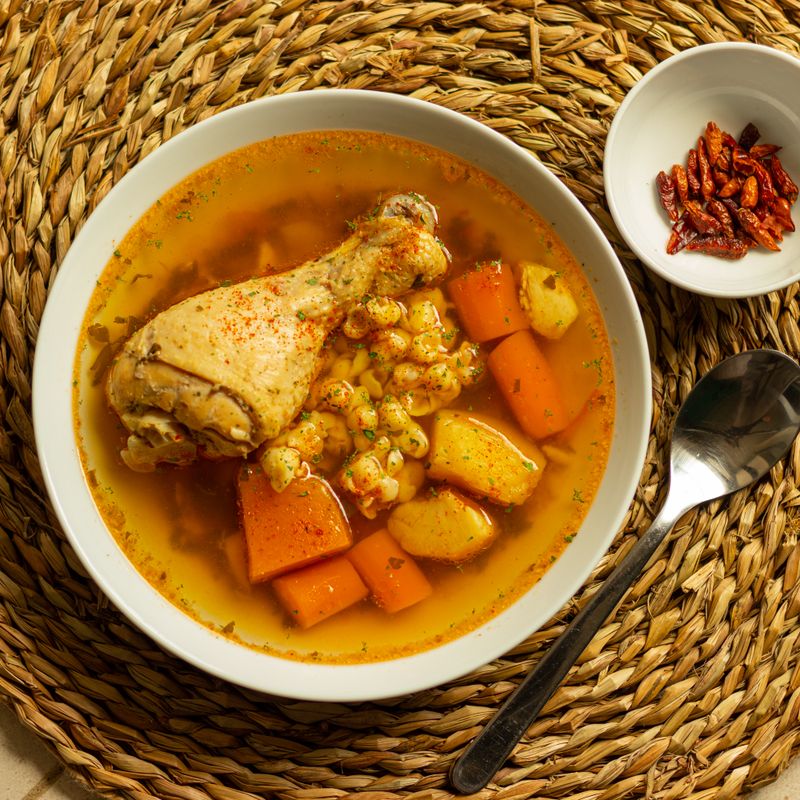
Pork and Hominy Stew (Posole Rojo)
Tender chunks of pork shoulder and plump hominy simmer in a brick-red broth built from toasted guajillo chiles, garlic, and Mexican oregano. Finish each bowl with crunchy cabbage, radish, cilantro, and lime for a deeply savory, mildly spicy stew.
- Prep
- 35 min
- Cook
- 2 hr 45 min
- Wait
- 25 min
- Total
- 3 hr 45 min
- Makes
- About 3½ quarts (8 generous bowls)
Steps
Before you start
- Plan on about 3¾ hours start to finish; most of it is unattended simmering on the stovetop. No oven is needed.
- Guajillo chiles burn quickly. Toast them only until fragrant, or the sauce will taste bitter.
- Pat the pork very dry with paper towels so it browns instead of steaming.
- Salt is split up: 2 tsp on the pork, 1 tsp in the chile sauce, then a final adjustment at the end with the separate finishing salt.
- Use low-sodium broth so you can control the salt, since the stew reduces as it simmers.
Toast the chiles
- Set a dry 10–12-inch (25–30 cm) skillet over medium-low heat.
- Working in 2 batches, lay the seeded guajillo chiles flat and press each with a spatula for 15–20 seconds per side, until they smell fruity and toasty and darken slightly.
- Transfer to a heatproof bowl.
+ Show details− Hide details
Ready when: Chiles are fragrant, slightly darker, and pliable; no black spots or acrid smoke.
Tip: If a chile scorches or smells bitter, discard it and toast a fresh one; burnt chile ruins the whole pot.
Soak the chiles
- Pour the 1 cup (240 ml) boiling water over the toasted chiles.
- Weigh them down with a small plate so they stay submerged.
- Let them soak for 20 minutes.
- Meanwhile, cut and dry the pork and prep the onion and garlic as listed.
+ Show details− Hide details
Ready when: Chiles are completely soft and bend without cracking.
Season and brown pork
- Toss the pork cubes with 2 teaspoons of the kosher salt (keep the remaining 1 teaspoon for the sauce).
- Heat the oil in a 6-quart (5.5 L) heavy pot over medium-high heat until it shimmers.
- Brown the pork in 2–3 batches, leaving space between pieces, for 2–3 minutes per side.
- Move each finished batch to a plate.
+ Show details− Hide details
Ready when: Pork has a deep golden-brown crust on at least two sides; it does not need to be cooked through.
Tip: Crowding the pot makes the pork steam and turn gray. Brown in batches.
Start the pork broth
- Return all the pork and any juices to the pot.
- Add the whole onion half, the 4 smashed garlic cloves, the bay leaves, and the 10 cups (2.4 L) chicken broth.
- Scrape up the browned bits from the bottom.
- Bring to a boil over high heat, then reduce to low.
- Skim any gray foam from the surface.
+ Show details− Hide details
Ready when: Liquid reaches a full boil, then settles to a bare simmer with only a few bubbles breaking the surface.
Simmer pork until tender-ish
- Cover the pot with the lid slightly ajar.
- Simmer gently on low heat for 75 minutes, stirring every 20 minutes.
- The pork will be mostly tender but still a bit firm at this point; the final simmer finishes it.
+ Show details− Hide details
Ready when: A pork cube resists slightly when pierced with a fork but is no longer tough.
Tip: Keep it at a gentle simmer; a hard boil toughens the meat. If pork pokes above the liquid, add ½ cup (120 ml) hot water.
Blend the chile sauce
- While the pork simmers, put the soaked chiles and all of their soaking water in a blender.
- Add the chopped onion half, the 4 whole garlic cloves, the oregano, cumin, and the remaining 1 teaspoon salt.
- Blend on high for 1–2 minutes.
- Press the sauce through a fine-mesh strainer into a bowl, discarding the skins and seeds left behind.
+ Show details− Hide details
Ready when: Sauce is completely smooth, brick red, and pours like thin tomato sauce.
Tip: Straining removes tough chile skins and gives a silky broth. Scrape the underside of the strainer to get all the sauce.
Add the chile sauce
- Remove and discard the onion half and bay leaves from the pot.
- Stir in the strained chile sauce.
- Return to a simmer over medium-low heat, then lower the heat so it barely bubbles.
- Cover with the lid slightly ajar and simmer for 30 minutes, stirring once.
+ Show details− Hide details
Ready when: Broth is a uniform deep red and bubbles gently at the edges.
Add hominy and finish
- Stir in the drained, rinsed hominy.
- Cover with the lid slightly ajar and simmer on low for 45 minutes more, stirring every 15 minutes and scraping the bottom.
- Meanwhile, prepare the cabbage, radishes, lime wedges, cilantro, and avocado for serving.
- If the pork is not yet tender at 45 minutes, keep simmering in 10-minute increments.
+ Show details− Hide details
Ready when: Pork shreds easily when pressed with a spoon (about 195°F/90°C inside) and the hominy is tender and slightly bloomed.
Tip: If the stew thickens too much or the pork sticks out of the liquid, add ½ cup (120 ml) hot water at a time.
Season and rest
- Skim excess red fat from the surface with a spoon if you prefer a leaner broth.
- Taste and add the finishing salt, ¼ teaspoon at a time, until the broth tastes savory and bright.
- Turn off the heat and let the stew rest, covered, for 5 minutes.
+ Show details− Hide details
Ready when: Broth tastes well-seasoned and rounded, not flat.
Tip: Season the final amount at the end; the stew reduces as it cooks and over-salting early is hard to fix.
Serve with garnishes
- Ladle the stew into warm bowls, making sure each gets plenty of pork and hominy.
- Top with a handful of cabbage, a few radish slices, cilantro, and diced avocado if using.
- Serve with lime wedges for squeezing over each bowl.
+ Show details− Hide details
Tip: Add the cabbage right before eating so it stays crisp.
Good to know
Tips
- Do not skip straining the chile sauce; it is what gives the broth a smooth, silky texture.
- Pork shoulder has plenty of fat and collagen, so avoid lean cuts like loin, which turn dry and stringy.
- Rinse canned hominy well to remove the briny canning liquid, which can make the stew taste flat.
- For more heat, blend 1–2 dried chiles de árbol into the sauce; for less, make sure every guajillo is fully seeded.
Make ahead
The stew tastes even better the next day. Cook through step 9, cool, and refrigerate up to 3 days. Prepare the garnishes fresh when serving.
Storage & reheating
Room temperature: no more than 2 hours. Refrigerator: cool completely and store in an airtight container up to 4 days. Freezer: freeze without garnishes up to 3 months; thaw overnight in the fridge. Reheat gently on the stovetop over medium-low heat, stirring occasionally, until steaming hot (165°F/74°C), adding a splash of broth or water if thick.
Substitutions
- dried guajillo chiles → 3 guajillo plus 3 ancho or New Mexico dried chiles. Ancho adds a sweeter, fruitier depth; New Mexico chiles are slightly earthier. Keep the total at about 6 chiles.
- dried Mexican oregano → regular dried oregano. Use 2 teaspoons; Mexican oregano is more citrusy and earthy, but regular oregano works.
- low-sodium chicken broth → water. Use 10 cups water plus an extra 1 teaspoon salt added at the end; the stew will be lighter but still flavorful because of the pork.
- boneless pork shoulder (pork butt) → bone-in pork country-style ribs. Use 3½ lb (1.6 kg); remove the bones before serving. Keep simmering until the meat is fork-tender.
More stews
See all →
Find more like this
- Meal
- Dinner
- Cuisine
- Mexican
- Main ingredient
- Pork Shoulder
- Method
- Stovetop
- Season
- Winter Comfort Food