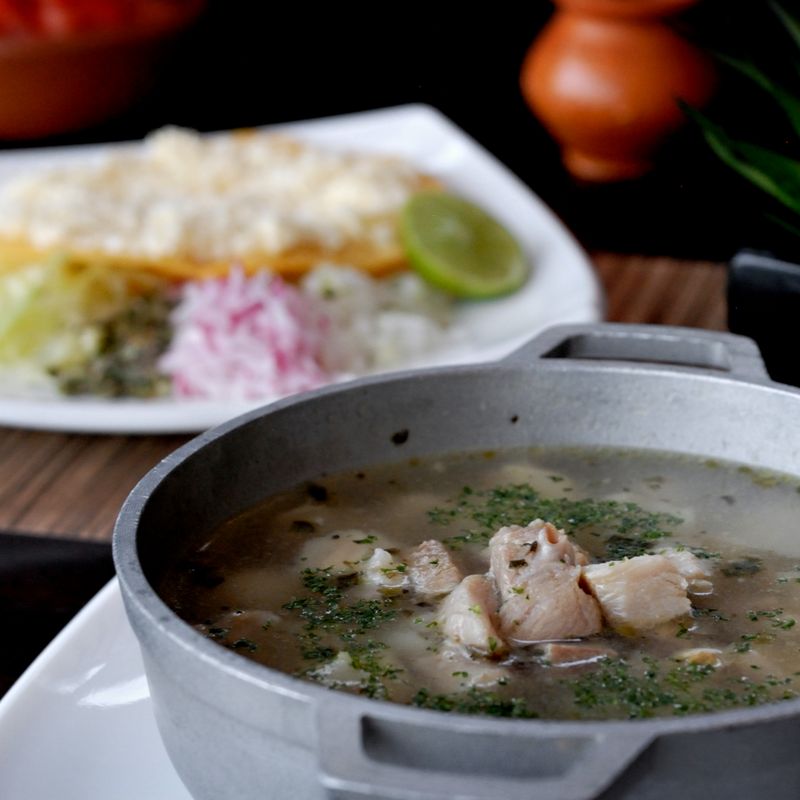
Pork Pozole Rojo
A deep red, gently spiced Mexican soup of tender pork shoulder and plump hominy in a smoky guajillo and ancho chile broth. Pile on crunchy cabbage, radishes, onion and lime so each bowl is bright, fresh and hearty.
- Prep
- 45 min
- Cook
- 2 hr 15 min
- Total
- 3 hr
- Makes
- About 4½ quarts (4.3 L), 8 generous bowls
Steps
Before you start
- Read the timing first: the pork needs about 90 minutes of gentle simmering before the chile sauce goes in, so use that time to soak the chiles and prep the garnishes.
- Wear gloves or wash your hands well after handling dried chiles, and avoid touching your eyes.
- Buy dried chiles that are pliable and leathery, not brittle and dusty. Brittle chiles are old and taste bitter or flat.
- Make sure you have a 6–8 quart (5.7–7.5 L) pot and a blender that can handle hot liquid.
Start the pork broth
- Put the pork chunks, 10 cups (2.4 L) cold water, the quartered ½ of the onion, the 6 whole garlic cloves, bay leaves, 1 tsp of the oregano and 1 tbsp of the kosher salt in a 6–8 quart (5.7–7.5 L) pot.
- Set over high heat and bring to a boil, about 10 minutes.
+ Show details− Hide details
Ready when: Gray foam rises to the surface and the liquid is at a full rolling boil
Tip: Starting the pork in cold water draws out more flavor into the broth and makes skimming easier.
Skim and simmer pork
- Skim off the gray foam with a spoon.
- Reduce the heat to low so the liquid barely bubbles, partially cover the pot and cook for 80–90 minutes, giving it a stir every 30 minutes.
- Start the chiles (next step) during this time.
+ Show details− Hide details
Ready when: A piece of pork pulls apart easily with a fork and is tender all the way through (about 195°F / 90°C inside)
Tip: Keep the simmer gentle. A hard boil makes the pork tough and the broth cloudy.
Toast and soak chiles
- Heat a dry 10-inch (25 cm) skillet over medium heat.
- Toast the guajillo and ancho chiles in a single layer, pressing flat with a spatula, for 20–30 seconds per side until fragrant and slightly darker.
- Move them to a large bowl, pour over 3 cups (710 ml) very hot water, weigh them down with a plate and soak for 20 minutes until completely soft.
- Reserve the soaking water.
+ Show details− Hide details
Ready when: Chiles smell toasty and fruity and are pliable; they should not smell sharp or acrid
Tip: Do not let the chiles scorch or blacken. Burnt chiles turn the sauce bitter, so discard and start over if they do.
Blend the chile sauce
- Lift the chiles from the soaking water into a blender.
- Add the chopped ¼ of the onion, the 4 garlic cloves, the cumin, 1 tsp of the oregano, 1 tsp of the kosher salt and 1 cup (240 ml) of the soaking water.
- Blend on high for 1–2 minutes until completely smooth, adding up to ½ cup (120 ml) more soaking water only if the blades won't catch.
- Pour through a fine-mesh sieve into a bowl, pressing with a spoon, and discard the skins.
+ Show details− Hide details
Ready when: Sauce is brick red, smooth and pourable like heavy cream
Tip: Discard the remaining soaking water as it can taste bitter.
Fry the chile sauce
- Heat the oil in the same skillet over medium heat until shimmering.
- Carefully pour in the strained sauce (it will spatter) and cook, stirring often, for 5–6 minutes.
+ Show details− Hide details
Ready when: Sauce darkens to a deep brick red, thickens slightly and no longer smells raw
Tip: Frying the sauce mellows the raw chile edge and deepens the flavor. Lower the heat if it spatters wildly.
Shred the pork
- Using a slotted spoon, lift the pork onto a cutting board.
- Fish out and discard the onion quarters, garlic and bay leaves from the broth.
- Pull the pork into bite-size chunks and shreds with two forks, discarding any large pieces of fat or gristle.
+ Show details− Hide details
Ready when: Pork shreds with no resistance and is no longer pink
Tip: Leave some chunks larger than shreds. They hold up better during the final simmer.
Simmer with hominy
- Stir the fried chile sauce into the broth, then add the drained hominy and the shredded pork.
- Bring to a bare simmer over medium-low heat and cook uncovered for 30 minutes.
- Taste and add the remaining kosher salt a pinch at a time, up to 2 teaspoons, until the broth tastes savory and well seasoned.
+ Show details− Hide details
Ready when: Broth is a rich red and slightly thickened, and hominy kernels have burst open like flowers and taste tender and chewy
Tip: If the broth reduces too much, add up to 1 cup (240 ml) hot water. Skim any red oil from the surface if you prefer a lighter soup.
Prep the garnishes
- While the pozole simmers, put the shredded cabbage, sliced radishes, finely diced onion and lime wedges in separate small bowls.
- Set out the tostadas and chile flakes, if using.
+ Show details− Hide details
Ready when: Cabbage is in thin ribbons and radishes are in thin rounds
Tip: Keep the radishes in ice water until serving if you like them extra crisp; drain well before using.
Serve the pozole
- Ladle the hot pozole into wide bowls with plenty of pork and hominy in each.
- Top generously with cabbage, radishes and onion, crush the remaining 1 tsp oregano between your palms over each bowl, and squeeze in lime juice.
- Serve with tostadas and chile flakes at the table.
+ Show details− Hide details
Ready when: Soup is steaming hot throughout and the toppings stay crisp on top
Tip: Add the garnishes at the table, not in the pot, so the cabbage and radishes stay crunchy.
Good to know
Tips
- Don't skip straining the chile sauce; it gives the broth a silky texture without bits of chile skin.
- Season in stages and taste at the end. Canned hominy contributes salt, so wait until the final simmer to finish seasoning.
- Chill the finished soup and lift off the solidified fat from the top if you want a leaner pozole.
- For a milder soup, seed the chiles thoroughly and skip the chile flakes. For more heat, add 2 dried chiles de árbol to the soak.
Make ahead
The pozole tastes even better the next day. Cook through step 7, cool, and refrigerate for up to 4 days. Prep garnishes the day you serve. The chile sauce alone can be blended and strained up to 3 days ahead and kept covered in the fridge; fry it just before adding to the pot.
Storage & reheating
Room temperature: no more than 2 hours. Fridge: store the soup without garnishes in an airtight container for up to 4 days. Freezer: freeze in portions for up to 3 months and thaw overnight in the fridge. Reheat gently on the stove over medium-low heat until steaming, adding a splash of water if it has thickened. Store garnishes separately; cabbage and radishes keep 2–3 days in the fridge.
Substitutions
- boneless pork shoulder (pork butt) → bone-in pork country ribs or neck bones. Bone-in cuts add body to the broth. Use 3½ lb (1.6 kg), and remove the bones after simmering before shredding the meat.
- dried ancho chiles → additional guajillo chiles (2 more). The soup will be a little less sweet and a bit brighter in flavor.
- canned white hominy → 2 cups (about 340 g) dried hominy, soaked overnight. Simmer the soaked hominy with the pork for the last 60 minutes, or until tender, before adding the chile sauce.
- dried Mexican oregano → dried marjoram or regular oregano. Use about half as much as regular oregano, which is stronger and more minty.
More stews
See all →

Find more like this
- Meal
- Dinner
- Cuisine
- Mexican
- Main ingredient
- Pork Shoulder
- Method
- Stovetop
- Season
- Winter Comfort Food