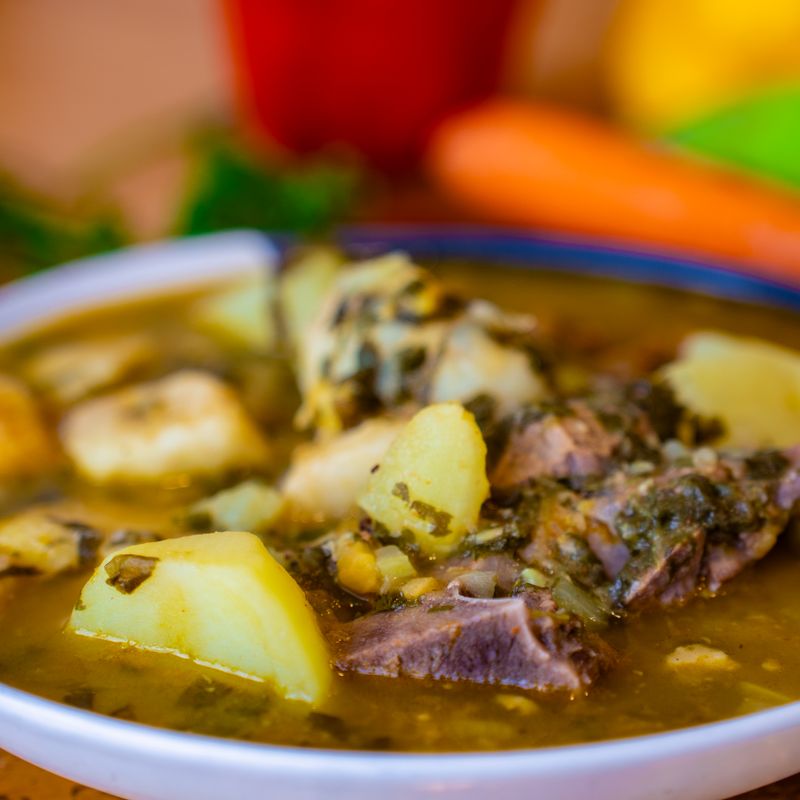
Classic Beef Stew
Tender chuck beef, carrots and potatoes in a rich, glossy gravy built on a deeply browned sear and tomato paste. A gentle stovetop braise turns a tough cut into spoon-soft beef.
- Prep
- 20 min
- Cook
- 3 hr 10 min
- Wait
- 25 min
- Total
- 3 hr 55 min
- Makes
- About 3 quarts (6 generous bowls)
Steps
Before you start
- Plan for about 4 hours start to finish; most of it is hands-off simmering. This recipe is made entirely on the stovetop, so no oven is needed.
- Buy a whole chuck roast and cube it yourself if you can. Pre-cut 'stew meat' is often uneven and from mixed cuts, so it cooks unevenly.
- Use a 6-quart (5.7 L) or larger heavy pot with a lid so the beef can brown without crowding.
- Use low-sodium broth so you control the salt as the stew reduces.
Prep and season beef
- Pat the beef cubes very dry with paper towels.
- Spread them on a large plate or baking sheet and sprinkle all over with the salt and pepper.
- Let them sit at room temperature for 15 minutes while you peel and cut the onions, carrots and potatoes.
- Keep the carrots and potatoes in separate bowls (cover the potatoes with cold water if you cut them early; drain before using).
+ Show details− Hide details
Ready when: Beef surface looks dry, not wet or shiny
Tip: Wet meat steams instead of browning, so dry it thoroughly.
Flour the beef
- Sprinkle the flour over the seasoned beef and toss with your hands until every cube has a thin, even dusting with no wet patches or clumps of flour.
+ Show details− Hide details
Ready when: Beef looks lightly dusted and matte
Tip: The flour browns into the crust and later thickens the stew, so you won't need a separate slurry.
Sear in batches
- Set the heavy pot over medium-high heat and add 1 tablespoon of the oil.
- When it shimmers, add about one-third of the beef in a single layer with space between cubes.
- Leave it untouched for 3 minutes, then turn and brown the other sides for 4 to 5 minutes more.
- Move the browned cubes to a clean plate.
- Repeat with 1 tablespoon oil and the remaining beef in two more batches.
- Lower the heat to medium if the pot bottom starts to smell burnt.
+ Show details− Hide details
Ready when: Beef is deep brown on most sides; it does not need to be cooked through
Tip: Crowding the pot drops the temperature and the beef turns gray. Brown in batches even though it takes longer.
Soften the onions
- Reduce the heat to medium and add the remaining 1 tablespoon oil.
- Add the onions and a splash of the broth (about 2 tablespoons) to loosen the browned bits.
- Cook, stirring often and scraping the bottom of the pot with a wooden spoon, for 6 to 7 minutes.
+ Show details− Hide details
Ready when: Onions are soft, translucent and golden at the edges
Toast tomato paste
- Stir in the garlic and tomato paste.
- Cook, stirring constantly, for 2 to 3 minutes, spreading the paste against the pot bottom so it darkens.
+ Show details− Hide details
Ready when: Paste turns from bright red to brick red and smells sweet and rich
Tip: Don't skip the toasting; it removes the raw, tinny tomato flavor.
Deglaze the pot
- Pour in the red wine (or an extra ½ cup/120 ml broth if skipping it).
- Scrape up all the browned bits from the bottom with a wooden spoon and simmer for 2 minutes to cook off the sharp alcohol smell.
+ Show details− Hide details
Ready when: Bottom of the pot is clean and the liquid has reduced by about half
Start the braise
- Return the beef and any juices on the plate to the pot.
- Add the remaining broth (a little less than 4 cups/960 ml, since the splash used earlier is fine), the water, Worcestershire, bay leaves and thyme.
- Stir and bring to a boil over high heat.
- Reduce to low so the surface barely bubbles, cover with the lid slightly ajar, and simmer on the stovetop for 100 minutes, stirring gently every 25 minutes.
+ Show details− Hide details
Ready when: Liquid shows only a few lazy bubbles at a time; a beef cube still holds its shape but starts to yield when pressed with a spoon
Tip: A hard boil makes beef tough and stringy. Keep it at a bare simmer.
Add the vegetables
- Stir in the carrots and potatoes, pushing them down into the liquid (they should be mostly submerged).
- Return to a gentle simmer, cover with the lid ajar, and cook for 35 to 40 minutes.
+ Show details− Hide details
Ready when: A potato chunk slides off a knife with no resistance and the beef shreds easily with a fork
Tip: If the beef is still chewy when the vegetables are done, keep simmering 15 more minutes; the vegetables will hold.
Thicken and finish
- Discard the bay leaves and thyme stems.
- Remove the lid, stir in the peas if using, and simmer over medium-low heat for 8 to 10 minutes.
- Gently mash a few potato chunks against the pot side to thicken further if you like.
- Taste and add more salt and pepper as needed.
+ Show details− Hide details
Ready when: Gravy coats the back of a spoon and leaves a clear line when you drag a finger through it
Tip: Season at the end; the stew concentrates as it reduces, so early salting can overshoot.
Rest and serve
- Take the pot off the heat and let the stew rest, uncovered, for 10 minutes so the gravy thickens slightly and the temperature becomes comfortable to eat.
- Ladle into warm bowls and sprinkle with parsley.
+ Show details− Hide details
Ready when: Gravy is glossy and spoonable, not watery
Good to know
Tips
- Choose chuck for its marbling and collagen; lean cuts like round turn dry and stringy in a stew.
- Cut the beef in large 1½-inch pieces; they shrink as they cook.
- Keep the simmer gentle. Peek and adjust the heat if you see more than a few bubbles at once.
- If the stew looks thin at the end, simmer uncovered a few minutes longer; if too thick, add water ¼ cup at a time.
Make ahead
The stew tastes better the next day. Cool completely, refrigerate in an airtight container, and reheat gently on the stove. If you want bright green peas, stir them in only when reheating.
Storage & reheating
Room temperature: no more than 2 hours. Fridge: up to 4 days in an airtight container. Freezer: up to 3 months (potatoes soften slightly after freezing). Thaw overnight in the fridge and reheat in a pot over medium-low heat, stirring often, until steaming hot (165°F/74°C); add a splash of water or broth if too thick.
Substitutions
- dry red wine → Extra low-sodium beef broth plus 1 tsp red wine vinegar. Keeps the bright acidity without alcohol.
- Yukon Gold potatoes → Russet potatoes or parsnips. Russets break down more and thicken the gravy; cut larger and watch closely.
- fresh thyme sprigs → 1 tsp dried thyme. Add with the bay leaves.
- all-purpose flour → 2 tbsp cornstarch mixed with 2 tbsp cold water. For gluten-free; skip the flouring step, stir in the slurry during the Thicken and finish step and simmer 2 minutes.
More stews
See all →
Find more like this
- Meal
- Dinner
- Cuisine
- American
- Method
- Stovetop
- Season
- Winter Comfort Food