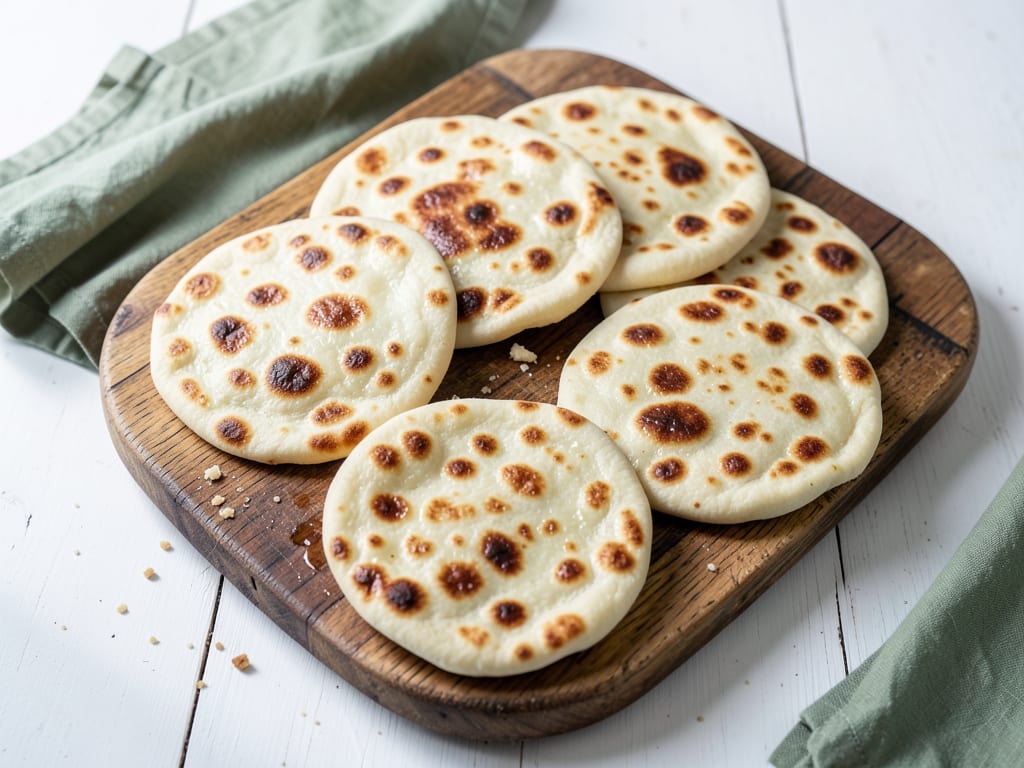
Piadina Dough (Piadina Romagnola)
A soft, pliable Italian flatbread dough enriched with lard and milk, rolled thin and cooked on a hot griddle until blistered and golden. Perfect for folding around prosciutto, cheese, and greens.
- Prep
- 28 min
- Cook
- 20 min
- Wait
- 35 min
- Total
- 1 hr 23 min
- Makes
- 8 piadine, about 9 inches (23 cm) each
Steps
Before you start
- Warm the milk to about 100°F (38°C), just lukewarm to the touch, so the lard blends in easily.
- Have the lard at room temperature so it is soft and spreadable, not melted.
- Plan on 30 minutes of resting time for the dough; this relaxes the gluten so it rolls thin without springing back.
- Use a dry, heavy skillet, cast-iron griddle, or crêpe pan. No oil is needed.
- About 10 minutes before the last piadina comes off the pan, preheat the oven to 200°F (95°C) so it is ready to keep the stack warm.
Mix dry ingredients
- In a large bowl, whisk together the flour, salt, and baking soda for about 30 seconds so the baking soda and salt are evenly distributed.
- Make a well in the center.
+ Show details− Hide details
Ready when: No streaks or clumps of baking soda remain in the flour.
Add lard and milk
- Add the soft lard to the well in small spoonfuls and pour in the warm milk.
- Stir with a wooden spoon or your hand, pulling in flour from the edges, until a shaggy dough forms and no dry flour remains, about 2 minutes.
- Squeeze the lard into the flour with your fingertips as you go.
+ Show details− Hide details
Ready when: A rough, slightly sticky mass with no dry patches.
Tip: If the dough feels stiff and crumbly, add 1 tablespoon (15 ml) more warm milk. The dough should be softer than bread dough.
Knead until smooth
- Turn the dough onto a lightly floured surface and knead firmly for 6–8 minutes, pushing it away with the heel of your hand, folding it back, and turning it a quarter turn each time.
- Stop when the dough is smooth, elastic, and soft like an earlobe.
+ Show details− Hide details
Ready when: Surface is smooth and the dough springs back slowly when pressed with a finger.
Tip: Use only the minimum dusting flour; too much makes the piadine dry and stiff.
Divide and shape
- Cut the dough into 8 equal pieces, about 105 g (3¾ oz) each; weigh them for even rounds.
- Roll each piece between your palm and the counter into a smooth ball, tucking the edges underneath.
- Place the balls on the counter with a little space between them.
+ Show details− Hide details
Ready when: Eight smooth, seamless balls of equal size.
Rest the dough
- Cover the balls with an inverted bowl or a damp kitchen towel and let them rest at room temperature for 30 minutes.
+ Show details− Hide details
Ready when: Balls look slightly puffed and feel soft and relaxed when gently pressed.
Tip: Don't skip this rest. Dough that springs back while rolling hasn't rested long enough.
Heat the griddle
- Set a 12-inch (30 cm) cast-iron skillet or griddle over medium-high heat and let it heat for 3 minutes, dry with no oil.
- When a pinch of flour dropped on the surface browns within about 30 seconds, it is ready.
+ Show details− Hide details
Ready when: A pinch of flour browns in about 30 seconds without burning instantly.
Roll out one piadina
- On a lightly floured surface, flatten one ball with your palm, then roll it into a thin round about 9 inches (23 cm) across and 1/16 inch (2 mm) thick.
- Roll from the center outward, rotating the dough a quarter turn after every pass to keep it round.
- Keep the remaining balls covered.
+ Show details− Hide details
Ready when: An even, thin round that you can nearly see your fingers through when lifted to the light.
Tip: Don't worry about a perfect circle; slightly rustic edges are traditional.
Cook first side
- Lay the round on the hot griddle.
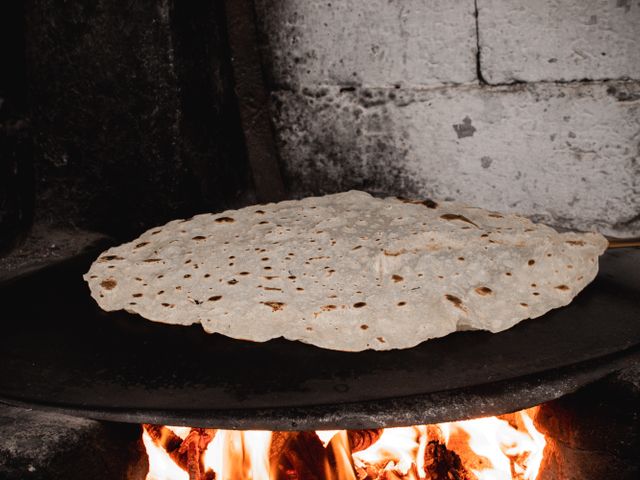
- Cook for 1 to 1½ minutes, until the underside has brown spots and the top surface begins to bubble.
- If large bubbles balloon up, gently pierce them with a fork tip to keep the dough flat.
+ Show details− Hide details
Ready when: Underside is speckled with golden-brown spots and the top shows small bubbles.
Tip: If the spots turn dark brown or black in under a minute, lower the heat to medium.
Flip and finish
- Flip with a spatula or tongs and cook the second side for 1 minute, until it is also speckled golden brown and the piadina is cooked through but still soft and pliable.
- Move it to a plate and cover with a clean kitchen towel.
+ Show details− Hide details
Ready when: Both sides have golden-brown freckles; the bread bends without cracking.
Tip: Overcooking makes piadine crisp and brittle. Pull them off when still flexible.
Repeat with the restOven 200°F / 95°C
- Roll and cook the remaining 7 balls the same way, rolling the next one while the previous one cooks.
- Stack the cooked piadine under the towel as you go so they stay warm and soft.
- Preheat the oven to 200°F (95°C) while you cook the last few.
+ Show details− Hide details
Ready when: Eight cooked piadine, each with golden-brown spots and still pliable.
Tip: Wipe any burnt flour from the pan between batches with a dry paper towel so it doesn't scorch.
Steam and serveOven 200°F / 95°C
- Wrap the stack of piadine in the towel, set it on a baking sheet, and place it in the 200°F (95°C) oven for 5 minutes so trapped steam softens them further.
- Serve warm, folded around fillings such as prosciutto, squacquerone or mozzarella, and arugula.
+ Show details− Hide details
Ready when: Piadine are soft, warm, and fold without cracking.
Tip: Don't leave them in the oven longer than 15 minutes or they will dry out.
Good to know
Tips
- Weigh the flour for accuracy; scooping can add up to 20% extra and make the dough stiff.
- Roll thinly: piadine should be around 2 mm thick for a soft, bendy texture rather than a thick pita-like bread.
- Keep unrolled dough covered at all times so it doesn't form a dry skin.
- Cook on a very hot, dry surface; a pan that isn't hot enough yields pale, leathery bread.
Make ahead
Make the dough through step 4, wrap the balls individually in plastic, and refrigerate up to 24 hours. Bring to room temperature for 30 minutes before rolling.
Storage & reheating
Room temperature: wrapped in a towel inside a zip-top bag for up to 1 day. Fridge: up to 4 days in an airtight bag. Freezer: stack with parchment between each and freeze up to 3 months. Reheat in a dry skillet over medium heat for 30–45 seconds per side until warm and pliable; thaw frozen ones first.
Substitutions
- lard → extra-virgin olive oil, 90 ml (6 tbsp). Gives a slightly more fragrant, less traditional flavor; the dough will be a touch softer.
- whole milk → warm water, 240 ml (1 cup). Produces a slightly less tender, less rich piadina but works well.
- lard → unsalted butter, 100 g (7 tbsp), softened. Adds a buttery flavor; cook slightly cooler to prevent over-browning.
- all-purpose flour → Italian 00 flour, 500 g. Gives an even softer, more tender texture; you may need 1–2 tbsp extra milk.
More flatbreads
See all →


Find more like this
- Meal
- Lunch
- Cuisine
- Italian
- Diet
- Sugar-Free