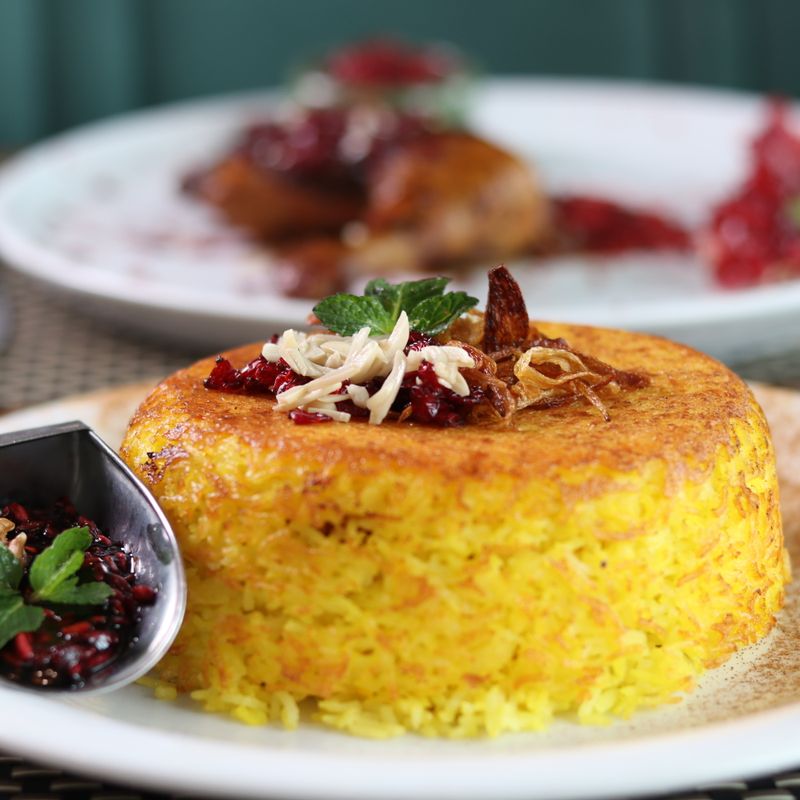
Persian Saffron Rice Pilaf with Barberries
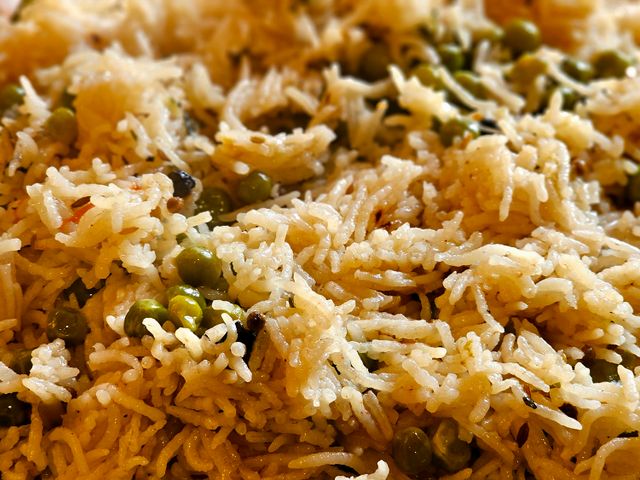
Fluffy, separate grains of basmati rice parboiled and steamed Persian-style with a golden saffron crust (tahdig) on the bottom, then topped with jewel-like barberries glazed in butter and sugar, and caramelized onion for sweetness.
- Prep
- 25 min
- Cook
- 1 hr 10 min
- Wait
- 2 hr 30 min
- Total
- 4 hr 5 min
- Makes
- 6 servings (about 8 cups cooked rice)
Steps
Before you start
- Rice needs to soak for at least 2 hours, so start ahead of time.
- Grind the saffron and steep it in hot water at least 20 minutes before using for the deepest color.
- Dried barberries (zereshk) are very tart and sandy: rinse them well just before cooking, and don't soak them long.
- Use a good non-stick pot with a tight-fitting lid so the crust releases cleanly.
Rinse and soak rice
- Place the basmati in a large bowl and cover with cold water.
- Swirl with your hand, then pour off the cloudy water.
- Repeat 4–5 times until the water is nearly clear.
- Cover the rice with 2 quarts (2 L) of fresh cold water, stir in 2 tablespoons (36 g) of the salt, and soak for 2 hours.
+ Show details− Hide details
Ready when: Grains look opaque white and snap rather than crush when pressed between your fingers
Tip: Don't skip rinsing. Surface starch makes the rice gummy.
Steep the saffron
- Grind the saffron with the pinch of sugar in a mortar until it is a fine powder.
- Stir in the 3 tablespoons hot water and let it steep for at least 20 minutes while the rice soaks.
+ Show details− Hide details
Ready when: Liquid is a deep, dark orange-red
Tip: Ground saffron gives far more color than whole threads.
Parboil the rice
- Bring 3 quarts (3 L) of water and the remaining 2 tablespoons (36 g) salt to a rolling boil in the large pot.
- Drain the soaking rice and add it to the boiling water.
- Boil, stirring gently once or twice in the first minute, for 5–7 minutes.
- Start tasting at 5 minutes.
+ Show details− Hide details
Ready when: Grains are soft on the outside but still have a firm, chalky center when bitten, and rice floats near the surface
Tip: The water should taste salty like the sea. Much of the salt drains away.
Drain and rinse
- Drain the rice in a large fine-mesh sieve.
- Rinse briefly with lukewarm water for about 10 seconds to stop the cooking and wash off surface starch.
- Let it drain thoroughly.
+ Show details− Hide details
Ready when: Grains are separate and not sticky
Tip: Work gently so you don't break the long grains.
Make the crust base
- In a medium bowl, whisk the yogurt, egg yolk, 2 tablespoons of the saffron water, and 1 cup of the drained rice until fully combined and evenly yellow.
- In the 4–5 quart non-stick pot, heat 2 tablespoons of the melted butter and the oil over medium heat until the butter is melted and shimmering, about 1 minute.
- Spread the yogurt-rice mixture evenly across the bottom and press flat.
+ Show details− Hide details
Ready when: Mixture forms an even layer about ½ inch (1 cm) thick covering the whole bottom
Tip: Keep the remaining saffron water (about 1 tablespoon) for coloring the top later.
Mound the rice
- Spoon the remaining rice gently on top of the base in a pyramid shape, mounding it in the center and leaving the edges thinner.
- Using the handle of a wooden spoon, poke 5–6 holes down to the bottom to let steam escape.
+ Show details− Hide details
Ready when: Rice forms a loose cone with steam vents reaching the pot bottom
Tip: Do not pack the rice down. Loose rice means fluffy grains.
Steam the rice
- Mix the final 2 tablespoons melted butter with the ¼ cup (60 ml) water and drizzle over the mound.
- Wrap the lid in a clean kitchen towel, cover the pot tightly, and cook over medium heat for 10 minutes until steam builds.
- Reduce heat to low and steam for 40 more minutes without lifting the lid.
+ Show details− Hide details
Ready when: Steam hisses steadily from under the lid, and the rice smells nutty and toasty with no scorched smell
Tip: The towel absorbs condensation so the rice doesn't turn soggy.
Cook the onion
- While the rice steams, melt 2 tablespoons of the topping butter in the skillet over medium heat.
- Add the onion and cook, stirring often, for 12–15 minutes.
+ Show details− Hide details
Ready when: Onion is deep golden brown and soft, with caramelized edges
Tip: Lower the heat if the onion browns before it softens.
Glaze the barberries
- Push the onion to one side of the skillet or remove it to a plate.
- Melt the remaining 1 tablespoon butter in the skillet over low heat.
- Add the rinsed barberries and sugar and stir constantly for 1–2 minutes.
- Remove from the heat immediately.
+ Show details− Hide details
Ready when: Barberries plump up and look glossy and bright red; the sugar dissolves
Tip: Barberries burn in seconds and turn bitter. Keep them moving and pull the pan off the heat early.
Color the saffron rice
- Remove the pot from the heat and set it on a damp towel for 5 minutes to loosen the crust.
- Scoop about 1½ cups of the fluffy white rice into a bowl and stir in the remaining 1 tablespoon saffron water until evenly golden.
+ Show details− Hide details
Ready when: Scooped rice is vivid golden-orange
Tip: The damp towel creates a thermal shock that loosens the crust.
Plate and serve
- Gently spoon the white rice onto a large platter.
- Top with the saffron rice, the caramelized onion, and the barberries.
- Loosen the crust with a spatula, flip or lift it out in pieces, and serve alongside, golden side up.
+ Show details− Hide details
Ready when: Rice is fluffy and separate, and the crust is deep golden and crisp
Tip: Serve right away while the crust is crunchy.
Good to know
Tips
- Aged basmati holds its shape through parboiling; fresh or low-quality rice tends to break and turn mushy.
- Use the bite test: the grain should snap with a firm core after parboiling and finish softening in the steam.
- If your pot lid doesn't fit tightly, place a layer of foil under the towel-wrapped lid to trap steam.
- Never stir the rice once it's in the steaming pot, which would break the crust and the grains.
Make ahead
"Soak the rinsed rice up to 8 hours ahead in the salted water in the fridge. Steep the saffron up to 1 day ahead, covered, in the fridge. Caramelize the onion up to 2 days ahead, and glaze the barberries just before serving."
Storage & reheating
"Room temperature: up to 2 hours. Refrigerator: store in an airtight container up to 4 days. Freezer: up to 2 months in a sealed freezer bag. Reheat covered in a microwave or in a pot with 1–2 tablespoons water over low heat for 8–10 minutes until steaming hot, and re-crisp the crust in a hot skillet."
Substitutions
- dried barberries (zereshk) → unsweetened dried cranberries. Rinse and use the same amount, but reduce the sugar to 1 tablespoon since they are sweeter and less tart.
- plain whole-milk yogurt → sour cream or Greek yogurt thinned with a splash of water. Gives a similar tangy, golden crust.
- unsalted butter → ghee. Has a higher smoke point and gives a nutty flavor.
- aged white basmati rice → other long-grain aged white rice. Texture will be slightly less fragrant and the grains won't stretch as long.
More pilaf
See all →


Find more like this
- Meal
- Dinner
- Cuisine
- Persian
- Main ingredient
- Basmati Rice
- Method
- Stovetop