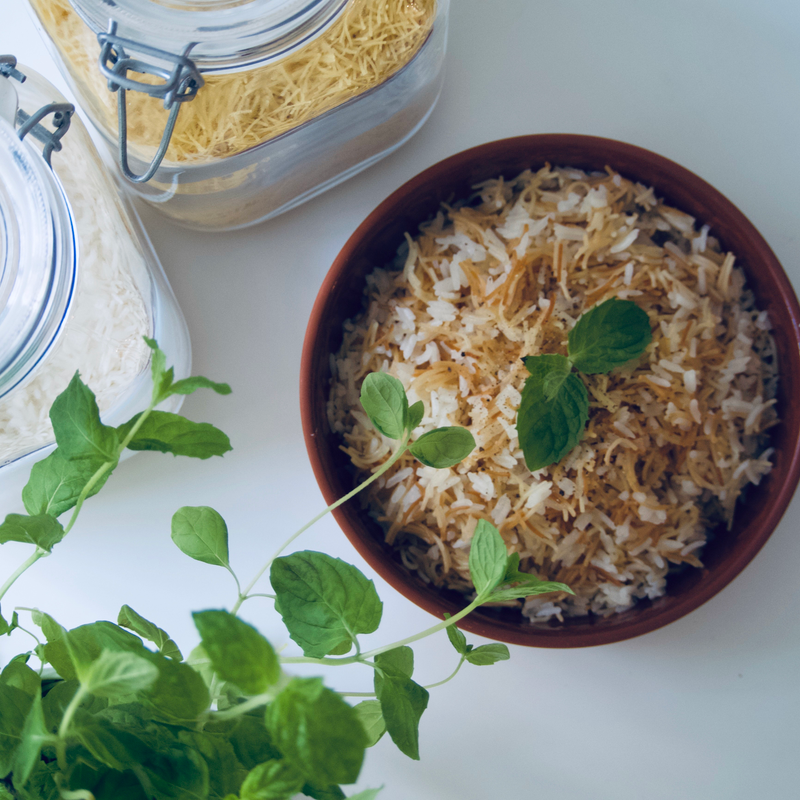
Rice Pilaf with Vermicelli
Fluffy, separate grains of basmati rice cooked in chicken broth with golden toasted vermicelli, sweet onion and butter. It's the classic Middle Eastern side for roast chicken, kebabs, stews and grilled fish.
- Prep
- 17 min
- Cook
- 30 min
- Wait
- 21 min
- Total
- 1 hr 8 min
- Makes
- About 6 cups (6 side servings)
Steps
Before you start
- Plan on about 68 minutes start to finish. The rice soaks for 20 minutes and the cooked pilaf rests for 10. You do the onion, broth and nut prep while the rice soaks, so only about 11 minutes of the soak counts as extra waiting time in the total.
- Use a heavy 3-quart (3 L) saucepan with a tight-fitting lid. A thin pot scorches the bottom of the rice.
- Use low-sodium broth if you can. Regular broth can make the pilaf too salty once you add the salt.
- Measure everything before you start. The vermicelli goes from golden to burnt in seconds.
Rinse and soak rice
- Put the rice in a medium bowl and cover with cold water.
- Swirl with your fingers, then pour off the cloudy water.
- Repeat 4 to 5 times until the water is almost clear.
- Cover with fresh cold water and soak for 20 minutes.
- Do the next two steps while it soaks.
- When the time is up, drain in a fine-mesh sieve and shake well.
- Let it sit in the sieve until needed.
+ Show details− Hide details
Ready when: Water runs nearly clear after rinsing; grains look opaque white after soaking
Tip: Don't skip rinsing. Surface starch is what makes pilaf gummy.
Prep and heat broth
- While the rice soaks, finely dice the onion.
- Break the vermicelli into ¾-inch (2 cm) pieces.
- Pour the broth into a small saucepan and heat over medium heat until steaming and barely simmering, about 4 minutes.
- Keep it hot over the lowest heat.
+ Show details− Hide details
Ready when: Broth is steaming with tiny bubbles at the edges
Tip: Hot broth keeps the pot from cooling down, so the rice cooks evenly.
Toast the nuts
- If using, toast the pine nuts in a small dry skillet over medium-low heat, shaking the pan often, for 2 to 3 minutes.
- Tip them onto a plate right away so they stop cooking.
+ Show details− Hide details
Ready when: Nuts are light golden and smell nutty
Tip: Pine nuts burn fast. Don't walk away from the pan.
Brown the vermicelli
- In the 3-quart saucepan, melt the butter with the olive oil over medium heat.
- Add the vermicelli and stir constantly for 3 to 4 minutes, until most of the pieces are deep golden brown, like toasted wheat.
+ Show details− Hide details
Ready when: Noodles are deep golden brown and smell toasty
Tip: Colour means flavour, but dark brown noodles taste bitter. If they darken too quickly, lower the heat.
Soften the onion
- Add the diced onion to the vermicelli and stir.
- Cook over medium heat for 3 to 4 minutes, stirring often, until the onion is soft and translucent but not browned.
+ Show details− Hide details
Ready when: Onion is soft, translucent and smells sweet
Coat the rice
- Add the drained rice.
- Stir gently for 2 minutes so every grain is coated in butter and the rice looks glossy and slightly more opaque.
- Sprinkle in the salt, pepper and cinnamon (if using) and stir once more.
+ Show details− Hide details
Ready when: Grains are glossy and coated in fat, with a faint toasty smell
Tip: Stir gently. Soaked basmati is fragile and snaps easily.
Add broth and boil
- Pour in the hot broth and stir once to level the rice.
- Raise the heat to high and bring to a full boil, about 2 minutes.
- Taste the broth: it should taste pleasantly salty, a little saltier than you'd like soup.
- Add a pinch of salt if it is bland, then stir once more.
- Do not stir again after this point.
+ Show details− Hide details
Ready when: Broth is boiling across the whole surface
Tip: Taste before covering. You can't adjust the salt once the lid is on.
Cover and simmer
- As soon as the broth reaches a full boil, turn the heat to the lowest setting and cover with the tight-fitting lid right away.
- Cook undisturbed for 15 minutes without lifting the lid.
- At 15 minutes, lift the lid once to check: the broth should be absorbed, with no liquid pooling and small steam holes dotting the surface.
- If a little liquid remains, re-cover and cook 2 more minutes.
+ Show details− Hide details
Ready when: On the single check at the end, no liquid bubbles at the edges and steam holes are visible on the surface
Tip: If your lid is loose, put a clean kitchen towel between the pot and lid to trap steam. Keep the towel ends away from the flame.
Rest off the heat
- Turn off the heat, put the lid back on, and leave the pot undisturbed for 10 minutes.
- This lets moisture spread evenly through the rice and firms up the grains so they don't smash when you fluff them.
+ Show details− Hide details
Ready when: Rice on top looks dry and fluffy, not wet
Tip: Resting is what separates fluffy pilaf from sticky pilaf.
Fluff and serve
- Uncover and fluff the rice with a fork, lifting from the bottom and folding gently to mix in the vermicelli.
- Taste and add more salt if needed.
- Transfer to a serving dish and scatter the toasted pine nuts and chopped parsley on top.
- Serve hot.
+ Show details− Hide details
Ready when: Grains are separate and tender with no hard centre, and the vermicelli is evenly distributed
Tip: Use a fork rather than a spoon, which mashes the grains.
Good to know
Tips
- Ratios: soaked, well-drained basmati takes 1 part rice to about 1⅓ parts broth (2 cups rice to 2⅔ cups broth). Unsoaked rice needs about 1½ parts (2 cups to 3 cups), because soaked grains have already absorbed water.
- Brown the vermicelli to a deep golden colour for the best nutty flavour, but stop before it turns dark brown.
- Do not stir after the broth boils. Stirring releases starch and makes the rice sticky.
- For a richer finish, stir 1 tablespoon of cold butter into the hot rice when you fluff it.
Make ahead
Rinse and soak the rice up to 1 hour ahead, drained and kept at room temperature. You can dice the onion and break the vermicelli a day ahead; keep the onion covered in the fridge. The cooked pilaf can be held, covered, in the pot off the heat for up to 30 minutes before serving.
Storage & reheating
Cool within 1 hour of cooking. Refrigerate in an airtight container for up to 3 days, or freeze for up to 2 months. Reheat in a covered saucepan over low heat or in the microwave, sprinkling 1 to 2 tablespoons of water or broth per cup of rice, until steaming hot throughout (165°F / 74°C). Do not leave cooked rice at room temperature for more than 1 hour.
Substitutions
- low-sodium chicken broth → vegetable broth or water plus ½ teaspoon extra salt. Vegetable broth makes the dish vegetarian. If using water, the flavour will be milder.
- long-grain basmati rice → long-grain jasmine or American long-grain white rice. Rinse but skip the soaking. Use 3 cups (710 ml) broth for 2 cups rice, since unsoaked rice absorbs more liquid, and cook covered for 15 minutes as written.
- unsalted butter → ghee. Ghee gives a richer, nuttier flavour and tolerates higher heat without browning.
- dried vermicelli noodles (thin pasta nests or strands) → broken angel hair pasta or fideo. Brown it the same way. Thicker pasta may need an extra minute to toast.
More pilaf
See all →

Find more like this
- Meal
- Dinner
- Cuisine
- Middle Eastern
- Main ingredient
- Basmati Rice
- Diet
- HalalSugar-Free
- Method
- Stovetop
- Quick & Easy
- 5 Ingredients or LessEasyOne-Pot