
Persian Halva Sohan with Pistachios and Saffron
A luxurious Persian brittle made from roasted flour, clarified butter, honey, and saffron, studded with pistachios. Sohan is a traditional confection with a crumbly, melt-in-mouth texture and aromatic saffron notes, perfect for serving with tea or as a gift. The technique requires careful stirring over gentle heat to create a silky, caramel-colored halva that will shatter into golden shards when cooled.
- Prep
- 15 min
- Cook
- 30 min
- Wait
- 1 hr
- Total
- 1 hr 45 min
- Makes
- About 1 lb (450 g) or 24 pieces
Steps
Before you start
- Line an 8×8-inch (20×20 cm) square baking pan with parchment paper, leaving a 2-inch overhang on two sides for easy lifting
- Measure out all ingredients before starting—this recipe moves quickly once you begin stirring
- Have a wooden spoon and heat-resistant spatula within arm's reach
- Toast the pistachios lightly in a dry skillet over medium heat for 2 minutes to intensify their flavor, then chop them coarsely
Toast the flour
- Pour the flour into a heavy-bottomed 3-quart saucepan over medium heat.
- Stir constantly with a wooden spoon for 8–10 minutes, breaking up any clumps that form.
- The flour will gradually darken from pale cream to a light tan and smell warm and nutty.
- Be patient—this slow roasting removes raw flour taste and develops the halva's flavor.
- Do not let it burn or turn dark brown.
+ Show details− Hide details
Ready when: Flour is light tan and fragrant, without any raw flour smell
Tip: Keep the heat steady and stir to prevent burning. If the flour darkens too fast, lower the heat and keep stirring.
Infuse saffron in water
- While the flour toasts, place the saffron threads in a small bowl and cover with 3 tablespoons of warm water (about 110°F / 43°C).
- Let steep for 10 minutes to release the color and aroma.
- The water will turn golden-red.
+ Show details− Hide details
Ready when: Saffron water is deep golden-red in color
Tip: Use warm but not boiling water—boiling damages saffron's delicate flavor and color.
Add ghee and cardamom to flour
- Once the flour is toasted, add the ghee slowly while stirring constantly.
- The mixture will bubble gently and smell fragrant.
- After all the ghee is incorporated, add the crushed cardamom pods and stir for 2 minutes to infuse their flavor throughout.
+ Show details− Hide details
Ready when: Mixture is evenly combined and cardamom aroma is noticeable
Tip: Add the ghee gradually to prevent splattering. Keep stirring so the flour cooks evenly in the fat.
Combine honey and saffron
- Pour the honey into the saucepan with the flour and ghee mixture, stirring constantly for 2 minutes.
- The mixture will darken slightly and become glossier.
- Then add the steeped saffron and its soaking water, stirring until fully blended.
- The halva will take on a pale golden color with hints of saffron red.
+ Show details− Hide details
Ready when: Mixture is uniformly golden with saffron color throughout
Tip: Stir slowly and deliberately to avoid splashing the hot mixture. The honey will make the halva sticky at first—this is normal.
Cook halva until thickOven 230°F / 110°C
- Continue stirring over medium heat for 10–12 minutes.
- The mixture will gradually thicken, the liquid will mostly evaporate, and the texture will become creamy and cohesive.
- The halva should pull away slightly from the sides of the pan when you drag your spoon through it, and the temperature should reach about 230°F (110°C) on an instant-read thermometer.
- The color will deepen to a warm caramel-gold.
+ Show details− Hide details
Ready when: Mixture is thick and glossy, pulls away from the pan sides, and reads 230°F (110°C) on a thermometer
Tip: Don't skip the thermometer—it ensures the halva has the right texture without being too soft or too dry. Stir constantly to prevent sticking or burning on the bottom.
Add salt and fold in pistachios
- Remove the saucepan from the heat.
- Stir in the sea salt, then fold in the chopped pistachios gently but thoroughly, breaking up the cardamom pods as you fold so they distribute evenly.
- If using rose water, add it now and fold in carefully.
- Work quickly but gently so the pistachios don't crush.
+ Show details− Hide details
Ready when: Pistachios are evenly distributed throughout, and halva is still warm but workable
Tip: Add the pistachios while the halva is still warm so they blend in; if it cools too much, they won't distribute evenly.
Transfer and shape
- Pour the warm halva into the prepared 8×8-inch (20×20 cm) pan lined with parchment.
- Using a heat-resistant spatula or the back of a wooden spoon, spread it out evenly to fill the pan, pressing it down gently to compact it.
- The halva should be about ¾ inch thick.
- Work quickly as it cools fast; you have about 3–4 minutes before it becomes too stiff to spread.
+ Show details− Hide details
Ready when: Halva is evenly spread and slightly compressed in the pan
Tip: If the halva cools too quickly and becomes hard to work, briefly return the pan to low heat for 30 seconds to soften it just enough to spread.
Cool and set
- Let the halva cool completely at room temperature for 45–60 minutes.
- It will firm up and develop a slightly crumbly surface.
- Do not refrigerate at this stage—room temperature cooling ensures the proper brittle texture.
+ Show details− Hide details
Ready when: Halva is completely cool to the touch and has a firm, slightly crumbly surface
Tip: Avoid moving the pan while cooling, as vibrations can create unwanted cracks.
Cut and serve
- Once cooled, lift the halva out of the pan using the parchment overhang.
- Place it on a cutting board and cut into 24 pieces (about 1½×2 inches / 4×5 cm each) using a sharp knife.
- If the halva is very brittle and crumbly, a gentle sawing motion works better than pressing down hard.
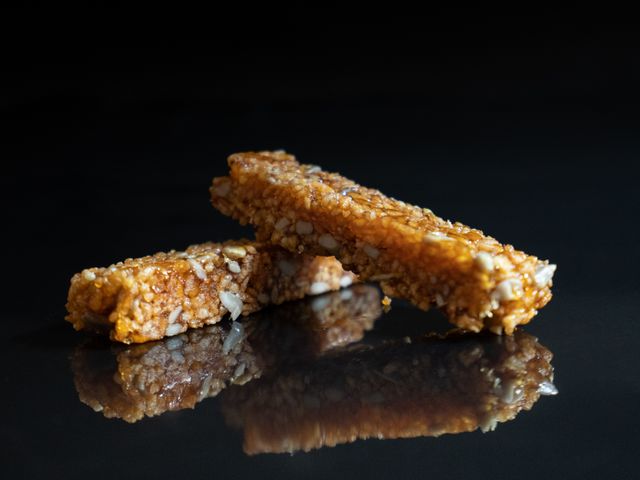
- The pieces should be golden, studded with pistachios, and have a matte finish.
+ Show details− Hide details
Ready when: Halva is cut cleanly into uniform pieces without excessive crumbling
Tip: A warm knife (dipped in hot water and dried) will cut through more cleanly if the halva becomes too brittle and crumbly.
Good to know
Tips
- Measure honey by weight for accuracy—halva is sensitive to the honey-to-flour ratio. Too much honey makes it sticky; too little makes it crumbly.
- Toast the flour slowly and steadily; rushing this step will result in harsh, burnt flavors. A medium heat is better than high heat.
- Stir constantly once the honey is added to prevent the halva from sticking to the bottom and burning. A wooden spoon is ideal because it doesn't conduct heat the way metal spoons do.
- This halva is best enjoyed fresh or within a few days. As it sits, it gradually loses some of its delicate saffron aroma, though the flavor remains pleasant. Serve it with strong black tea or cardamom tea for a traditional pairing.
Make ahead
Halva Sohan can be made up to 5 days ahead. Store it in an airtight container at room temperature, and it will actually improve slightly as the flavors meld.
Storage & reheating
Room temperature: 5 days in an airtight container (away from heat and direct sunlight). Refrigerator: 2 weeks in an airtight container (the texture will become slightly harder, but the flavor deepens). Freezer: up to 3 months in an airtight container. Thaw at room temperature for 30 minutes before serving. Halva does not require reheating; serve at room temperature or slightly chilled.
Substitutions
- ghee (clarified butter) → unsalted butter, melted and browned until the milk solids sink to the bottom (then carefully poured off). Ghee is traditional and provides a deeper, nuttier flavor. Browned butter is a close substitute but may result in a slightly lighter color and less intense flavor.
- honey → light brown sugar (¾ cup / 180 g) mixed with 2 tablespoons water. Brown sugar will create a darker halva with a caramel note. The texture will be very similar, though the saffron color will be less prominent.
- roasted unsalted shelled pistachios → blanched sliced almonds or a mix of chopped almonds and pistachios (total 100 g). Almonds are mild and less aromatic but provide a pleasant texture. Tradition calls for pistachios, so use them if possible for authentic flavor.
- saffron threads → ¼ teaspoon of ground turmeric plus a tiny pinch of ground clove for warmth. This will not match saffron's subtle floral notes, but the color and warm spice will be somewhat similar. Use only if saffron is unavailable.
More middle eastern sweets
See all →


Find more like this
- Meal
- Dessert
- Cuisine
- Persian
- Diet
- VegetarianHalal
- Method
- Stovetop