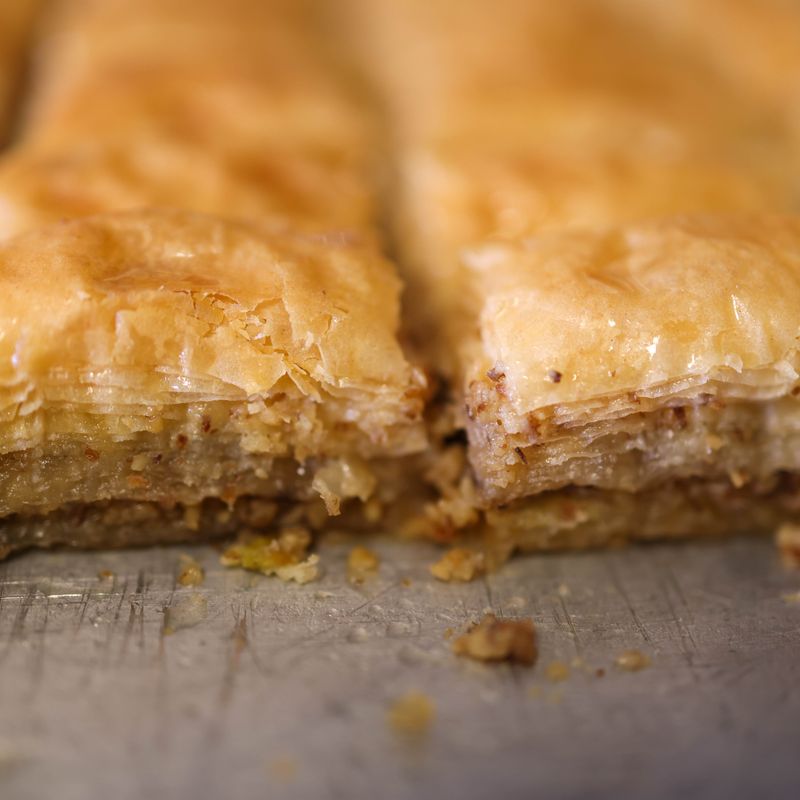
Barley Honey Walnut Baklava Bites
Crispy phyllo pastry layers wrapped around a nutty filling of toasted walnuts, barley flour, and warm spices, finished with a fragrant honey syrup. These bite-sized baklava pieces are less sweet than traditional versions, with a subtle earthiness from the barley that complements the floral honey and cinnamon.
- Prep
- 35 min
- Cook
- 35 min
- Wait
- 45 min
- Total
- 1 hr 55 min
- Makes
- 24 baklava bites
Steps
Before you start
- Have all your ingredients measured and ready—working with phyllo moves quickly and it dries out fast
- Preheat your oven to 325°F (160°C)
- Remove phyllo from the refrigerator 30 minutes before starting to let it come to room temperature gently
- Clarify your butter if you prefer; it'll give the pastry a crisper texture
Toast the walnuts
- In a large skillet over medium heat, toast the chopped walnuts for 5–7 minutes, stirring frequently, until they're fragrant and lightly browned.
- Transfer to a plate to cool for 5 minutes.
+ Show details− Hide details
Ready when: Walnuts smell fragrant and are light golden brown
Tip: Don't skip toasting—it deepens the flavor significantly and makes the bites taste less raw.
Make the filling
- In a bowl, combine the cooled toasted walnuts, barley flour, cinnamon, cardamom, and sea salt.
- Stir in the 3 tablespoons of honey until evenly distributed throughout the mixture.
- The filling should feel slightly moist and hold together loosely when pressed.
+ Show details− Hide details
Ready when: All ingredients are evenly incorporated and the mixture holds loosely when pressed
Tip: Don't overmix or the filling will become pasty. A loose, chunky texture is what you want for crunchy bites.
Prepare the baking pan
- Brush the bottom and sides of a 9×13-inch (23×33 cm) baking pan generously with melted butter.
- Lay out the phyllo package and keep the stack covered with a damp kitchen towel to prevent drying.
+ Show details− Hide details
Ready when: Pan is evenly buttered; phyllo is ready to use
Tip: A damp towel keeps phyllo from cracking and becoming brittle—check it often and re-dampen as needed.
Layer the base
- Remove one sheet of phyllo from the stack and place it in the buttered pan, letting any excess hang over the edges.
- Brush lightly with melted butter.
- Repeat with 4 more phyllo sheets, brushing each with butter.
- You'll have a sturdy 5-layer base.
+ Show details− Hide details
Ready when: Five phyllo sheets are stacked and brushed, covering the pan bottom
Tip: Phyllo tears easily—work gently and don't worry about small rips; they'll be covered by filling.
Add filling layer
- Spread the walnut-barley filling evenly over the phyllo base in a thin, even layer, leaving a small ½-inch (1.3 cm) border from the edges.
- Use about three-quarters of the filling.
+ Show details− Hide details
Ready when: Filling is spread evenly across the phyllo with a thin, consistent layer
Tip: A thin filling layer is key—too much makes the bites difficult to cut and overly dense.
Top with phyllo
- Layer 5 more sheets of phyllo over the filling, brushing each sheet lightly with melted butter.
- Make sure the top sheet is also brushed with butter so it browns evenly.
+ Show details− Hide details
Ready when: Top phyllo layer is evenly brushed with butter and lies flat
Tip: Even buttering is crucial—dry spots will burn, and unbuttered areas won't crisp.
Cut into bites
- Using a sharp knife, score the pastry into 24 pieces.
- Cut the pan in half lengthwise (2 cuts), then make 5 cuts across the width to create 24 roughly 2-inch (5 cm) squares.
- Wipe your knife clean between cuts to prevent phyllo shredding.
+ Show details− Hide details
Ready when: 24 pieces are cut through phyllo layers and filling
Tip: Score deeply but don't cut all the way through the bottom layer—this ensures crispy bites that stay together while baking.
Bake until goldenOven 325°F / 165°C
- Place the pan in a preheated 325°F (160°C) oven and bake for 35–40 minutes, until the phyllo is deep golden brown and crispy.
- The edges may brown faster than the center; if they start to darken too much, loosely tent the pan with foil for the final 10 minutes.
+ Show details− Hide details
Ready when: Top is deep golden brown and crispy; a piece tested from the edge feels very crisp when pressed
Tip: Lower heat than traditional baklava prevents the barley flour from burning. Watch after 30 minutes—ovens vary.
Make the honey syrup
- While the baklava bakes, combine the ¾ cup honey, ¼ cup water, and lemon zest in a small saucepan.
- Bring to a gentle simmer over medium heat and let it bubble softly for 5 minutes.
- Remove from heat, stir in the vanilla extract, and let the syrup cool for 10 minutes until it's warm but not hot.
+ Show details− Hide details
Ready when: Syrup simmers gently and lemon zest infuses, then cools to warm (about 140°F / 60°C if checking with a thermometer)
Tip: A warm syrup soaks in without softening the phyllo; a hot or cold syrup won't penetrate as effectively.
Apply the syrup
- Remove the baklava from the oven when it's golden.
- Let it cool in the pan for 3 minutes, then slowly drizzle or brush the warm honey syrup evenly over the hot pastry, pouring it into the cut lines so it soaks through the layers.
- Let it rest for 30 minutes at room temperature before serving.
+ Show details− Hide details
Ready when: Syrup is evenly distributed and absorbed; baklava is set and still warm
Tip: Pouring syrup onto hot phyllo makes it absorb quickly without pooling. Warm (not hot) syrup is key—boiling syrup can break down the delicate pastry structure.
Separate and serve
- Once fully cooled and set, use a thin, sharp knife to cut through the baklava along your score lines to separate the bites completely.
- Serve at room temperature.
+ Show details− Hide details
Ready when: All 24 bites are cleanly separated and ready to serve
Tip: Separating after the syrup sets ensures clean, intact pieces without phyllo shreds breaking off.
Good to know
Tips
- Barley flour has less gluten than wheat, so it doesn't toughen with mixing—don't worry about overmixing the filling.
- Phyllo dries out incredibly fast; work in small sections and keep the rest covered with a damp towel the entire time.
- If you can't find barley flour, look for it in the baking or natural foods aisle, or order online—it's becoming more common and adds real dimension to this recipe.
- The lemon zest in the syrup balances the sweetness and prevents the baklava from tasting one-dimensional or cloying.
Make ahead
Baklava bites can be made up to 3 days ahead. Bake and apply syrup, then store in an airtight container at room temperature. They actually taste better on day 2 or 3 as the flavors meld and the syrup fully penetrates.
Storage & reheating
Room temperature: up to 5 days in an airtight container. Refrigerator: up to 1 week (they may soften slightly but remain delicious). Freezer: up to 1 month in an airtight container. To reheat, place on a baking sheet at 275°F (135°C) for 5–8 minutes until warm and crisped.
Substitutions
- barley flour → all-purpose flour or spelt flour. Use the same amount; you'll lose the subtle earthiness but retain the structure. Spelt adds a slightly nuttier note.
- raw walnuts → pistachios or hazelnuts. Maintain the same weight. Pistachios create a more traditional baklava; hazelnuts add deeper richness.
- ground cardamom → ground cloves or allspice. Use half the amount (⅛ teaspoon) as these spices are more assertive. Cloves give a warmer note; allspice is milder.
- raw honey → agave nectar or maple syrup. Use the same volume; the flavor profile changes slightly but the bites remain excellent. Maple adds a woody note.
More middle eastern sweets
See all →



Find more like this
- Meal
- Dessert
- Cuisine
- Middle Eastern
- Main ingredient
- Lemons
- Diet
- VegetarianHalal
- Method
- Oven