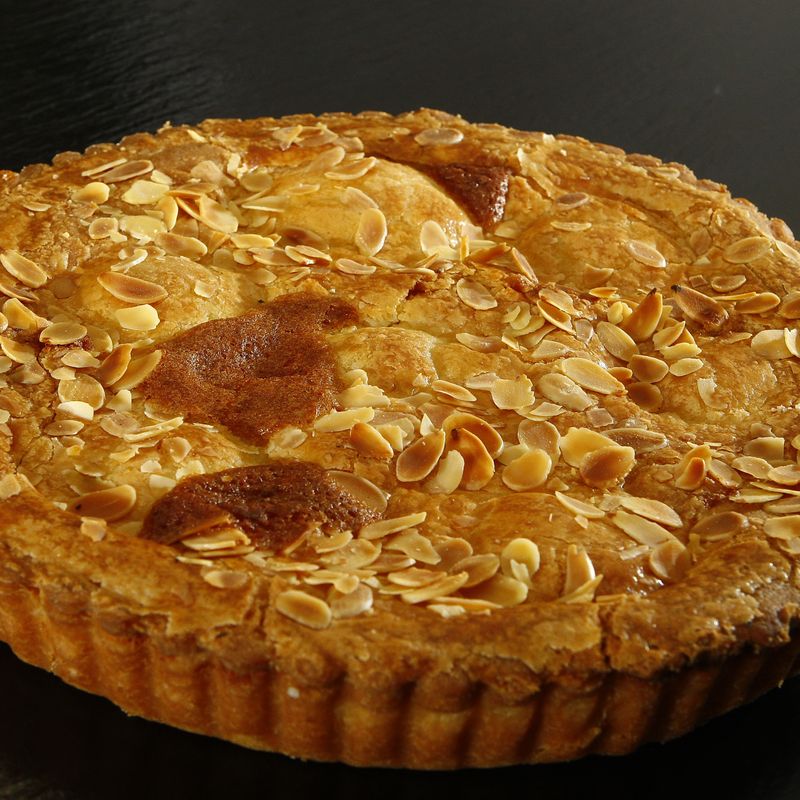
Slow Cooker Spiced Quince Paste with Walnut and Almond Crust
A luxurious Middle Eastern dessert made by slow-cooking quince with warming spices until it transforms into a silky, jewel-toned paste, then baked atop a toasted walnut and almond crust. The combination of cardamom, cinnamon, and clove deepens the quince's natural floral sweetness. Rich, perfumed, and elegant—perfect for special occasions or as an edible gift.
- Prep
- 25 min
- Cook
- 55 min
- Wait
- 8 hr
- Total
- 9 hr 20 min
- Makes
- 1 tart (12 slices)
Steps
Before you start
- Peel, quarter, and core the quince; work quickly as it discolors—toss cut pieces with lemon juice as you go
- Have a food mill or fine-mesh strainer ready to purée the cooked quince
- Toast the nuts for the crust ahead (10 min at 350°F / 175°C), then cool before pulsing
Cook quince in slow cooker
- Place peeled, cored quince pieces in a 6-quart slow cooker.
- Toss the quince with 2 tbsp fresh lemon juice to prevent discoloration.
- Add 1½ cups water, 1½ cups sugar, one cinnamon stick, 4 crushed cardamom pods, and 3 whole cloves.
- Stir well to combine.
- Cover and cook on LOW for 8 hours, or until the quince is completely soft and falls apart easily when pressed with a fork.
- The mixture will have turned a deep rose color.
+ Show details− Hide details
Ready when: Quince is completely soft and breaks apart easily with minimal pressure
Tip: Do not rush this step—slow cooking allows the spices to infuse fully and the quince to develop its characteristic color and depth of flavor.
Strain and purée quince
- Remove and discard the cinnamon stick, cardamom pods, and cloves.
- Pass the cooked quince and its liquid through a food mill or fine-mesh strainer into a large bowl, pressing gently with the back of a spoon to extract all the pulp.
- You should have approximately 2 cups of smooth paste.
- Stir in 1 tsp rose water (if using) and ¼ tsp salt.
+ Show details− Hide details
Ready when: Paste is smooth with no lumps; any solids have been pressed through the strainer
Tip: Use a food mill for the silkiest texture; if using a strainer, don't press so hard that you force unwanted fiber through.
Make walnut-almond crust
- Pulse 1¼ cups toasted walnuts and ¾ cup toasted almonds in a food processor until finely ground but still with some texture (not a powder).
- Transfer to a bowl and stir in ½ cup flour, ½ tsp cinnamon, ¼ tsp nutmeg, and ¼ tsp salt.
- Cut 5 tbsp cold butter into small cubes and add to the mixture.
- Using your fingertips, rub the butter into the nut mixture until it resembles coarse breadcrumbs.
- Add 1 room-temperature egg yolk and mix with a fork until the mixture just comes together.
+ Show details− Hide details
Ready when: Mixture resembles coarse breadcrumbs; when squeezed, it holds together but remains crumbly
Tip: Keep the butter cold—this helps create a more textured, less dense crust. Do not overmix once the egg yolk is added.
Press crust into panOven 350°F / 175°C
- Preheat your oven to 350°F (175°C).
- Line a 9-inch round tart pan with parchment paper (or use a pre-lined pan).
- Press the walnut-almond crust evenly across the bottom and up the sides of the pan, using the palm of your hand and your fingers.
- Build an even layer about ¼ inch thick.
+ Show details− Hide details
Ready when: Crust is even and packed firmly, no thin spots or gaps
Tip: If the crust cracks as you press it, dampen your fingers slightly and continue—the moisture helps seal small breaks.
Prebake the crustOven 350°F / 175°C
- Bake the crust alone at 350°F (175°C) for 10 minutes, just until it is set but not yet browned.
- Remove from the oven and let cool for 2 minutes before adding the quince paste.
+ Show details− Hide details
Ready when: Crust is pale golden and holds its shape; the butter is set
Tip: Prebaking prevents a soggy crust. Watch carefully—the nuts can brown quickly, so err on the side of slightly underbaked.
Spread quince paste
- Spoon the quince paste onto the prebaked crust and smooth it into an even layer about ½ inch thick, leaving a small border of crust visible around the edges.
- Use an offset spatula or the back of a spoon, dipped briefly in water to prevent sticking.
+ Show details− Hide details
Ready when: Quince paste is evenly spread with a smooth, level surface
Tip: Wetting your spatula prevents the thick paste from dragging and tearing; a small border of visible crust looks more polished.
Bake tart until setOven 350°F / 175°C
- Return the tart to the 350°F (175°C) oven and bake for 25–30 minutes, until the quince paste is set at the edges but still slightly jiggly in the very center (about a 2-inch circle in the middle).
- The crust edges should be golden brown.
- Remove and cool completely on a wire rack—this will take 1–2 hours.
- The paste will firm up considerably as it cools.
+ Show details− Hide details
Ready when: Edges are set and pull away slightly from the pan sides; center has a subtle jiggle; crust is golden brown
Tip: Overbaking makes the paste dry and grainy. A slight wobble in the center ensures it will be silky and glossy when fully cooled.
Optional gloss and serve
- Once completely cooled, you may brush the surface of the quince paste lightly with 2 tbsp warm honey thinned with 1 tsp water, using a pastry brush.
- This adds a subtle sheen and reinforces the jewel-like appearance.
- Chill for 30 minutes if desired to make slicing cleaner, or serve at room temperature.
- Remove the tart pan and transfer to a serving plate just before serving.
+ Show details− Hide details
Ready when: Honey glaze is smooth and evenly applied; tart is fully cooled
Tip: The glaze is optional but transforms the tart visually. For the cleanest slices, dip your knife in hot water and wipe between cuts.
Good to know
Tips
- For the cleanest presentation, remove the tart from its pan only after it is completely cooled and set—this prevents cracking or sticking.
- Quince paste naturally thickens as it cools; what seems loose in the pan will firm to a spreadable, sliceable consistency.
- Fresh quince has a unique fragrant, almost perfumed quality that is the star of this dish. If quince is unavailable, this recipe cannot be easily substituted; however, pear-quince hybrids (if you can find them) work well.
- Toast your nuts just before use for maximum flavor and color. Raw or barely toasted nuts will taste bland, and over-toasted nuts become bitter.
Make ahead
The quince paste can be made up to 3 days ahead and refrigerated in an airtight container. The crust can be made and prebaked 1 day ahead (store in an airtight container). You can assemble and bake the tart 1 day ahead; reheat gently at 300°F (150°C) for 10 minutes if you prefer it warm, or serve chilled.
Storage & reheating
Store the cooled, unglazed tart covered at room temperature for up to 2 days; the paste firms up and keeps well. Refrigerate for up to 5 days in an airtight container; the texture remains excellent. Freeze the baked, unglazed tart (wrapped well in plastic wrap and foil) for up to 1 month; thaw at room temperature for 2 hours before serving or reheating. The tart is best enjoyed within 1–2 days of baking, when the crust is still crisp.
Substitutions
- rose water → orange blossom water or 1 tsp finely grated orange zest. Rose water is traditional and delicate; orange blossom water offers a different floral profile, while zest brings a citrus brightness. Either deepens the flavor in a different direction.
- raw walnuts → pistachios (1¼ cups raw, unsalted). Pistachios create a more delicate, slightly sweet crust with a beautiful pale green color. Toast them the same way as walnuts.
- honey → apricot jam thinned with 1 tsp water, warmed and pressed through a strainer. Apricot jam adds a complementary fruity sheen and prevents the glaze from being too sweet. The strain removes lumps.
- granulated sugar → 1 cup sugar plus ½ cup honey. Honey adds depth and a subtle caramel note. Reduce the water slightly to 1¼ cups to account for the liquid in honey.
More middle eastern sweets
See all →


Find more like this
- Meal
- Dessert
- Cuisine
- Middle Eastern
- Diet
- VegetarianHalal
- Method
- OvenSlow Cooker
- Occasion
- Parties