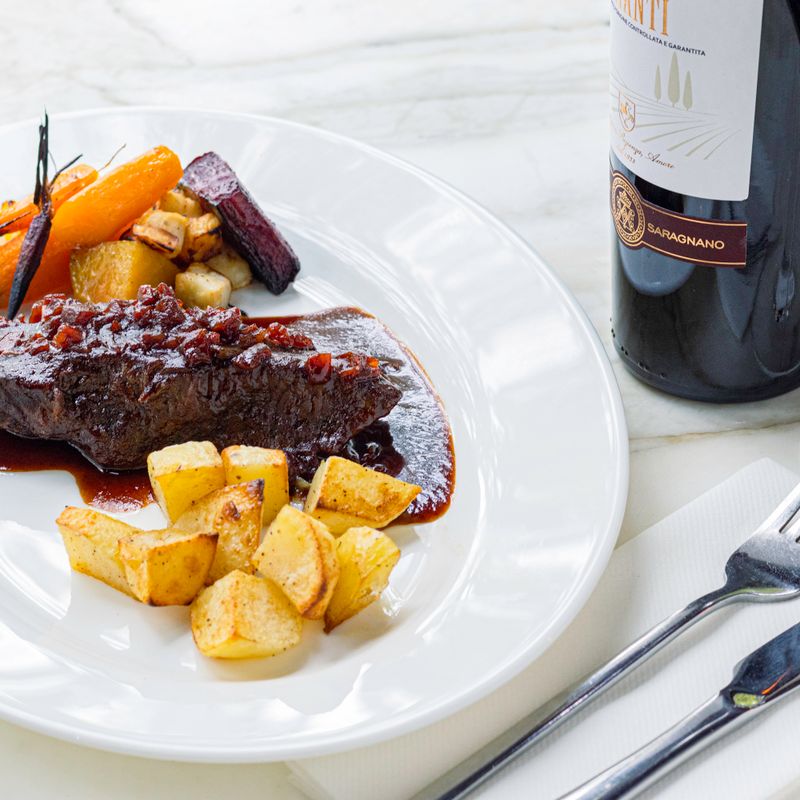
Passover Red Wine Beet Brisket
A richly flavored braised brisket marinated in a tangy wine-based liquid with roasted beets, sharp horseradish, and Dijon mustard. The marinade becomes the braising liquid, creating deep flavors and a tender, succulent meat perfect for Passover celebrations and special dinners.
- Prep
- 1 hr
- Cook
- 4 hr
- Wait
- 12 hr 45 min
- Total
- 17 hr 45 min
- Makes
- 1 brisket (8 servings)
Steps
Before you start
- Choose a 4.5 lb (2 kg) beef brisket, flat cut if possible, and trim visible fat to 1/4 inch thickness
- Ensure all ingredients are Passover-certified, including the wine, mustard, and beef broth
- Plan ahead: this recipe requires overnight marinating, so begin the day before serving
- Use a large, non-reactive container for marinating (glass, ceramic, or heavy plastic)
Roast and prepare beetsOven 400°F / 205°C
- Preheat oven to 400°F (200°C).
- Scrub the 2 beets under cold water.
- Wrap each tightly in foil and place on a baking sheet.
- Roast for 35–40 minutes until a knife pierces easily.
- Remove, let cool 10 minutes, then peel and discard skin.
- Coarsely grate into a large bowl.
- Set aside.
+ Show details− Hide details
Ready when: Beets are tender when pierced with a knife
Tip: Wear gloves while handling beets to prevent staining your hands
Prepare marinade ingredients
- While beets roast, mince the 10 garlic cloves, peel and grate the 2 tablespoons (20 g) fresh ginger, and peel and finely grate the 3 tablespoons (45 g) horseradish—work in a well-ventilated area as horseradish fumes are sharp.
- Measure the 2 cups (480 ml) red wine, 3 tablespoons (45 g) Dijon mustard, and 1/4 cup (60 ml) olive oil.
+ Show details− Hide details
Tip: Grate horseradish near an open window—its volatile compounds irritate eyes and sinuses
Combine all marinade ingredients
- In the bowl with grated beets, whisk together the red wine, mustard, and olive oil until well combined.
- Stir in the minced garlic, grated horseradish, grated ginger, quartered onions, and bay leaves.
- Season generously with kosher salt and freshly ground black pepper.
- Taste the marinade—it should be vibrant and balanced, with the sharpness of horseradish and mustard cutting through the wine.
- Adjust seasoning as needed.
+ Show details− Hide details
Tip: Taste the marinade before the brisket goes in—it's your last chance to adjust seasoning
Sear brisket on both sides
- Pat the 4.5 lb (2 kg) brisket dry with paper towels.
- Season both sides generously with kosher salt and black pepper.
- Heat a large Dutch oven or braising pan over medium-high heat and add a thin coating of oil.
- Once hot, carefully place the brisket in the pan and sear for 3–4 minutes per side until a deep brown crust forms.
- The meat will release easily from the pan when ready to flip.
+ Show details− Hide details
Ready when: Brisket develops a deep mahogany crust on both sides
Tip: Don't move the brisket for the first 3 minutes—stillness creates a better crust
Marinate brisket overnight
- Remove the seared brisket from the pot and place it in a large non-reactive container (glass, ceramic, or food-safe plastic).
- Pour the prepared marinade with wine, beets, vegetables, and all over the brisket, ensuring it is mostly submerged.
- Cover tightly with plastic wrap or a lid.
- Refrigerate for at least 8 hours, preferably overnight (12–16 hours).
- The longer it marinates, the deeper the flavor penetrates the meat.
+ Show details− Hide details
Tip: Prepare the marinade up to 24 hours ahead and keep it refrigerated until needed
Prepare oven and let meat warmOven 325°F / 165°C
- Remove the marinated brisket from the refrigerator 20–30 minutes before braising so it comes closer to room temperature—this ensures even cooking.
- Meanwhile, preheat the oven to 325°F (160°C).
- Transfer the brisket and all its marinade (vegetables, liquid, bay leaves) to the Dutch oven.
- The liquid should come about halfway up the sides of the brisket.
- If the liquid is too shallow, add 1–2 cups (240–480 ml) of Passover-certified beef broth to reach proper level.
+ Show details− Hide details
Tip: Room-temperature meat browns and cooks more evenly than cold meat straight from the refrigerator
Braise in oven until fork-tenderOven 325°F / 165°C
- Cover the Dutch oven with its lid and place in the preheated 325°F (160°C) oven.
- Braise for 3.5–4 hours.
- At the 2-hour mark, carefully remove the lid, turn the brisket over, and return the lid so it braises evenly on both sides.
- The brisket is done when a fork easily pierces the meat with no resistance and the thickest part shreds slightly apart.
- The internal temperature at the thickest point should reach 190–195°F (87–90°C).
+ Show details− Hide details
Ready when: Brisket is fork-tender; internal temperature reads 190–195°F (87–90°C) at the thickest point
Tip: Don't peek constantly—each time you open the lid, heat escapes and cooking time lengthens. Check only once at the 2-hour mark
Rest and slice
- Remove the Dutch oven from the oven and let the brisket rest in its braising liquid for 15 minutes.
- This allows the meat to relax and retain its juices.
- Transfer the brisket to a cutting board.
- Strain the braising liquid through a fine-mesh sieve into a saucepan, discarding the solids (or reserve them to serve alongside).
- Skim excess fat from the surface if desired.
- Slice the brisket against the grain into 1/2-inch (1.3 cm) thick slices.
- Serve with the strained braising liquid spooned over or alongside.
+ Show details− Hide details
Tip: Slice against the grain (perpendicular to the muscle fibers) for the most tender slices
Good to know
Tips
- Horseradish contains volatile compounds that burn the eyes and sinuses—grate it in a well-ventilated space, outdoors, or near an open window to minimize discomfort
- For a silkier sauce, blend the strained braising liquid with an immersion blender to incorporate the softened beets and create a smooth, glossy accompaniment
- Brisket is forgiving; even if it braises slightly longer than 4 hours, it will remain delicious. Use the internal temperature as your guide to doneness rather than relying on time alone
- If you have leftover braising liquid after serving, reduce it on the stovetop over medium heat until it thickens and becomes more concentrated—it makes an excellent gravy
Make ahead
Prepare the marinade up to 24 hours in advance and store it covered in the refrigerator. You can sear the brisket, submerge it in the marinade, and freeze both together for up to 3 months. Thaw in the refrigerator overnight before proceeding with the braising step.
Storage & reheating
Cooled leftover braised brisket and braising liquid keep in an airtight container in the refrigerator for up to 4 days. Reheat gently on the stovetop over medium-low heat or in a 325°F (160°C) oven for about 20 minutes until warmed through. Frozen brisket (sliced or whole, with braising liquid in an airtight freezer container) lasts up to 3 months. Thaw in the refrigerator overnight and reheat as directed above.
Substitutions
- fresh horseradish root → 2 tablespoons (30 g) prepared horseradish (Passover-certified, drained if packed in vinegar). Prepared horseradish is less sharp than fresh, so the overall marinade will be milder. The flavor will be good, though less vibrant.
- large fresh beets → 2 cups (240 g) roasted beets, canned or jarred (Passover-certified, drained). Skip the roasting step; simply drain, chop coarsely, and add directly to the marinade. Canned beets have a slightly softer texture and less concentrated flavor than fresh roasted.
- Passover-certified red wine (Concord grape or dry red) → 1.5 cups (360 ml) red wine plus 0.5 cups (120 ml) water or Passover beef broth. This dilutes the wine intensity and creates a more savory, less fruity braising liquid. Taste before serving and adjust salt.
- beef brisket, first cut → 4–5 lb (1.8–2.3 kg) beef chuck roast. Chuck roast is less lean than brisket and will become very tender when braised. It may require 30 minutes less cooking time due to higher fat content, so check for doneness at 3 hours.
More roasts
See all →
Find more like this
- Meal
- Dinner
- Cuisine
- American
- Main ingredient
- Beef Roast
- Quick & Easy
- Make Ahead